Dreamfall: The Longest Journey – Preview — Part 2
| Preview
Dreamfall: The Longest Journey
Preview by Randy Sluganski |
|
They say that every story has a beginning and an end. That may be true in most cases, but sometimes, however, the two are one and the same. – Zoë Castillo
The Longest Journey (TLJ) was the first, and still the only, game I ever personally awarded with a grade of A+. It was a remarkable achievement bolstered by memorable characters, an epic storyline and – most amazing of all considering the puritanical nature of the adventure genre – lesbians and the liberal use of the ‘F’ word. In fact, Flipper Burns – a character whose every other utterance seemed to be the ‘F’ word – is now so closely associated with the four-letter word, that his name is substituted for such word when typed by members of the JA Forum. Worldwide sales for TLJ – while not spectacular in North America – still reached levels usually not associated with adventure games.
So why muck with success? Right? Right?!
Ragnar Tornquist – developer and creator of TLJ – during a presentation of its sequel, Dreamfall: The Longest Journey at the 2005 E3, described Dreamfall as a ‘spiritual successor’ to The Longest Journey and there is nothing wrong with wanting to take a sequel in a new direction. After all, haven’t we all been subjected to enough insipid game and movie sequels that do nothing but mirror the original?
As the most anticipated adventure title since Syberia 2, Dreamfall was one of the most heralded games at this year’s E3 and deservedly so. Scheduled to be released at year’s end on both PC and Xbox, Dreamfall will feature some characters from TLJ, but will concentrate mostly on a new cast
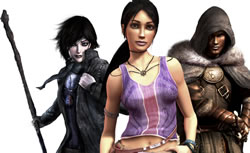
Core to the story are three playable characters: Zoë Castillo a twenty-year old young woman who lives with her grandfather; Kian an assassin who will begin to question his beliefs and returning from TLJ, April Ryan who will discover that no matter how hard you try, you cannot escape the past.
In what can best be described as a modernized version of point-and-click, characters will have an innovative ‘focus field’ that allows you to interact with and scan the environment. Instead of point-and-click, you sweep the area with the focus field to find interactive objects or inventory items. One of the puzzles we were shown utilized the ‘focus field’ as your character had to light a torch and it does facilitate a smooth transition between puzzle and game without interrupting the flow of the game.
The game will be completely rendered in real-time 3D and adventure gamers will need to prepare themselves for eye candy usually reserved for other genres. The game will also feature combat – though there will almost always be an option to solve a problem without combat either through stealth or wits – but there have been concessions made for pc gamers – and adventure gamers – who usually do not welcome combat in their games. Combat with the mouse will involve simple button clicking and be much less reflex intensive and easier in comparison to combat with the Microsoft joypad that will allow for manual blocking, two different kinds of attacks and other console standards.
So there you have it, what little information that is currently available or that we are permitted to reveal (and make sure to check out the nifty trailer).
But something nags at the back of my mind. No, I’m not bothered by the addition of action elements, nor am I flustered by the idea of three playable characters. But why does it seem that so much about this game is continually shrouded in secrecy? Why has a title of this magnitude yet to be signed by a North American publisher? And most importantly, why do I feel that Ragnar is no longer following his own, original vision of The Longest Journey mythos but is instead attempting to appeal to a more mainstream audience – has he become overly concerned about what others think of his game and its financial potential? Of course, this is all speculation on my part.
During an interview I conducted in early 2004 with Ragnar, in response to a question about the ‘controversy’ surrounding some of TLJ’s colorful language, he replied “As far as I’m concerned, there’s been no big “controversy” regarding language – only a few people, relatively speaking, have reacted negatively.” Yet, when towards the end of the E3 preview, after one of the character’s had sworn, Ragnar became immediately defensive – even though I did not hear anyone in the room comment on the language – and said, “We are going for a more mature game. We’re not afraid to use language that’s right for the situation or the character. We’re trying to create a grown-up game in a grown-up world so if characters are sleazy or dangerous they may use language that reflects that.”
That’s all fine and dandy as long as you don’t confuse swearing with maturity much like the misguided developers of Bloodrayne.
Maybe I’m being over-critical, but unlike other publications that are now jumping on the TLJ/Dreamfall bandwagon after largely ignoring the adventure genre for so long, I realize what Dreamfall represents not just as a game, but for the future existence of the adventure game as a viable, big-budget genre and I think Ragnar is the visionary who elevate the genre to new, higher standards.