The Longest Journey (#39216)
|
Developer: Funcom 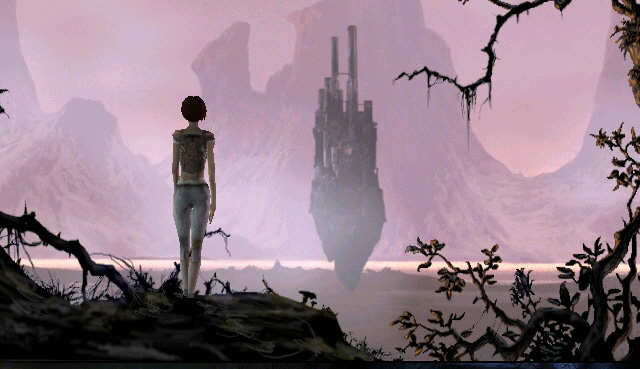 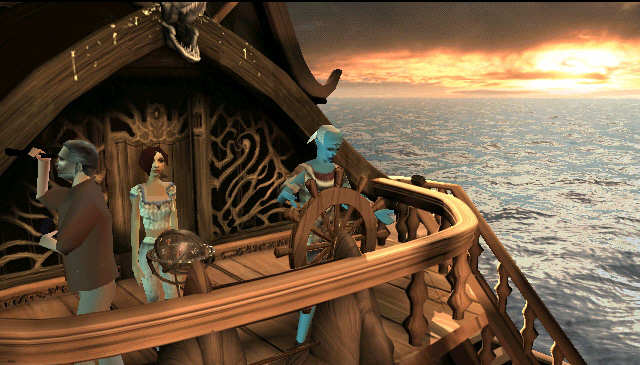 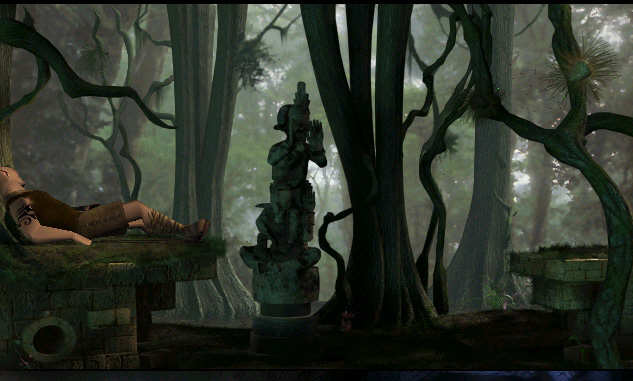  |
The Longest Journey will never be distributed or sold in any store in America. Let me repeat this in more detail for those who did not understand the first time: if you want to play this game, you will have to purchase it from overseas because The Longest Journey will never, ever be seen on any store shelf in any CompUSA, any Electronics Boutique, or any Wal-Mart in the United States. Funcom has had offers for distribution and turned them down in search of a bigger payday. It ain’t gonna happen. Even if The Longest Journey sells 5 million copies in Europe–it still ain’t gonna happen. For this game has every strike against it that you can think of. Puzzle solutions that would make no sense in the real world, protracted stretches of dialogue, a mythological universe rich in folklore, and a plot and theme brought to life by fully developed characters that we can’t help but care about. In short, it is a traditional, old-fashioned adventure epic.
With the release of The Longest Journey, writer and producer Ragnar Tornquist has immediately elevated himself into the hallowed ranks of Roberta Williams and Jane Jensen as a storyteller extraordinaire. His imagination has birthed a universe of characters and scenarios that will inhabit your imagination as vividly as anything from Frank Baum’s Wizard of Oz or Lewis Carroll’s Alice in Wonderland. This is a game that begs no sequels but has set the groundwork for endless retellings and updates. It is a breakaway game that would be equally effective as a novel on the order of Tolkien’s Lord of the Rings trilogy or a live-action, special effects-laden Hollywood blockbuster. It is the first game that I will ever be awarding a grade of A+, and I have reviewed over 150 games and played well over 400 adventure games. Is The Longest Journey the game that will finally save the adventure genre? No. No single game will shoulder that burden. But it is a huge step in the right direction. It is the apex of adventure gaming.
Exactly what is it that allows The Longest Journey to transcend the normal limitations of the adventure genre? First and foremost is April, the central character. Though the shell of the plot is your cliched “save the world” (or in this case, two worlds) theme, the framework upon which this story is composed delves much deeper. For April is entering upon a rite of passage; a maturation from the indecisive, self-deprecating teenage years into a hesitant adulthood that is at first shunned and then gradually embraced. Her reluctance to face responsibility, as evidenced by her leaving home, forces her eventually to confront a confused past. Yet, these universal themes of adolescence, femininity, and sexuality are presented so subtlety that the game can be enjoyed on many different levels. If one were to extract the superb dialogue and scripting from The Longest Journey, we would still be left with a game that is the equivalent of any of the King’s Quests or Monkey Islands. That is how much better this game is than anything on the market. Finally, the game’s conclusion and epilogue are masterpieces of subtlety. A dazzling ending is surpassed by an even more surprising epilogue.
As would befit a game christened The Longest Journey, April’s travels will take her from the bottom of the ocean floor to the outer reaches of space, from the boundaries of earth to the magic-laden world of Arcadia. Set in the 23rd century (though it could have just as easily been set in the present day), April Ryan is an 18-year-old visual arts college student. Lately, her dreams have become more vivid and nightmarish, and upon further exploration she discovers that her paranoia is not self-contained–others have begun to experience the same dreams. April will soon discover that she is a Shifter with the power to open portals between the worlds of science (Earth) and magic (Arcadia), between order and chaos, and the harmony of the Balance linking these two worlds is threatened with destruction. April is about to discover that one person can make a difference.
April is brought to life by the voice of Sarah Hamilton. The overall voice acting in The Longest Journey is superb, and Funcom is to be commended for its excellent translation from Norwegian. Hamilton especially captures the inflection nuances that allow us to believe in April’s growth as a woman. In fact, as much thought seems to have gone into the personalities and idiosyncrasies of the characters as into the script. The mole-men, or Banda, are timid of voice and tend to be nervous in their speech patterns. Abnaxus the tree-dweller’s speech pattern is slow and methodical as he carefully weighs his every word. Even secondary characters leave an impression: the old sailor who will not speak with you until his pipe is clenched between his teeth; or watch carefully as the prisoner in the police station slyly picks his nose. Personas are well-defined so that humor arises out of a situation or a knowledge of the characters and is never delivered via Monkey Island-style one-liners. Ask the old sailor to relate a maritime story for a firsthand example of a secondary character stealing a scene. Dozens of other barely noticeable eccentricities abound and imbue the cast with a life that you just know continues outside the boundaries of a game.
To further enhance this credibility, The Longest Journey is the only adventure game I can remember in which some of the main characters perish. Most important of all, though, no matter what choices you make, right or wrong, April cannot die, so the gameplay is never fractured by forcing you to frustratingly replay difficult sections. Thus, your last save never becomes an important issue. Some of the early chapters even allow April to choose her path–should I work overtime or stay home and rest? While her decisions affect the conclusion of these chapters, they do not alter the ultimate path of the story. Still, how many games have you ever played where your choices actually matter?
The Longest Journey is presented in wide-screen format. The top and bottom of your monitor will stay black, so as not to detract from the story, until you move your cursor and expose your inventory chest. I would suggest turning off the subtitles so as to not divert attention from the excellent voices. With minor exceptions, the entire game is played from a third-person point of view. A “diary” menu not only allows you save or load a game, but also to read April’s diary (very important for clues when you are stumped), watch a video replay of the impressive film sequences, or open a conversation log to read a transcript of all of the conversations April has had. The game is broken into a prologue and thirteen chapters. Each chapter is self-contained and cannot be revisited. Nor can you leave a chapter until all necessary tasks have been accomplished. While I enjoy the feeling of completion from finishing a chapter, I am sure some will complain that it makes the game too linear. It is very linear, but never did I feel as though I was being led around by the nose. Though the entire game is mouse-driven, the function keys can also be used for many of the incidental game features.
Top-notch writing, memorable characters, beautiful 3D animations against 2D backdrops, and a musical score that is more complementary than ornamental all unite for a once-in-a-lifetime gaming experience. So why won’t we ever see this game in North America?
The market here is vastly different than it is in Europe. Unless you have already proven yourself, then no one will take a chance on your product no matter how good it is. Funcom is well within its rights to attempt to convince a major player such as Sierra or LucasArts to purchase the distribution rights for North America, but these companies are just not interested. The companies that are interested cannot afford Funcom’s asking price. The marketing people at Funcom know they have a quality product, but they are approaching the North American market from a position of weakness and not, as they believe, strength. If they were to sell the distribution rights to The Longest Journey and if it were a unqualified success, then the sky would be the limit for the asking price for their follow-up project. So let’s assume that the marketing staff at Funcom finally capitulates and sells the distribution rights. What else needs to be changed for The Longest Journey to be successful in North America? Well, the box art needs to be more attractive. A painting of April stepping through a portal won’t attract many buyers in the United States. Why not a collage of the varied fantasy characters–the stickmen, the Gribbler, the White Dragon–surrounding a portrait of April? Make comparisons to the Wizard of Oz and the Lord of the Rings. Don’t be afraid to present the product as a pure adventure game with no action and, most importantly, a huge recommendation by Just Adventure splashed across the front of the box in huge, 3D Day-Glo letters 🙂 Sanitize the language. The Longest Journey contains a lot of swearing and sexual innuendoes directed toward April. Sixteen-year-old children should not be playing, much less reviewing, this game. Americans don’t mind vulgarity if it is included in a mindless action game that has no foothold in reality, but use profanity in a game that can be construed as family or nonviolent entertainment and you are asking to have your head handed to you on a platter. Retail it at $29.99. The price tag alone will attract hesitant purchasers. Finally, release it on CD-ROM and, to a lesser extent, DVD-ROM formats. This is a game that would convince gamers to purchase a DVD drive for their computers.
For those who must nitpick (and there are many reviewers who apply more stringent review standards to a adventure game, just as there are those whose narcissism leads them to also believe that their downgrading a game due to minutiae such as passé (in their opinion) 2D graphics or disk swapping–never mind that the plot and theme are excellent, their personal preferences must come first–somehow helps the industry to better itself), let’s present a list of items that some may find problematic.
Dialogue: The Longest Journey contains some of the longest stretches of dialogue I have ever encountered. Yet it is never trivial or intended only to artificially inflate the length of the game. It is extremely well-written and rich in background material. But it can and does become tedious at times. This problem could have been alleviated in part by utilizing changing camera angles and different points of view. As it is, the camera remains static during these prolonged conversations, and you may find yourself hitting the escape button and reading the missed snatches of dialogue later in the conversation log.
Disks: The Longest Journey ships on four CDs. There is not any disk-swapping, and the CDs are played in order. Still, I guarantee that one reviewer somewhere will find reason to complain about the excessive number of disks.
Puzzles: Sure, some of the puzzles are not feasible in the “real world,” such as using a gold ring as a connector for two broken wires. And yes, I did wonder why April was able to swim beneath the ocean with no problem but then later would not go into a shallow well of water to retrieve her talisman. But just as action games contain the occasional senseless jumping, running, and killing, so do adventure games contain the occasional senseless puzzle. But I have yet to see an action game given a lower score because a monster was slain with a nail gun rather than a laser gun, yet I have seen adventure games graded lower because a screwdriver might be used as a magic wand instead of loosening a screw.
Pixel-hunting: Yes, there is some pixel-hunting. But so what? It’s the nature of the beast. Just as first-person shooters require that the player eliminate foes, just as role-playing games allow the player to increase his/her character’s attributes, just as sports games must always have a victor, so too will adventure games always contain pixel-hunting. It is part of their charm.
Controls: Though the game is mouse-driven, the controls could have been improved. April walks very slowly. A double-click will cause her to run, but she is still not very quick. Though there are maps provided in certain areas of the game, there should have been a game map that would allow you to revisit anywhere you had already been in that chapter with just a click.
If this were a television show and you had just tuned in, you would think that I hated this game. And I realize that I have probably spent more time ranting and raving than I have praising The Longest Journey. Finally, it occurred to me exactly what it was that had gotten my dander up. There is no reason why every adventure game cannot be as well-done as The Longest Journey. But the constant bitching or whining of a mainstream gaming press that does not even enjoy, much less understand, the adventure genre has destroyed it for everyone else. Instead of listening to the informed voices of periodicals like Computer Games Magazine and webzines like Just Adventure that understand what makes an adventure game work, the publishers and distributors have relied on the misinformed whining of petulant, pimply-faced joystick jockeys from Gamespot and PC Gamer and attempted to mold adventure games into what action gamers want and not what adventure gamers desire. It is time we demanded of some reviewers that they raise their standards of reviewing. Once this minor miracle occurs, then maybe the developers and publishers will take seriously the requests for more quality over quantity.
The longest journey that The Longest Journey will ever make is to the shores of America. Unless Funcom drastically rethinks its marketing plan and signs with a company that actively supports the adventure genre instead of chasing after the corporate fat cats who couldn’t care less about the quality of a game or more about dollar signs. The Longest Journey is the type of game that can turn a “small” company respectable, and then Funcom could surf the wave of success instead of wallowing in self-pity for its inability to conquer, much less crack, the American marketplace.
Final Grade: A+
If you liked The Longest Journey,
Watch: The Neverending Story
Read: The Lord of the Rings
Play: King’s Quest V and VI
System Requirements: Desktop PC
Windows 95/98
Pentium 200 MHz (PII 266 MHz recommended)
32 MB free system RAM (64 MB recommended)
DirectX-supported graphic card with 2 MB onboard memory (640×480) (4 MB recommended)
Windows-compatible sound card
200 MB free hard disk space (1 GB recommended)
4X CD-ROM drive (8X recommended)
Windows-compatible mouse
Windows-compatible keyboard