The 7th Guest
|
The 7th Guest Publisher: Trilobyte |
When you were a kid, did you ever go to a haunted house during Halloween? Remember walking through the dimly lit rooms, trying to see everything in the dark, or worse, through the flash of a strobe light or the garish colors of day-glo paint and a black light, all the while some adolescent dressed like Freddie Krueger with an evil edge poked you with a stick, or waved some disturbing and indecipherable object at you to keep you moving along? Remember coming out the other side thinking that was pretty cool, and that you had gotten your money’s worth?
Well, if you’re that kind of weirdo, like me, then Trilobyte’s The 7th Guest is for you. Now this computer-generated haunted house is a little fancier, more like the Disneyland version, but you’re still provided with all the fun of sneaking through rooms and having ghosts jump out at you.
The game is played first-person–you are “Ego,” a faceless, nameless entity moving through the house discovering the unfolding story. The background story is of a man named Stauf, a drifter who has visions of toys, which he builds and sells, until the children who own them begin to die, and the scary mansion he has built. The interface is point-and-click, with indicated hot spots.
The presentation of the background story is excellent. It is meted out to you via a book that is read to you, just showing pictures to go with the story–no lengthy introduction of what you’re going to experience to read. The story is integral to the completion of the game. Bits of the story are given by ghosts as a reward for puzzles completed, or to move the story forward and access more rooms, in some instances. Now about those ghosts. Have you ever seen a reviewer or writer claim to have experienced the horrors of bad, hammy adventure game acting? This game has got to be the genus of that old saw, and gaming has apparently been living it down ever since. I don’t understand why game makers feel compelled to organize the slightest detail to perfection in graphics, puzzles and music, then when it is time to hire actors, someone asks the deli guy delivering sandwiches to “put that box down and come over here for a minute.” in other words, the acting is bad community theater quality at best, loud and overdone, the actors one for one chewing up the scenery. The story is excellent; this is not. The story, as a result, gets a C+ for the cruelty of having to watch those people constantly gyrate.
But this isn’t a game where we are here for the acting or story; the real star of the show is the puzzles. These are fun, very straight puzzles, word and sliding puzzles, puzzles using pieces from a chessboard, things like that. The puzzles are like taking a walk down the Toys R Us game isle, and thinking, “I saw a piece of that one in The 7th Guest, but it was all twisted around and different.” I played this game originally as a neophyte gamer and have returned to it more seasoned, and found the puzzles are still as entertaining as I remember; the only difference is that this time I could get through them in record time, but I do not know whether to attribute this to experience or familiarity. Nevertheless, this is an excellent game to give to someone new to adventure gaming to get him/her started, or hooked, as he/she can easily accomplish things and move around without too high a learning curve or difficulty in solutions. The game also provides a book in the library that, if returned to, will give you clues twice, and on the third time back it will solve the puzzle for you, which is great for someone new to puzzle games. Puzzles get an A.
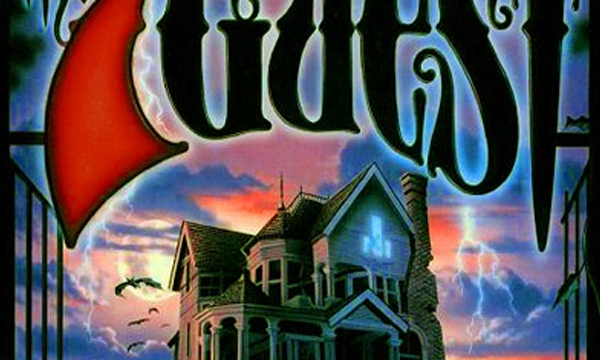
The graphics are one of the highlights and one of my most fondly remembered points of the game. Firstly, the cursor is a real highlight, and some work and thought was put into using this thoroughly throughout the game. It is really nicely designed, with changes to signify a puzzle, direction, story or main screen, and these are done large and with striking differences, so there’s no mistaking them. The details are fun, and just what the doctor ordered, haunted house-wise. There are eyeball plates in the dining room, the wallpaper is properly Victorian, the lighting sufficiently low and creepy. The interface dictates that you sail through the house like an apparition yourself, a fun thing that gives you the feel of being on a ride, and flying up and down the main staircase is a lot of fun. The graphics get an A.
The music, written and performed by one or more people known as “The Fat Man,” is clever enough that the game makers put it into its own audio CD, included in the package. One difficulty I had with the sound, and with the overall game for that matter, is that there were no preference settings to control volume, etc., and this has to be handled manually on the computer. The voices and sound often are fuzzy and sound as though they are coming from a cardboard box. The music and sound get a B.
Can you die in this game? No, except from causes exterior to the game, like dying from old age from being trapped in the maze.
Several bugs are contained in this game, for Mac players–the first time I played it I did it on a 68040, with virtual memory off, and it played great. This time, it was on a Power Mac, and what a nightmare. It does not play well on a Power Mac, with frequent crashes and freezes that I was able to get around being fairly savvy on Mac problem-solving, but let’s just say it was a good thing I had a copy of the unauthorized biography of Martha Stewart on hand, which assured me, in between restarts, that there were people in the world having a worse time of it than me. The game kept dumping out, at one point corrupting so badly Norton couldn’t fix it and a fresh copy had to be installed. Also, if too much memory is allocated (!?), it will lock up after the cake puzzle.
All in all, if Shivers is like a Tim Burton film, I’d have to say The 7th Guest is the Roger Corman of adventure games, mostly from the creepy, second-tier acting and costumes, like Fall of the House of Usher, a three-star Corman effort that is still relegated to American International release versus a major studio.
Final score is a B.
System Requirements:
Mac:
68030 or 68040 Mac
20 MHz or higher
System 7.0 or higher
4 MB RAM, 8 recommended
CD-ROM drive
32-bit addressing turned on
Note: You may encounter difficulties running this disc on a Power Mac. Try using QuickTime 2.1.PC:
386
2 MB RAM
10 MB disk space
DOS 5.0
Note: There is also a Win95 updated version available.