Review: 3 Skulls of the Toltecs
| 3 Skulls of the Toltecs
Developer: Revistronic 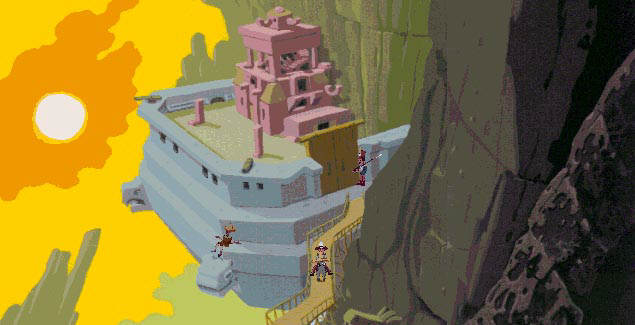 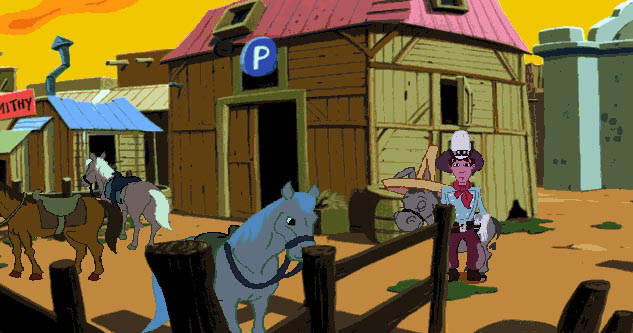 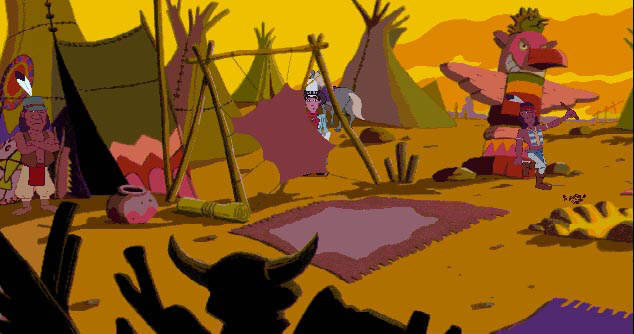 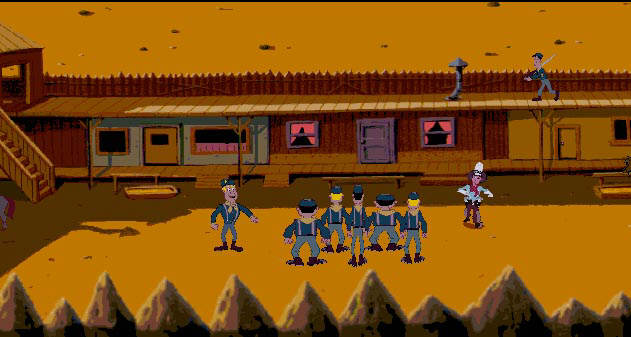 |
Some projects simply get in over their heads attempting to accomplish more than is possible with the available talent. 3 Skulls of the Toltecs most assuredly fits this category. It is not that the game is dated with its point-and-click interface and an immense inventory system. I happen to like that type of game. It’s not because the plot is a retread of a thousand old black-and-white Hollywood westerns–I also happen to like warmed-over cowboy and Indian stories. Nor is it the cartoony animations that could easily have been done by a moonlighting Lucas Arts employee. Rather, it is a matter of too many elements not living up to their full potential, of slipshod writing that never rises above a grade-school level, jokes that are flatter than a warm beer, and an interface that will put you to sleep quicker than a singing cowboy. I have played Freddie Pharkas and laughed at Josh Mandel’s comical observations and let me tell you, 3 Skulls of the Toltecs is no Freddie Pharkas and you, sir, are no Josh Mandel.
3 Skulls is a third-person adventure game that has you playing as lanky Fenimore Fillmore, a traveling cowboy with an exaggerated walk who has unwittingly contributed to the death of an Old West traveling salesman. As the unlucky salesman drifts off to a better world, you learn that he possesses a golden skull. You also learn that three such skulls are needed to unlock the storied Toltec treasure. When the skull is stolen from you by the same rustlers who were hunting the salesman, you decide to find all three skulls and collect the legacy for yourself. Of course, your search will take you to all of the familiar western locations–an Indian village, an army fort, an Old West town, etc. Everything is a cliché, but it is a familiar cliché that we do not see much of nowadays. So while the plot is not original, it is as comfortable as a ten-gallon hat and gets a grade of B.
The puzzles in 3 Skulls are actually a lot of fun. It is one of those take-anything-that-is-not-nailed-down inventory systems with a few red herrings thrown in to keep you on your toes. Numerous subjects that are seemingly unrelated to the main story (but eventually tie in) are unfolded through conversations with the supporting characters. The interface has been simplified as much as possible. Fenimore is controlled via your mouse, and once you have completed a certain portion of the game, an onscreen map appears that, thankfully, allows easy access to already-visited areas. As is common in these type of games, there is extensive backtracking, so the map is a welcome addition. But there are two glaring problems in this game, and one of them rears its ugly head during scenes when you attempt to advance a situation through dialogue trees. If Fenimore is positioned directly in front of a character and you click to ask a question, if he is not standing in the exact spot that was dictated by the programmers, then Fenimore will actually walk to the left of the screen, circle behind the character you want to question, and cross to the right of the screen, only to return to what seems to be, but I am sure is a millionth of a millimeter different, the exact same spot. Not only is this time-consuming and frustrating, but I actually put on quite a few pounds frequenting the refrigerator while waiting for Fenimore to position himself. While some of the puzzles are fun, the execution suffers from saddle rash: C-.
The animation is the cartoon equivalent of the Lucas Arts Monkey Island series. Crisp and detailed with small sight gags going on in the background–like an Indian plucking a feather from his headdress and using it to pick his nails. There is a nice cartoony feel for the old west, be it a swaybacked horse swatting flies with its tail or a saloon madam leaning over a banister to showcase her cleavage to prospective customers. The graphics are, at times, likewise impressive in that their simplicity convincingly conveys the sparseness of the west, yet there are also bewildering moments such as the French fort (pictured above) that had me wondering why it looked as though it was hanging in space. Confusing to say the least. Such lapses easily demote the graphics grade to a B-.
If ever a game faltered in its presentation through voice acting, then it is 3 Skulls of the Toltecs. It is not that the acting is bad. No, rather it is inadvertently racist. Indians speak broken English, “Me no trust white man,” Chinese characters sound like Hop Sing from Bonanza (No tickee, no washee). Not to mention one character’s poor man’s John Wayne imitation. This part of the game comes off so horribly because it is trying desperately to be F-Troop. But F-Troop was broad farce, meant to be ludicrous, and we laughed because we knew the idiosyncracies of the characters and their backgrounds. 3 Skulls wants to emulate, but never approaches, the writing standards of F-Troop, and it suffers terribly in comparison. F-Troop had college-educated Indians (portrayed by Italian actors!) who shrewdly spoke broken English so that the white man would not suspect their true ambitions. The soldiers of F-Troop were a lovable bunch who consistently bumbled their way to victory. I have a nagging suspicion that the developers of 3 Skulls meant for their creations to be viewed through the same glass, but poor writing and lack of character depth sabotage the effort. Voice acting: F.
3 Skulls is next to impossible to find and is really not worth the search. While the game does have its aforementioned good points, the clumsy interface and outrageous accents destroy any sense of authenticity and diminishes the fun element. Not bad enough to gain entrance to the Dungeon of Shame and not good enough to recommend, 3 Skulls’ ultimate destiny was the bargain bin–the Boot Hill of adventure games.
3 Skulls of the Toltecs final grade: C-
System Requirements: 486 DX2 66
MS DOS 6.0 or Windows 95
8 MB RAM
2x CD-ROM
256-color SVGA
Sound Blaster
Mouse