Review: The 7th Guest — Part 2
|
The 7th Guest Publisher: Trilobyte By Ray Ivey |
One of the most argued-about older titles, is The 7th Guest worth a look after almost eight years on the market?
This is a fairly notorious older title. Very popular when it came out, it has frequently not fared well in recent years when discussed. In fact, I’ve regularly seen it show up on gamers’ “Ten Worst Games I’ve Ever Played” lists.
Naturally, I was eager to play it.
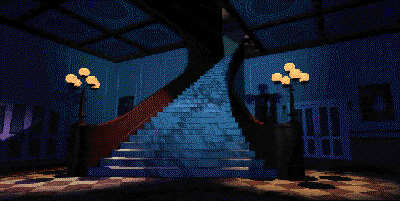
A Notorious Title
Call me off the wall, call me idiotic, call me irresponsible, but I had a wonderful time playing this game.
First of all, I’ve got to talk about the graphics. This game came out in the dark ages of 1992. I expected its look to be clunky and primitive. Right before beginning this game, I had just completed Gabriel Knight: Sins of the Fathers, a game that was released at least a year later than The 7th Guest, and I had really been a bit put off by the, let us just say, limited wonderfulness of the graphics of that famous and much-respected game.
Was I ever surprised! I was astounded at the quality of the graphics in The 7th Guest. Not only are they beautiful, colorful, evocative, and atmospheric, but movement in the game is in full-motion 3D animation! Compared to the flatness of (the newer) Gabriel Knight, I was simply blown away.
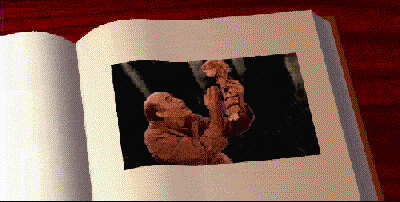
The paper-thin premise of this entertaining game is that you are the mysterious seventh guest to a party given by a brilliant maniac named Stauf. Stauf was famed as a toymaker and (conveniently) as a puzzle maker, and the bulk of the game consists of 21 puzzles of varying difficulty.
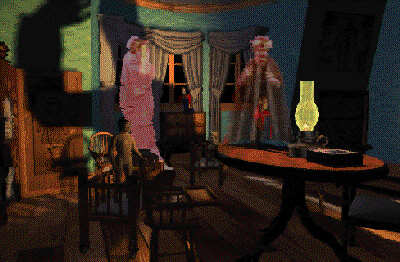
As you move through this beautifully rendered house, each time you solve a new puzzle, more of the house is available for you to explore. During your travels, you witness many short scenes between the ghosts of the first six guests. It seems Stauf has set them against each other to solve one big mystery: the identity of the seventh guest.
Other than Myst, The 7th Guest is the adventure perhaps the game most frequently used as a comparison standard when describing other games. It’s usually considered an insult to describe a game as being “like The 7th Guest.“
An Honorable Sub-Genre
So, I’m going to crawl a wee bit out on a limb here and say that, like Myst, many games were created that imitated T7G for a reason. In the case of Myst, it was an attempt to copy that game’s lovely, lyrical, mysterious beauty and tricky mechanical puzzles. In the case of T7G, an entire sub-genre sprang up: You, the gamer, are wandering around a mysterious place. You stumble one by one onto a series of puzzles. Each time you solve a puzzle more of the mysterious place is available for you … so you can enter a new room … and start a new puzzle! All of this is connected by a thin story line told either with cheesy cut scenes or discovered documents.
Okay, okay, it’s hokey. But, forgive me, it’s also a lot of fun. Games like T7G are challenging without being mentally taxing. As an adventure gamer, sometimes I’m indeed in the mood to solve the complex challenges of a Gabriel Knight or Circle of Blood. But sometimes it’s also fun to simply listen to the not-very-scary ghost make a not-very-good joke, and then hunker down and try to figure out how I’m going to reverse the positions of the black and white knights on a chessboard!
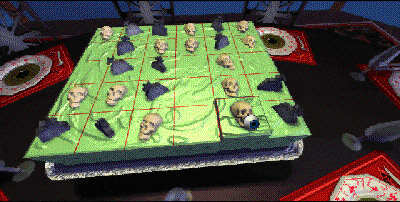
It’s fitting that, as the defining game of this sub-genre, T7G has a collection of puzzles that are very fun indeed. There’s everything from chess puzzles to sliders to mixed-up alphabet word builders to mazes. There’s even a wickedly difficult amoeba game you have to play against a very good artificial intelligence opponent.
Like another beloved game in this sub-genre, Shivers, T7G is admirable for the smoothness of its gameplay. The movement around the Stauf mansion is beautiful and fluid. There were no major bugs or technical difficulties. The game made sense, and almost all of the puzzles seemed “fair.”
Yes, the mad Mr. Stauf’s voiceover gets a bit grating, and the acting by the ghosts isn’t exactly Oscar level. But this game has a gleeful sense of fun that I found infectious. I liked its nice touches like whenever you close out of the game, Stauf shrieks at you “C O M E B A A A A A C K !”
Play this game if you’re in the mood for good puzzles and good cheesy fun. This genre-defining game is well worth a look if you missed it the first time around.
Final Grade: B
System Requirements:
Mac:
68030 or 68040 Mac
20 MHz or higher
System 7.0 or higher
4 MB RAM, 8 recommended
CD-ROM drive
32-bit addressing turned on
Note: You may encounter difficulties running this disc on a Power Mac. Try using QuickTime 2.1.PC:
386
2 MB RAM
10 MB disk space
DOS 5.0
Note: There is also a Win95 updated version available.