Road to India
|
Road to India Developer/Distributor: Microids      |
No Hope, no Crosby, not even Dorothy Lamour in a sarong. No singing, no punch lines, no double entendres. Just rats, dark alleys, murderous thugs, and mysterious religious cults. Thank goodness Road to India is a short game or I may have sacrificed myself to an eight-armed deity just for the comedic relief.
While it is nice to become immersed in a game world other than the usual exotic locales of Atlantis, Egypt, and Pittsburgh, it is also necessary that the gamer truly feel as though he is exploring and absorbing these foreign cultures, and this is where Road to India falls woefully short. For numerous reasons, what could have been a memorable and vivid gaming experience is instead just another run-of-the-mill adventure game.
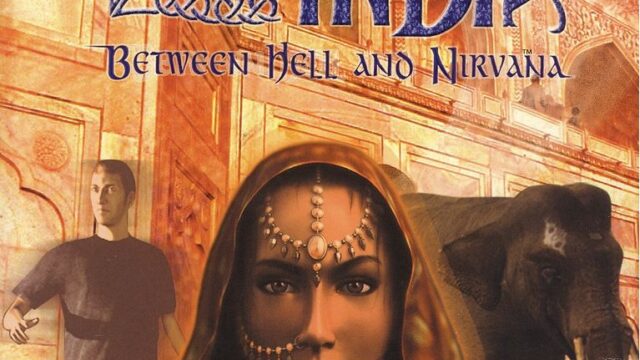
Road to India immediately grabs the player with an excellent opening as a bomb planted in a New Delhi marketplace serves as a cover to allow an underground cult to kidnap a popular Indian actress. We then watch as Fred, an American college student, bids farewell to his Indian fiancee, who is returning to India to visit her family. The student soon receives a “Dear Sahib” letter from his fiancee and, unaware that she is now involved with a cult, takes to the friendly skies to confront his true love face-to-face. As with the actress, an ancient cannibalistic sect that worships the goddess Kali has abducted the woman in preparation of offering her as a human sacrifice.
The supreme goddess Kali has been the subject of numerous books and Hollywood films. She is usually depicted as having an awful, frightening appearance with disheveled hair, a girdle of severed arms, a necklace of freshly cut heads, earrings of children’s corpses, and a bracelet of serpents. She has long, sharp fangs and claw-like hands with blood on her lips. I’m sure many of you are at this moment shaking your head in disbelief and bewilderment at how precisely I have just described your wife from your first marriage, but Kali is also the goddess who threatens stability and order, so I shall not even jest about such a matter.
This prologue and all of the following cutscenes are gorgeous and establish a malodorous Indian atmosphere. But these third-person scenes are so evocative and involving that maybe it is inevitable that once the game switches to the first-person playable portions, the game seems almost devoid of life. The cutscenes are full of touches of culture and teeming life, but when the player has control, the streets and alleys are empty. Other than the occasional street urchin or rodent, there is very little evidence of humanity, and the game loses much of its impact. In a country like India that has severe overpopulation problems, a game like Road to India could have much more of that stranger in a foreign land feeling of hopelessness if the main character were always surrounded by, yet unable to communicate with, the teeming populace. But in all fairness, such intense graphics would probably have been cost-prohibitive. Everyone and everything is extremely detailed and modeled, but it is what is missing that attracts more attention than what is present.
Yet Road to India still manages to maintain a sinister edge, much of which can be attributed to the game shifting between dream sequences and real-life situations. These dream sequences are presented as though through a soft filter and are always initiated by a realistic occurrence such as the main character being knocked unconscious. They also allow for the developers to take some liberties with reality, such as Fred’s easy admittance (well, easy after you solve a few puzzles) into the Taj Mahal and an intelligent conversation with a monkey. While sequences like this are forgivable, as they are presented as part of a dream, it is strange that the “waking” sequences are so void. As you walk the streets of India at night, then only other persons you see are a street urchin and eventually a bum. When you finally find the Kali worshiper’s house that is used as a front for their illegal activities, there is literally no one around, and when you stumble upon their secret hideout where the sacrifices are conducted, there is one, count ‘em one, person guarding this age-old cult with thousands of members.
Most of the puzzles are nicely integrated into the game and are fairly easy, but there are a few that are totally nonsensical, such as a Hellraiser-type puzzle box that is found late in the game. The solution to open this box is to simply click repeatedly on it until all of the pieces slide out and reveal a hidden key. What kind of puzzle is this? There is no rhyme or reason to the solution. Probably the worst puzzle, though, is one where you must wake a sleeping bum who has stolen your wallet. While the solution itself is not difficult, finding the necessary item becomes a ticklish nightmare. Yet other puzzles are well constructed and require some forethought and reasoning.
As for the other major gaming components: the voice acting is noticeably weak at times, as are some of the inane translations from French to English. The music is often appropriate to the setting but does begin to loop if you are stuck in certain areas for any length of time; but considering the linearity and ease of the game, this is not often a problem. There are also some unforgivable load times that do detract from the suspense. Finally, navigation in the mouse-driven, point-and-click atmosphere is a breeze.
Though Road to India is to be commended for presenting a different and welcome culture to gamers, it is also a game that can easily be completed by experienced adventurers in one afternoon. Even a newbie though should be able to fly through this game in under ten hours. In today’s marketplace, you should not pay more than $20 for this game if you are to get any entertainment value for your gaming dollar.
Final Grade: C+
If you liked Road to India:
Read: The Song of Kali by Dan Simmons
Watch: Gunga Din
Play: The Scroll
System Requirements:
Windows 95/98/00
Pentium II 350 MHz
3D video card
64 MB RAM
16x CD-ROM
Direct X 8