Review: Road to India — Part 2
|
Road to India Developer/Distributor: Microids By Tom Houston      |
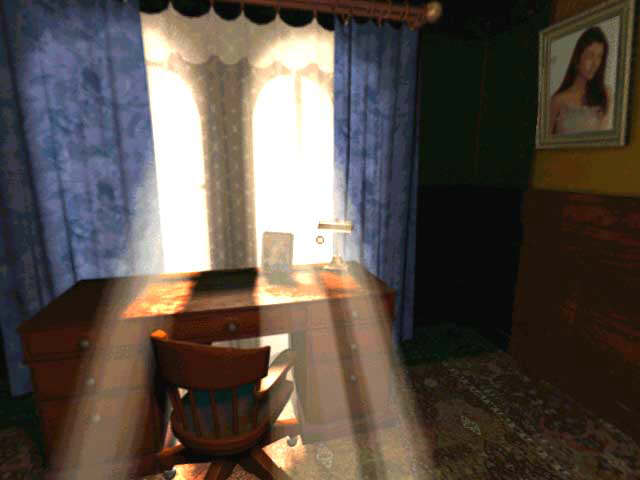
Fraught with danger and steeped in history, the Road to India is a strange, mysterious and rocky road along which you must proceed quickly yet cautiously. As the player, you will take the role of Fred Reynolds, who is living peacefully in New York City with his fiancee, a beautiful young Indian woman named Anusha.
Just one week ago, Anusha returned to India for a visit with her parents, and you have now received a disconcerting note from her stating that your engagement must be ended and that you are not to try to see her again. You have a strong sense that there is more to this situation than the note reveals, so you decide to embark on a trip to India to find Anusha, meet her parents, and discover what explanations lie behind the apparent mystery.
As you sit on the plane, traveling from JFK to India, you fall asleep and have a disturbing and ultimately prophetic dream about events occurring in India. First, one year ago, a man is seen carrying a briefcase into a marketplace in New Delhi. He places the briefcase on the ground near one of the stalls and leaves. The famous Indian actress Laj Vanti appears nearby, and the briefcase explodes. Laj Vanti must have been injured in some way by the detonation of the bomb, but all we know at this time is that she has disappeared from the scene. Eventually, the dream sequence concludes with a scene at the Taj Mahal, where Anusha is abducted.
What does the dream mean? Is there a connection between Laj Vanti and Anusha? There are no explanations … just the sinking feeling in the pit of Fred’s stomach that Anusha is in deep trouble and that he must act quickly to find her and unravel the unexpected circumstances that his dream seems to have foretold.
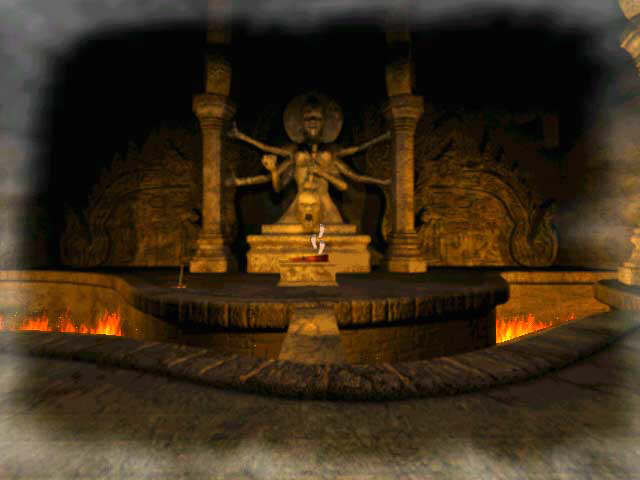
Upon arrival in India, Fred is unnerved to discover that Anusha’s abduction and the events in the dream are somehow tied to a secret religious sect of murderers and robbers, called Thugs, who were devotees of the Hindu goddess Kali but were thought to have passed from existence during the middle of the 19th century.
History tells us that the Thugs sect dates back to the 13th century, but its criminal activities were most prolific and, hence, troublesome beginning early in the 19th century. Also called Phansigars (stranglers), membership was primarily hereditary; it included both Hindus and Muslims; and all members were fanatical worshipers of the goddess Kali in whose honor they would kidnap their victims and perform human sacrifices.
The members of the Thugs sect were for the most part ordinary citizens with ordinary occupations, but in the autumn they would travel about the roads in groups, often disguised as merchants. When they encountered wealthy travelers, they would first befriend themselves and then wait for an opportunity to rob them and murder them using a ceremonial scarf that was reserved for the purpose. The Thugs were protected by the secrecy of their organization and also by the local government officials, with whom they shared the spoils.
Early on, under the British rule of India, it was decided that the terror of the Thugs, which at the time had accounted for over 40 thousand murders across India, must end, so they passed the anti-Thug law of 1836. Sir William Sleeman, using informers, troops, and mercenaries, managed to infiltrate the Thugs’ network and break the wall of silence that protected the membership of the sect. By 1848, nearly all of the members were thought to have been identified, arrested, and tried. Judgments had been meted out, and the Thugs, as an organization, were thought to have been eradicated.
Thereafter, the Thugs became a part of history, often the subject of literature but more familiarly a part of films, such as Gunga Din in 1939 and the more recent Spielberg film Indiana Jones and the Temple of Doom in 1984.
So what is this new association that links the disappearance of Laj Vanti and the abduction of Anusha to the Thugs sect? Are the Thugs truly an active, albeit secret, society? How do you obtain the information that you need to discover their whereabouts? In a strange and unfamiliar land, how will you know who to trust and who might turn out to be an enemy? These are just a few of the questions that you, as Fred, must ponder as you arrive in India.
An Occidental Tale
Following the events from your dream about the circumstances and scene of the abduction of Anusha, you go to the Taj Mahal and find it locked up. Convinced that answers to the mystery and perhaps even Anusha herself may be inside, you explore the outer area around the building and seek clues and information about Anusha, her abduction, and how to get into the Taj Mahal.
Your investigation will take you to the streets of New Delhi, where you meet a variety of characters that can be helpful or present threats to your health and survival. Also, you will go to the home of Anusha’s parents, where you will discover a disturbing surprise that will cause you to become very wary of appearances.
Eventually, as you recall and consider some of the details from your dream, you will discover the identity of a well-known man in New Delhi, who is likely to be the leader of the present day sect of Thugs.
As the mystery deepens, you will discover that you are in a race against time. If you have any hope of finding and rescuing Anusha from her captors, you will have to proceed quickly, yet cautiously, into the world of the Thugs and undo the sacrificial plans of the sect’s fanatical leader before it’s too late. (Note: The game is not timed.)
Progress through the game will be affected by additional dream sequences as well as the events of the game itself, so you will need to consider the information that you gather from different experiences and determine whether or not occurrences are simply illusions or that they should be taken as representative of real happenings. The game is linear in that you always must perform investigations in sequence and complete selected activities before you can move on to subsequent environments.
At the end, your questions will be answered, but it is the story’s journey that will be the most fun. What is the connection between Anusha and Laj Vanti? Why are the Thugs so interested in Anusha? How do Anusha’s parents fit into the mystery? What of the leader of these modern-day Thugs … what is his motivation?
The Game Interface
The game is played using a first-person perspective, except for a number of animated video sequences, which portray Fred from a third-person view. The player will have no control over these videos but will simply observe what Fred does often in action scenes that have been initiated by you. Again, once initiated, you will have no command over the scenes … just sit back and watch as Fred knocks somebody out or gets overcome himself. Nothing for us adventure purists to worry about here, since any action scenes are always scripted into these videos, and if action does occur, it is because it is supposed to.
The main menu, which appears at the start of the game, provides choices for starting a new game, loading a previously saved game, and quitting the game, as well as an options menu that includes graphics quality, sound and music volume, mouse sensitivity, and subtitles choices.
The game is basically a typical point-and-click adventure, using the mouse. Movement and actions are performed by clicking the left mouse button and include icons that tell the player that they can walk, talk, zoom in or out, take an object, or perform some sort of action. Clicking on the action icon will usually lead to an animated video sequence, such as opening a door and walking through or knocking out a guard. To look around your game environment, simply move the mouse in the desired direction. You will be able to look 360 degrees in any direction from any location.
You can skip an animated video sequence by pressing the space bar or escape key.
Pressing the right mouse button will access an electronic diary, which has three submenus, each of which is useful in following or recording your progress through the game.
The inventory menu is where you will find the objects that you have gathered during the game. You can combine objects in the inventory and select objects for use in the environment that you are in during the game.
The logbook menu is where Fred records his impressions and stores any documents that he obtains.
The save/load menu is used to save your game, which you should do often, or to load a previously saved game.
The electronic diary is also used to display preselected replies that are available to you for use in conversations with the characters that you encounter in the game. From the list of replies, you will want to choose those that best fit the action underway or will most likely provide the information that you need from the character that you are speaking with.
A Mixture of Graphics and Sound
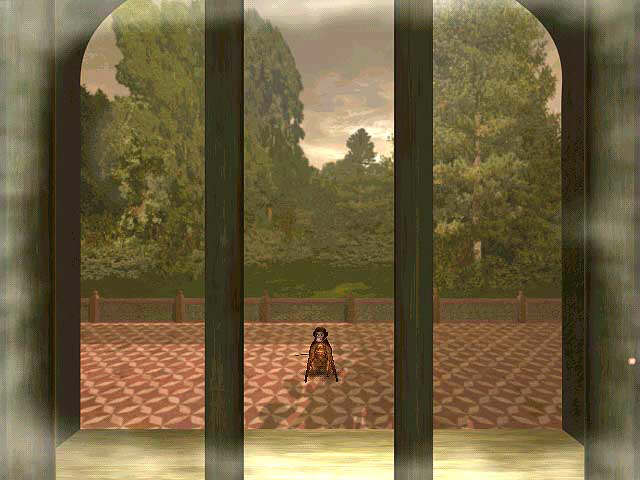
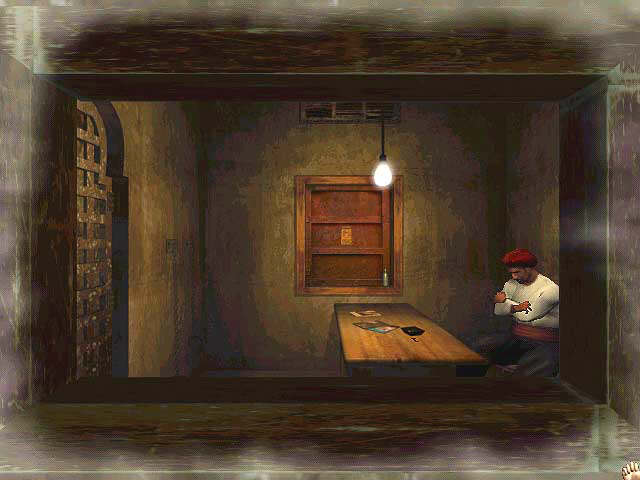
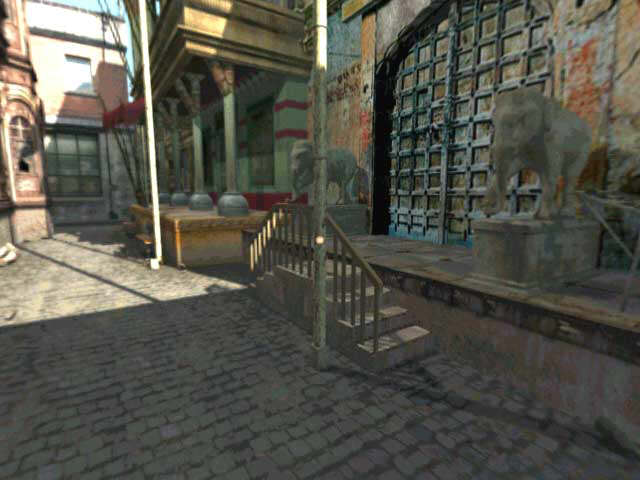
As is typical of just about every adventure game developed in France, the graphics in Road to India are outstanding. In particular, the movements of the 3D characters were wonderfully realistic, as they glided gracefully across colorful 2D backgrounds. Also, the video animations, such as the firebomb explosion at the market or the taxi driver smoking his cigarette as he pulled his fare through the landscaped streets in a jinrikisha–okay, a rickshaw–were superb.
Despite the beautiful overall graphic quality of the game, there was one unnerving problem that I encountered. Whenever a scene included a fire or flames, I got a graphic rainbow that surrounded the fire or flames. Very colorful … but somewhat of a graphical bug that detracted from the visual impression that I was enjoying.
The music presentation was surprisingly good. Balancing the traditional compositions that you would expect to hear in an Oriental locale with more modern, more dramatic, pulsating musical sounds that define the action sequences with crescendos, I found to be very effective, and it added to the experience of enjoyment when playing this game.
The most annoying bug, however, was to be found when holding conversations with other characters. Now … the voice acting was reasonably good, but I experienced an intermittent problem with the voice sounds that was very peculiar and troublesome. It seems that while holding a conversation, Fred’s vocal tones and those of the other character that you were speaking with would become garbled, distorted, and slowed, as if you suddenly had filled your mouth with marbles or wads of cotton or something. If it weren’t for the subtitles, I wouldn’t have known what they were saying and would have been unable to gather important clues needed to progress in the game. This was a major diversion for me and generated the only serious negative impression that I experienced while playing Road to India.
Searching for Puzzles
Road to India has a variety of puzzles that bridge the gap from nonstory-based, manipulation type puzzles, such as tile puzzles, to puzzles that are inventory-based, where the player must collect, combine, and use objects in order to progress in the game.
For those who react badly to these things, a word of warning: There is a tile puzzle right at the beginning of the game. Then a little further, on there is a puzzle that requires you to perform multiple movements in a certain order. Later, there is a puzzle that requires you to deal with a rat. Oh, yes … there is also a maze to get through.
Overall, I found that the above puzzles were rather easy to work through, and the inventory-based puzzles were very nicely integrated into the story, so no complaints from me.
The End of the Road
In general, I enjoyed playing Road to India, primarily because it moved along at a pace that sustained my interest in a story with a fair amount of tension, excitement, and historical interest. Although Road to India is clearly not a historical adventure in the manner that some of the Cryo or Index+/Wanadoo games are, it has a built-in historical reference: the legends of the Thugs and the goddess Kali. So for those of you that like an adventure that has a historical foundation, Road to India will add value to your game-playing experience.
It would have been nice to have more background information about how Fred and Anusha met and what drew them together in New York, before Anusha’s abduction in India. This might have heightened my emotional involvement and feelings for wanting to succeed in rescuing Anusha and bringing them back together. As it was, it was not an emotionally draining experience.
The graphics and video animations, except for the flame rainbows, were beautifully done, with high-quality, 3D character movements being a definite highlight.
The vocal sound presentation was the only real disappointment in the game. The puzzles were interesting but often predictable and, hence, not particularly challenging.
Final Grade: B-
System Requirements:
Windows 95/98/00
Pentium II 350 MHz
3D video card
64 MB RAM
16x CD-ROM
Direct X 8
Screenshots