Review: System Shock 2 — Part 2
|
System Shock 2 Developer: Irrational Games/Looking Glass Studios By Erik Reckase 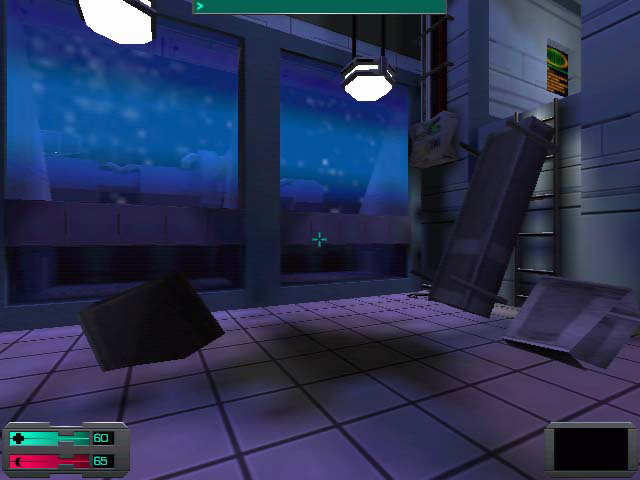 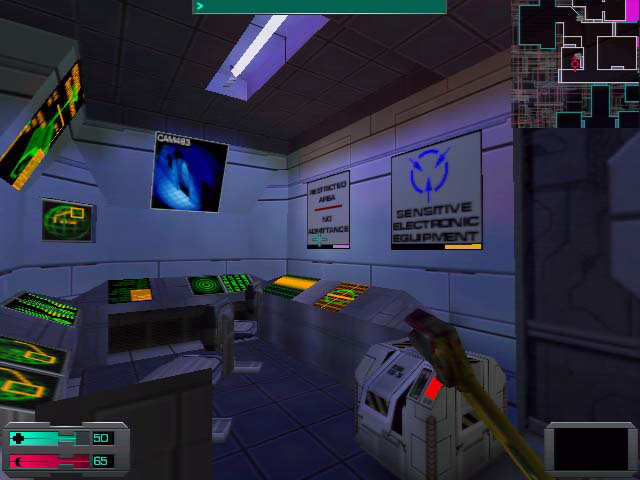 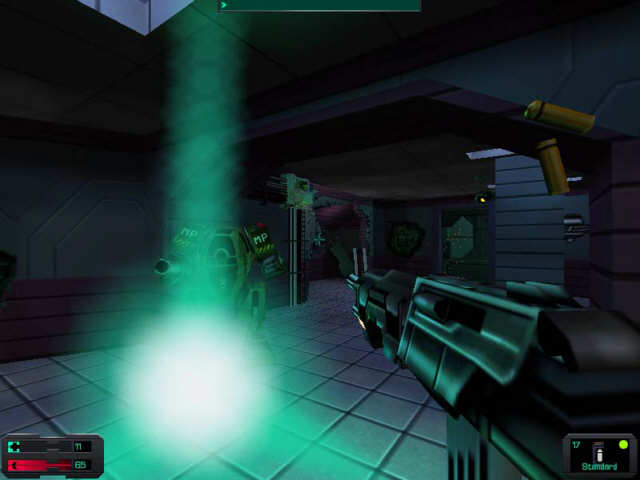 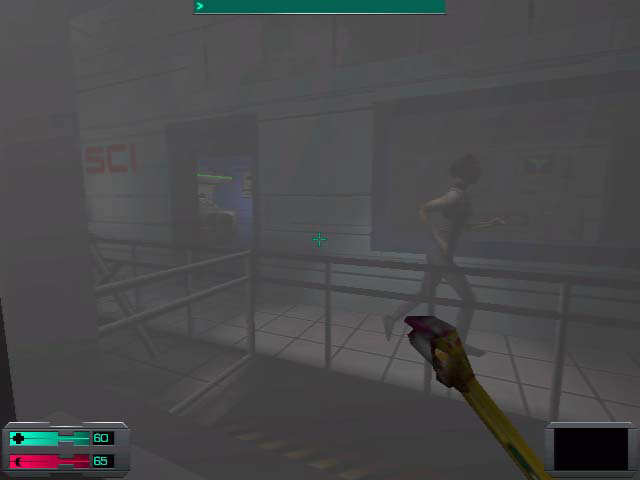 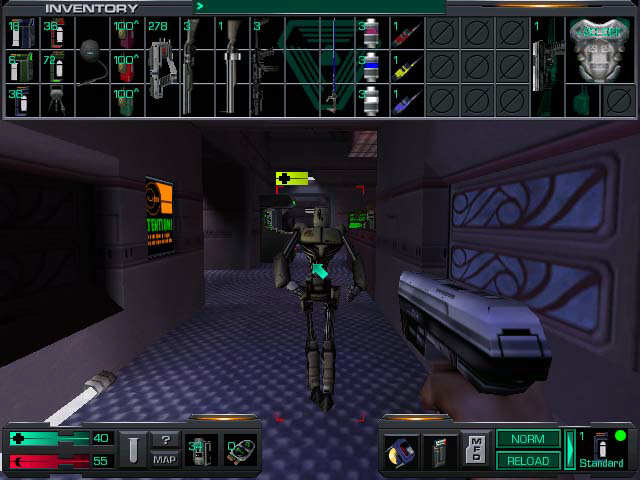 |
During my final year in college, I forked over a semester’s worth of financial aid to purchase my first computer–a 486 DX2/66 with 4MB RAM and a 40 MB hard drive. I did not, unfortunately, have a CD-ROM drive, and so as that format grew in popularity, there were fewer and fewer games that I could install and play. That’s when I found the original System Shock.
System Shock was, and still is, one of the best games ever written. It had a well-written plot, excellent graphics (considering the technology available at the time), and fascinating gameplay. System Shock was one of the first games to let you actually fly around in virtual cyberspace, searching for data and solving puzzles. I can remember numerous occasions when the on-screen action was enough to get my heart pounding and my fingers scrambling to change weapons or run away. Of course, it was also huge. It took me months to finish–and it never got repetitive.
Years passed. I got married, changed jobs a few times, and settled down. I finally got a new computer in January of this year, and after it arrived, I promptly went to the electronics stores, scanning shelves for games of interest. Oh ho! What’s this? A sequel to System Shock? For $19.95? I promptly purchased it, in the hopes that it would be as good as or better than the original.
I was not disappointed.
The Plot
This story takes place 42 years after SHODAN tried to destroy the Earth from Citadel Station in the original System Shock. The Earth’s nations have banded together into the UNN (Unified National Nominate) to prevent megacorporations from having the power to repeat the Citadel disaster. However, the discovery of a faster-than-light device by a UNN Nobel Laureate using corporate funding threatens the balance of power. A faster-than-light starship, the Von Braun, is built by the TriOptimum corporation for a test voyage; the UNN, fearing the increasing power of TriOptimum, permits the voyage as long as a UNN escort ship (the Rickenbacker) is allowed to escort the Von Braun. A few months into the journey, the Von Braun receives transmissions from a distress beacon in the Tau Ceti system–far outside the boundaries of colonized space.
Here’s where you come in. Having trained in one of three military disciplines (Navy, Marines, or OSA) for three years, you’ve been assigned to the Von Braun for your first real mission. When the game starts, you have just woken up from cryosleep with a set of military-grade cybernetic implants and no memory of what happened over the last few weeks. You quickly realize that things are not going as planned.
The remaining part of the story is revealed to you in a series of emails and voice logs left around the ship. Bit by bit, you put together exactly what’s happened on the ship and what you can do to stop the onslaught. There are a number of smaller subplots that you uncover while wandering around the ship that serve to make the story even more compelling.
Any story’s goal is the suspension of disbelief, convincing the reader/player that what they are experiencing could actually happen. I’ve read many stories and played many games that simply did not convey this sense of realism, and I’m happy to say that SS2 jumped right out of that muddy puddle and sucked me in. Plot gets an A.
Graphics
System Shock 2 uses the Thief Dark Engine for its graphics, and it’s truly a thing to behold. I ran the game at 800×600, and I could not believe my eyes–the detail that was put into the game is tremendous. For example, magazines look like real magazines, with legible titles and discernible images on the covers. Everything about the ship looks exactly like it should–as if panicked crew members had been rushing around, trying to survive the alien onslaught, and eventually failing. The ship’s layout was also well thought-out–separated into “decks” with different overall purposes (recreation, science, cargo, etc.), it was almost as if they were working from the design of an actual working spacecraft, instead of inventing it as they went along. (I should mention that my machine uses the Intel 810e chipset, and the game did not work until I downloaded a patch from Electronic Arts. Once installed, however, it worked with no problems whatsoever. Although the patch was specifically designed to add multiplayer functionality to the game, it also solved my problem.) Graphics: A.
Music/Sound Effects/Voice Acting
From the quiet whirring of security cameras, to the squeals of over-intelligent monkeys, to the buzzing of annelid flies, the sound in this game is spectacular. I have never heard a game sound this good. You use your ears almost as much as your eyes when exploring the ship, as the creatures you share it with all make noises as they move around. I often found myself stopping before walking around a corner to try to sense what would be on the other side … and that only happens when the sound is done perfectly.
As far as music goes, there isn’t much. That’s perfectly all right, since the music would take away from the ambient sounds of a weakened ship. When music is used, it heightens the emotions you’re feeling, so you hardly notice that it’s playing.
The voice acting is, in a word, interesting. If vending machines could talk, what would they sound like? The first time I walked up to the SS2 interpretation of a vending machine and heard it say “Thank you for choosing ValueRep!” in a semi-sarcastic, insincere voice, I laughed hysterically. After about the tenth time, it seemed less funny and more like a social commentary on advertising, which made the game even more creepy. You hear many of the crew members in the voice logs they left behind, and although it seemed hardly likely that all of these people left messages in this format scattered all over the ship, the acting was quite good, and was sufficiently well-performed to suspend my disbelief. This category gets an A+.
Gameplay/Puzzles
This is definitely not a pure adventure game. In fact, it’s a combination of three different genres; there are RPG elements, first-person shooter elements, and adventure elements in SS2. However, I found that each element could be enjoyed or ignored, depending on the user’s tastes. I’ve never been much of an RPG gamer, so I paid less attention to that aspect of the game and more on exploring the ship and following the plot. If first-person shooter isn’t your fancy, there are plenty of cheat codes to get you through that aspect of the game. There are very few games that allow you play the way you want to–it’s a great design.
For the most part, the puzzles in SS2 are of the “find this object and put it there” and “figure out the code to open that” variety. The game takes notes for you (similar to Outcast), keeping track of the next goal you need to reach, so you won’t be wandering aimlessly looking for an unknown object. There’s also an automap feature, helping you identify areas of the ship that you haven’t explored, and navigation beacons to remind you to come back to a particular area. A little more variety in the puzzles would have been great, but I give credit to the developers for at least making the puzzles realistic.
As far as gameplay goes, there’s a lot to say, since this game is also very large. First, although this game is a single CD, it’s amazingly vast. I repeatedly thought to myself as I explored the ship, “I think this is the last level …” only to be proven wrong over and over again. The folks at Looking Glass/Irrational should be commended for putting so much “game” into this game.
The RPG elements in SS2 are quite well-implemented; for example, upgrade modules are used to improve your character’s abilities. These modules can be found around the ship, but the majority of the modules are given to you as rewards for completing designated tasks. This is the most plausible character development system I’ve seen; it avoids the “kill more enemies, gain more experience, increase character level” paradigm that seems to be mandatory in most RPGs.
The first-person shooter aspects of the game are also very good. An interesting twist was added to this game; your weapon quality degrades over time. This means that as a gun is used, it will eventually become unusable, unless you can maintain or repair it. There’s a wide variety of weaponry in the game, and just like many other shooters, different weapons and ammunition have different effects on the other creatures and robots on the ship.
The game control system is also very good. Many common actions can be performed by keys on the keyboard, but in general, everything is accessible using the mouse. The only necessary keyboard usage is for character movement and accessing inventory. SS2 also implements “training” at the beginning of the game (similar to Half-Life), so you get some experience moving around and using objects before the game really begins. Puzzles: B+.
Final Grade: A
This is a dark, gloomy, creepy, gory game. It definitely deserves the M rating that it received, but the violence in the game seems justified. Yes, there are dead crew members all over the ship, some killed by the aliens, and some who took their own lives to avoid assimilation. Isn’t this expected, given the storyline? I wouldn’t recommend this game to the squeamish.
I was, quite honestly, blown away by this game. There is so much packed into this one CD that I’ve only touched the surface of System Shock 2’s features. Go buy this game. It’ll be $20 well spent.
(Easter egg note: For those with a taste for comedy, there are two Easter eggs that I know about in the game. The first, which is documented on a number of different gaming pages, involves a hard-to-find basketball. The second, which I found myself, takes place between the second and third training mission. As you head towards the departure bay where you choose your training mission, you pass a glass window with a few robots moving about. While you watch, the protocol droid proceeds to do a great Macarena!)
System Requirements: Windows 95 or 98
Pentium 200 MHz (300 MHz recommended)
32 MB RAM (64 MB recommended)
4x-speed CD-ROM
4 MB D3D compatible video card or greater (4 MB D3D compatible accelerator card or greater recommended)
DirectX compatible sound card
Windows compatible mouse, keyboard
DirectX 6.0 or later
200 MB free hard drive space (500 MB recommended)