Review: Outcast — Part 2
|
Outcast Developer: Appeal By Ray Ivey
|
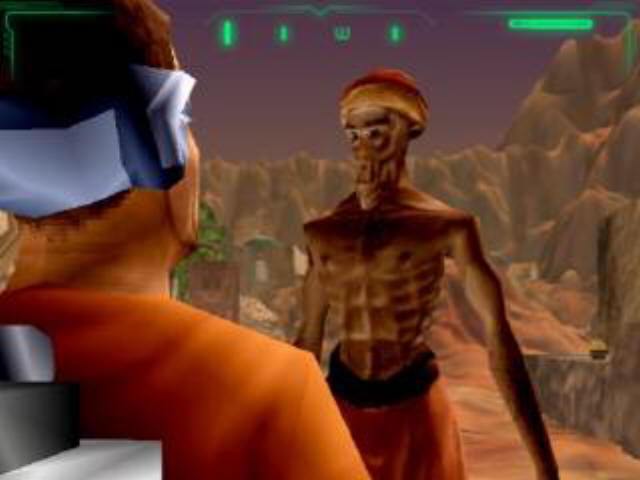
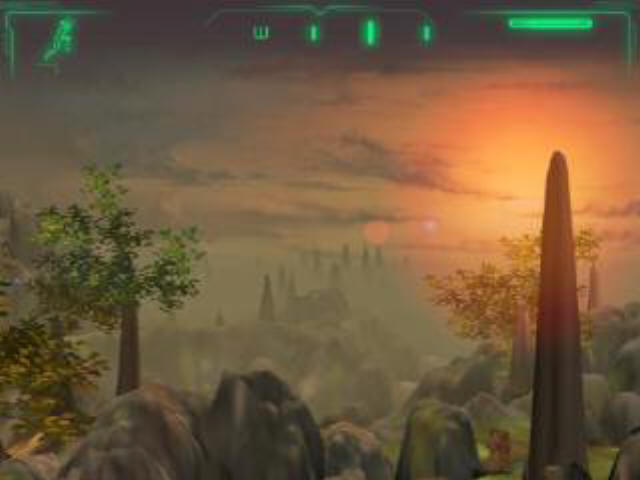
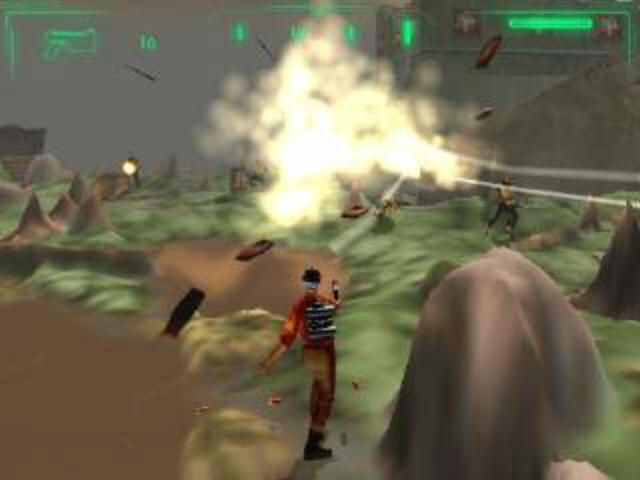
Just finished playing Appeal’s remarkable game Outcast, and I’m exhausted. I’ve lost sleep. I’m worn out. Why? From staying up late playing the game? From working hard to solve the puzzles? From surviving vicious combat?
Nope. It’s trying to think up all the superlatives I’m going to need to use in this review that has me so tired. How many words that end with “-est” can I use? Hmm …
Let me admit to two things right up front, Intrepid Reader. First, I am an action moron. I have learned that I have absolutely no interest in shooting, combat, weapons, etc. Those aspects of a games simply do not interest me. Therefore, please keep in mind that this is the review of an adventure player, not an action player.
Second, I’ve lost any sense of objectivity with this game. I just loved it.
Outcast comes from Infogrames, the innovative French company that has been shaking up the computer gaming world all the way back to the days of Alone in the Dark. The best way I can describe this game is to say that it’s an adventure game built on an action game framework.
The game begins with your introduction to the story’s hero, a studly Navy Seal named Cutter Slade. He’s called in to help with a teensy-weensy problem a bunch of government scientists have–they’ve accidentally created a black hole that’s in the process of, ahem, eating the world. Don’t you just hate it when that happens?
Slade is told that he and three others will be sent through an interdimensional wormhole to retrieve a probe that’s supposed to solve the problem.
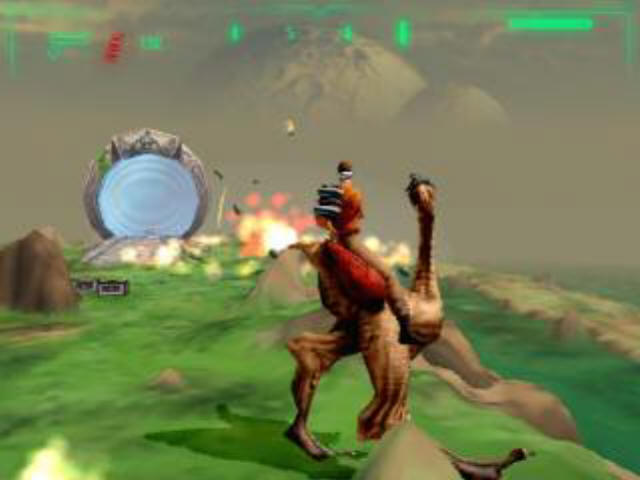
The opening movie ends with Cutter going through the wormhole and waking up in a rough wooden hut in the freezing cold with a huge creature that looks like a bipedal camel looming over him. The creature is talking to him and calling him something … he’s calling him “Ulukai.”
Huh?
And here’s where your adventure begins. It seems that not only has Cutter been separated from his companions, but he’s been pushed into an alternate universe, on a world called Adelpha. This world is under the brutal reign of a military dictator, and for Cutter to get the help he desperately needs to recover the probe and save earth, he has to–by the way–save Adelpha as well.
So much for set up.
That Old Messiah Thing
The creature who’s talking to you is a Talan, and he and his people seem to think you are a savior who was prophesied to come and free them from the yoke of Fae Rhan, the aforementioned evil dictator. So now your mission is a dual one. You must travel to the six regions of Adelpha to collect components of the Earth probe while aiding the poor Talan in their struggle against Fae Rhan.
For the first couple of hours of the game, I felt as overwhelmed as Cutter was feeling. The game throws so much information at you, and uses an interface much more complicated than that of a pure adventure game, that it can be truly intimidating. It all takes some getting used to. What makes the interface worth learning, however, is that it really is full of vital resources. There’s a mapping feature that plots out the territory for you, including enemy positions. There’s an inventory screen that scrolls through Cutter’s bag of tricks. There’s a lexicon that automatically keeps track of all the strange new words you’re learning. Perhaps most importantly, there’s an automatic notepad that functions as an extended “to do list.” In a game as vast and complex as Outcast, this feature is indispensable. Also, there is a tremendous amount of flexibility in the interface. You can operate in first-person mode (great for shootouts) or third-person mode (great for navigating). You can make the camera zoom in or out. Because of all these options, simply learning to move around took me some time.
Luckily, the first chapter of the game consists of a series of training exercises designed to get you comfortable with all of the skills Cutter will need to survive Adelpha, including swimming, crawling/sneaking, shooting, and jumping. In fact, the game will not progress until you’ve “passed” these tests.
But once you do, look out. This game sets new standards for open, nonlinear play. To repair the earth probe, Cutter has to collect five “mons,” each in a different region of Adelpha. He can do this in any order.
In addition to Ranzaar, the base area where you start the game, you’ll be exploring five other areas. One is a dense hilly forest. One is a like a huge series of terraced rice paddies peppered with temples. Another is a huge desert city. One is a series of small islands. And one is a bleak, dusty mining region.
Each of these areas is big. Did I say “big”? I mean huge. Huge, and completely wide open. You are free to roam around them, in real time. And roam you will. Though capturing the “mon” is your ultimate aim in each area, getting there involves solving multiple, complex quests. Some of the quests are required, and some are optional.
You Say Pixels, I Say Voxels
Much has been made of Appeal’s decision to use old-fashioned voxels instead of pixels in this game. No graphic acceleration in a 1999 game? Shock!
I don’t know all the technical ramifications of this decision, but here’s how it affects the game. The game takes a while to load (okay, one night I resolved the eternal struggle between good and evil while waiting for it to load), and the levels take a bit to load, but once the region is loaded, it’s loaded. In other words, you are free to explore each of Adelpha’s huge areas without any pauses for the new room, or field, or whatever, to load. This feature seriously contributes to the feeling of reality in the game.
AI That’s Really “I”
There are literally hundreds of characters in Outcast. Unlike adventure games that seem sparsely populated, or action adventures in which the population consists of mindlessly attacking bad guys, the world of Outcast feels real because the characters seem real. Your quests are generated by interacting with these characters. Each of them has his own agenda (I’m not being sexist; you meet no female Talan in the course of the game), and this agenda can possibly be used to help further your own aims.
While you go about your business in the game, you are surrounded by Talan who are going about their business. Plus, everything you do in the game has a ripple effect to all of the other characters. It’s just amazing. Help out a mining boss to get him to agree to stop mining, and later in the game you’ll find out the evil soldiers’ weapons aren’t as good because the metal to make them is not available.
This sort of integration runs throughout Outcast. It’s all so real-feeling that it didn’t matter at all to me that the puzzles weren’t particularly chewy. It was just so incredibly fun to gallivant around the various huge environments, sometimes on foot, sometimes riding my Twon-Ha (you’ll just have to play the game to see what that is), and helping the good Talan of Adelpha overthrow the evil dictator.
The game is a dream come true for fans of nonlinear games. This game makes Dark Side of the Moon seem rigidly linear!
Since, as I’ve mentioned, I am a freely confessed action moron, I played Outcast with cheat codes firmly in place. As a player, I’m just not interested in how good I am at shooting. This didn’t diminish my enjoyment of the game one little bit.
However, for those better at the action genre than I am, Outcast will be an even more complex and engrossing experience, as you will have to use careful strategy to know when to use (or waste) ammunition, how to make money to buy more ammunition, and how to avoid losing the game because of that whole annoying death thing.
Let’s Not Forget the Other Things
Even though there are many, many characters, to your character’s earthly eyes, many of them look very much alike. Therefore, you spend a certain amount of time stopping characters and asking, “Where’s Zaloff?” and then following his directions. This, added with the real-time traveling throughout the game, added to the intensely real atmosphere.
The voice acting in the game is simply superb. The various characters, even when they look maddeningly alike (and after all, wouldn’t they?), each have distinct and interesting personalities.
The music is simply incredible, dramatic and varied, and as performed by the Moscow Orchestra adds yet another classy element to the proceedings.
I’m going to try to shut up now, but first let me try to come up with some kind of coherent conclusion.
Is Outcast for every adventure player? Sadly, no. The tricky interface and action elements will be a turnoff to some players. But if, like me, you’re an adventure purist who likes to find out how far a game can really take you, I challenge you to dive into Outcast.
How intense an experience was this game? Well, let’s just say that it’s now over a week since I’ve finished it and I find myself wondering how all of my Talan friends are doing …
Thank goodness the sequel to Outcast has already been announced!
Have I mentioned that you can actually see Cutter’s breath when it’s cold?! Sorry, I promised to shut up …
Final Grade: A+
System Requirements: 200 MHz Pentium
600 MB free space
32 MB RAM
4x CD-ROM
Sound card
Video card with 2 MB memory
Windows 95/98