Outcast
|
Outcast Developer: Appeal  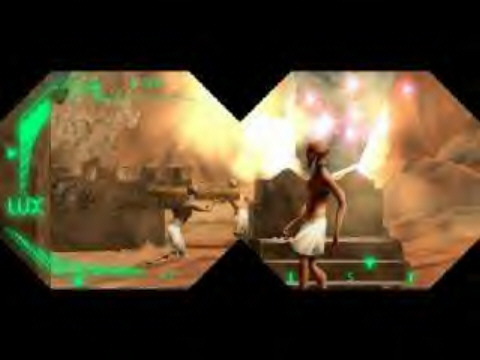 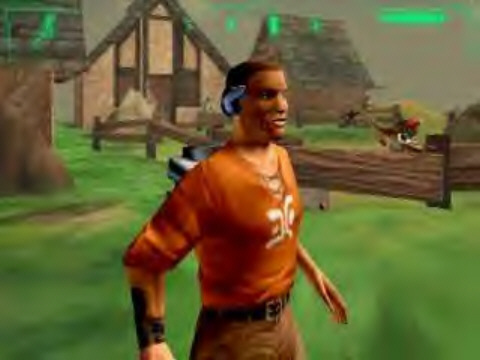 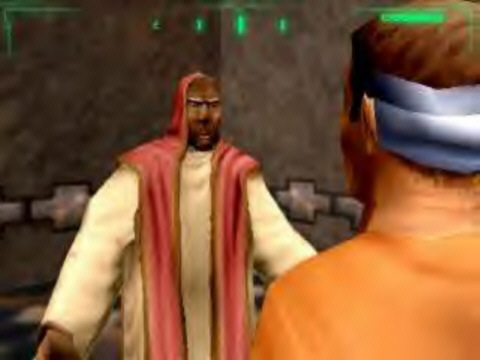 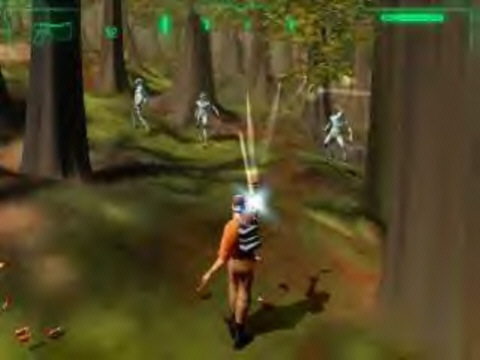 |
I typically abhor and avoid like the plague any product–be it book, movie, or game–that requires memorizing a new language. I have more than enough difficulties with English, never mind an entire new lexicon created solely for a few nights’ enjoyment. The rare exception in my case was reading A Clockwork Orange, but even that classic was discarded halfway through and I instead watched Kubrick’s film adaptation. Well, there is no Outcast movie, yet, and I have been itching to play the final version of this game ever since I first viewed it in a dark, crowded room at the E3 almost two years ago. So now it seems the time has come to ask the local Shamaz to pay a house call in preparation of my saddling and mounting my Twon-ha for the long ride into Okaar (I do know that after learning all of these new phrases and their associations, Infogrames had better darned well have a sequel in the works!).
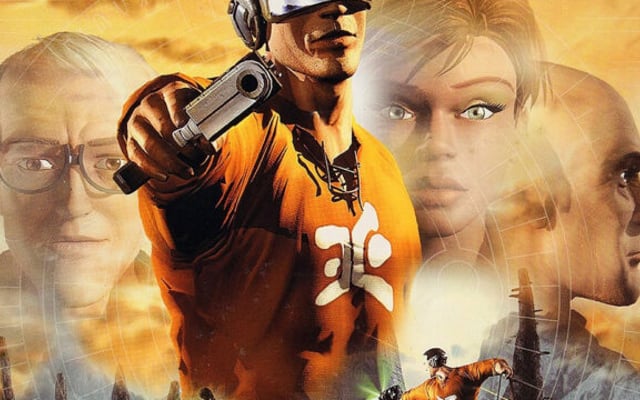
Outcast’s scenario is as familiar to science fiction fans as a warm, fuzzy Tribble. The United States military has secretly deployed a probe in search of a newly discovered parallel universe. The probe successfully locates and commences to transmit data from this alternate universe. The experiment soon backfires when the probe is damaged by an inquisitive alien, and its destruction triggers a cataclysmic chain of events that results in a black hole that threatens to engulf the earth. Time to call Cutter Slade, leader of a covert team of highly trained professionals. Danger is their middle name, and saving the universe in only 25 days their game. (Note to critics who have been whining about Cutter’s name: I’ve never heard any of you complain about Duke Nukem or the myriad other silly action hero names. What would you like the guy’s name to be–Bob Smith, Jim Jones?) Cutter must now lead an elite group of scientists on a search to find and repair the damaged probe. The transfer goes amiss, and when Cutter awakens not only are his crew and equipment missing, but the local alien population has decided that he is the Ulukai (Soul of the Essence or savior) who will free the population from tyranny. So begins your quest to not only save this alien world, but Earth.
One thing can be said in Cutter’s favor: at least he is not a character in his fifties or sixties performing unbelievable stunts and running around with a woman half his age like the claptrap Hollywood subjects us to in every new Sean Connery and Harrison Ford film. In fact, it seems as though Cutter is (or will be in a sequel) involved in an interracial (gasp!) relationship with “girlfriend” Marion Wolfe. I applaud Infogrames for their decision to treat gamers as mature adults. In fact, Infogrames has done more of the unexpected by providing a wonderful 44-page manual that not only describes in great detail the weapons and gadgetry of Outcast, but also the flora and fauna of the six regions you will visit, a lexicon, tips to get through the game, and biographies of the main characters.
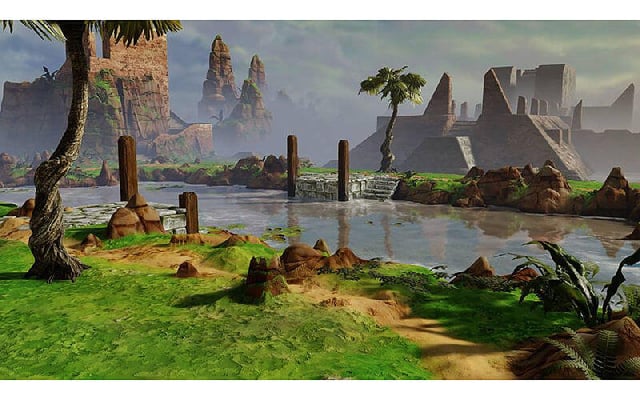
Outcast is part of that new breed of action/adventure games, and I will immediately and wholeheartedly recommend it for any adventure gamer. Infogrames has taken into consideration that probably more people do not have a 3D video card than do have one and thus the developers have used voxels to create a beautiful world that looks as good on a low-end system as it does on a monster machine. The graphics can be stunning, especially to traditional point-and-click adventure gamers who are accustomed to limited maneuvering in a 2D world. Character animation has been further enhanced by motion capture, and backgrounds benefit from beautiful lighting effects. Infogrames had promised that the amount of action or adventure in the game would be variable according to the player’s preferences, and they have kept their word. There do exist situations where you decide to burst in like Rambo or use your gray cells like Hercule Poirot. The plot depends a great deal on character interaction and development that will allow you to build a reputation among the natives. Your ability to decide on the best course of action shapes what puzzles you may encounter and the reactions you will experience from other game characters. One of the fascinating aspects of Outcast is that as you learn the language, you can then eavesdrop and understand previously foreign conversations. Yes, there are situations where you must use force, but for the most part stealth and cunning will emphasize the adventure aspects of Outcast.
Adelphia is huge, and to rescue its inhabitants, Cutter must collect the five sacred Mons from the various regions of the world. Armies guard every important area, and in order to succeed, Cutter must gain the trust of the natives through various procedures that will bring out the instincts of the adventure gamer. There’s an enormous amount of exploration to be performed. The regions of Adelphia are all distinct, yet diverse, but it is the inhabitants of this world and their extraordinary personalities that will most appeal to the gamer in search of more than action or puzzles.
Yet all is not milk and honey for adventure gamers in the world of Outcast. The game controls, though customizable, are complex. The beginning of the adventure, in Ranzaar, is nothing more than a training ground to allow you to feel comfortable with the maneuvers–jumping, swimming, crawling–that Cutter will need to survive. You will also find some of your lost equipment, much of which I at first found to be daunting. The HUD, or Heads Up Display, is used the most, as it allows you to scan and memorize terrain and reproduce it as a map, serves as a compass, detects new objects, and I hear the new model also makes a mean omelet. Objects that you collect can be shrunk and stored in your miniaturization backpack, finally solving every adventure gamer’s age-old question of “where does he fit all that stuff?” Weaponry is the usual assortment of upgradable big guns that make action gamers feel less impotent and leave adventure gamers wondering what button needs pressed to make the danged thing shoot. Most interesting of all is the Gaamsaav crystal, a sacred stone that must be activated in order to imprint your essence on it to save your game. The developers of Outcast have detailed or given origin to every nuance in order to infuse the six worlds of Adelphia with as much realism as possible. The outcome is a game that is more immersive than any that have come before.
Adding powerfully to the overall experience is the music. There is not a game, or many movies for that matter, that can hold a flickering torch to the musical score of Outcast. We are presented with nearly 60 minutes of original music, performed by the 81-piece Moscow Symphony Orchestra and a 24-person choir. The score is a sweeping, grandiose affair that far exceeds anything that has ever been done in a computer game. Lush instrumentals propel the story forward as you allow yourself to be willingly whisked off into the depths of this fantasy epic. Even the voice acting, the downfall of many a potential best-seller, is performed with elan. Cutter is especially distinctive, though one wishes he would cut back on the stereotypical he-man wisecracks that first became popular with Clint Eastwood’s Dirty Harry character and have carried over into the computer gaming arena.
In retrospect, Outcast has the potential to be the Star Wars of computer gaming (heck, the credits at the end of the manual are at least as long as many movies!). The stage has been set; the universe well-defined. Kudos to Appeal for infusing their game with such intricate details and memorable scenery. If Infogrames’s marketing department is astute enough to release some Cutter Slade action figures, comic books, etc., there would be a built-in fan base who would clamor for a sequel. They have already released a hilarious television commercial in France that would be a huge hit if it were translated for an English-speaking audience. It would be a shame to let such a lush, rich gaming experience wither and fade away into the setting sun of Adelphia.
Final grade for Outcast: A.
System Requirements: 200 MHz Pentium
600 MB free space
32 MB RAM
4x CD-ROM
Sound card
Video card with 2 MB memory
Windows 95/98