Review: Oddworld: Abe’s Exoddus
|
Oddworld: Abe’s Exoddus Developed by: Oddworld Inhabitants 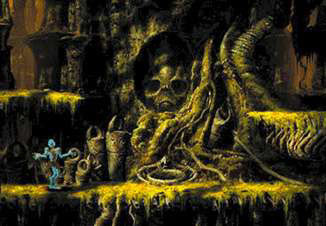 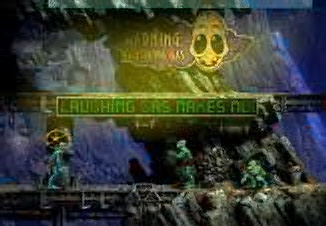  |
Out of all the images of last year’s E3, the one that still stands out in my mind most vibrantly (well, except for the extremely talented bikini-clad models who so expertly displayed their wares) is the excellent preview of the opening cinematic from Oddworld: Abe’s Exoddus. Finally released in November of 1998, Exoddus is not so much a sequel as a continuation of the critically successful Oddworld: Abe’s Oddyssee. Both games employ the same platform-based, side-scrolling atmosphere, and both employ the same colorful animation and humorous characters prevalent in Oddworld. If you are a fan of the numerous variations of Lemmings games or of The Lost Vikings, then you will want to join Abe in his quest to save his fellow Mudokons.
Exoddus is billed as an action/adventure game, yet it is anything but. The action sequences are very few and far between. There are times when you will have to run and jump, grab onto ledges, or even expel body gas (I can’t wait until we have smell-o-vision for computer games), but for the most part the emphasis is on using your sense of logic and your cognitive memory in order to proceed to the next level. This is a feast for players who love puzzles without character depth, evasion through stealth, and patience through timing.
In the first game, Abe had to shut down a factory that was not only using his fellow Mudokons as slaves but also using their body parts to make food products (shades of Soylent Green!). In Exoddus, Abe must shut down the Soulstorm Brewery. The factory is using the bones from an ancient sacred burial ground as the main flavor ingredient in its brew. Abe must once again free the slaves and also put the disturbed bones of the burial ground to rest. As is obvious, this is not a game that is heavy on plot, nor is it meant to be. Still, if you are to promote yourself as an adventure game. … Plot–C.
The puzzles are the crux of Abe’s world. The gameplay starts simply, and as you progress through the levels, the difficulty and pacing become marginally harder. The two most common puzzles in the game involve speech and manipulation. The main goal of the game is to convince your fellow Mudokons to follow you to freedom. Escape portals surrounded by doves are you goal as you weave your way past traps and guards, always maneuvering a group of slaves to their freedom. You must figure out different ways to unlock doors, activate equipment and keep your multitude of Mudokons under control. Your most pressing problem, though, is to convince the Mudokons, whose eyelids have been sewn shut, to follow your lead, especially since you score points for each soul saved. This can be accomplished in a variety of ways, including bodily possession, special treatment such as a slap in the face or an embrace, or Gamespeak. Gamespeak allows Abe to speak to his contingency by using varying tones of voice in order to obtain their “blind” devotion. If there is a negative aspect to the puzzles, it would be the repetition that is involved as you progress deeper into the factory and the die-and-repeat-the-area procedure that is necessary in some of the regions. To offset a lot of this repetitiveness, the developers have instituted a save-anywhere option that is a blessing. Puzzles–A.
The graphics and animation of Abe’s Exoddus are excellent, though there really is no noticeable improvement from the first game of the series. As mentioned previously, the cut scenes and opening animation are gorgeous. Each type of Mudokon has his own distinct look and personality, with Abe and his carp-like face and moon-dog expressions the highlight. Pre-rendered 2D scrolling backgrounds keep the pacing lively and colorful with a nice assortment of shadows and hidden areas for Abe to slink, tip-toe and hide in from his enemies. The animations are always fluid and lifelike and sure to draw a chuckle or two. Overall, this is a splendid but not inspired effort. Some deviation from the foreseen would have been a welcome and invigorating change. Graphics–B.
The sound and music are both superb, but it is the voice of Abe that truly shines. His exchanges with the slaves as he commands them to “wait,” “follow me,” or “sorry” are always humorous throughout the course of the game and never grow old. You will, in fact, find yourself repeating certain phrases to the slaves just for the chuckle the responses elicit. The music varies according to the location. It modulates in frequency according to the severity of the situation; for example, as a guard picks up Abe’s trail, the music quickens in pace until Abe has made a successful getaway. In this way, it much more resembles a movie serial soundtrack than it does the typical computer game with looping sound effects and music. Music, sound effects and voices–A.
Abe is not for everyone, though everyone who plays it will enjoy the experience. His is a world full of humor and peril, but in this age of genre-crossing, Exoddus is not a game that fits simply into one category. If you played the first, then this is more of the same. If you have wanted to play a platform game that is not riddled with impossible action maneuvers, then Abe may tickle your fancy. If you are a fan of Lemmings-like puzzles and situations, then you and Abe may get along swimmingly. If nothing else, it can be said that Oddworld: Abe’s Exoddus is truly a game for all players.
Final Grade: B
System Requirements: Pentium 166
Windows 95/98
16 MB RAM
32 MB free hard drive space
4X CD-ROM Drive