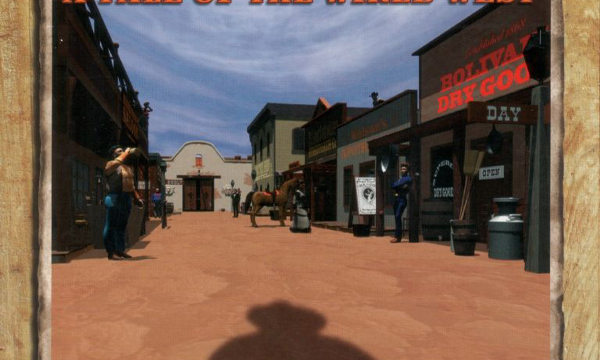
Review: Dust: A Tale of the Wired West
|
Dust: A Tale of the Wired West |
Dang, Buck, Sometimes You’re Dumber Than a Knobby Headed Ox
Dust is one of the few of the adventure game genre that steps outside the usual formulas of mystery stories, ancient civilizations, et al., to do something better known to the likes of Hollywood: tell a good old-fashioned Western tale.
You are dropped into the edge of a small but densely populated western town, Diamondback, which is set in 1882 New Mexico. The game gives the player five days to discover and solve the mysteries found, including the secret behind a local silver mine and what some of the townsfolk are hiding. There are some lighthearted things built into the story–the name of the town saloon is the “Harddrive;” a family in town is named “Macintosh.” Hillary Rodham (Clinton) is the doctor, and this is used for some partisan shots at her proposed health plan and opponents, which is the first time I’ve ever seen someone’s political stance built into an adventure game.
The graphics are dated but not entirely unpleasant. Rooms and street are nicely designed–they give a real air of an old western town with 3D-rendering. The interface is an easy-to-use combination of keyboard to walk and mouse to take and use inventory items and move objects. The design was something fairly new for the time period in which the game was produced; it allows the characters to move freely throughout the town in real-time and to recall conversations and have later reactions based on these. There are some nice, well-designed animations including the intro sequence and pieces that show the passage of time.
The biggest problem I had with the graphics was repetitive talking heads. When a character is clicked on, the view moves in, and the player is treated to the head of a live actor and conversation strings to choose from. There are several problems with this. Firstly, the sound does not even attempt to blindly match the mouths, and apparently the head jerking and rolling is not the designer’s attempt at a campy execution of an Exorcist remake–it’s actually supposed to convey the idea that real people are talking to you. Secondly, the acting, if it can be called that, is so odious that it looks as though Saturday Night Live is doing a skit skewering the subject of adventure games. The game docs boast a total of 35 talking characters, an absolute cornucopia of bad acting, and one gets the idea that “talking characters” was a “newfangled contraption” to these designers, just as “talking pictures” was to the makers of movies in the first portion of the 20th century, and in that grand tradition everyone was more interested in hearing the sound itself rather than concerning themselves with the quality of performance.
Puzzles in Dust are actually fun, mostly inventory-based, and are one of the highlights of the game. Unfortunately, they often must be used with the talking heads, and the only good thing about this is that in many instances, it shuts the actors up, a true boon to the sanity of the player. There are good clues given to game goals throughout. There is more than one spot in the game where you have a gunfight, and while these are not terribly undoable, there are no cheat codes for this part of the game, fella, so you just have to pull yourself up by your bootstraps and get tough.
One aspect of the game puzzles is that occasionally the player has to pay for things, and will continually need more money to do so, and money is earned by gambling in the saloon. It fit into the motif of an old western town, but truthfully, I dislike gambling, so this soon became tiresome for me. Also, I don’t know if I’d be able to give this game to a kid in good conscience knowing he’d come out the other side understanding fully all the aspects of how to play poker, blackjack, or a slot machine, and it seems to me someone did not think things through very carefully here. Some of the characters in the saloon are very obviously hookers, so this definitely sounds the death knell on this being a game for the family/children.
A plus on the design end of things is a built-in help area, designed seamlessly into the game as an old curiosity shop, run by a man called … “Help.” I’m assuming the name was chosen so that the player will not mistake the purpose of this game area. Nevertheless, it is a well-designed aspect, only giving clues if the player has been stuck for a while, and clues are given in two different degrees: a hint or a blatant solve for the next action to be done. There is also a nicely designed built-in mapping feature.
The music fit the game well–it’s old-west style player piano music, a strumming guitar, harmonica music. The intro piece had the proper Gunsmoke affiliations, all of which worked fine in setting the tone. Sound is also well-designed and well-integrated, with noises getting louder as the source is approached. I’ve covered the actors above, but just let me add that the sound of their voices themselves I found for the most part to actually be grating on my nerves, and the idea that I had to have multiple conversations throughout the game with the same characters over and over in order to progress was almost more than I could bear.
I think it’s a pretty safe call to say this game is not going to make my top 10 list any time in this new century. The “novice” score is higher because newbies will simply have no idea of how many much-better games there are out there to play so they won’t dislike it nearly as much as I did.
Final Grade:
Novice player: C
Intermediate player: C-
Expert player: D+
System Requirements:
Mac:
System 6.0.7 or greater
68030 or faster processor
8 MB RAM
Color Mac
Power Mac native
2X CD-ROM drivePC:
Win 3.1, 95 or NT 3.51
486 or faster
8 MB RAM
2X ROM drive or faster
Super VGA with 256 colors
100% Windows compatible sound card