Review: Crusader: A Conspiracy in the Kingdom of Jerusalem — Part 2
|
Crusader: A Conspiracy in the Kingdom of Jerusalem Developer: Index+/France Telecom Multimedia By Ray Ivey 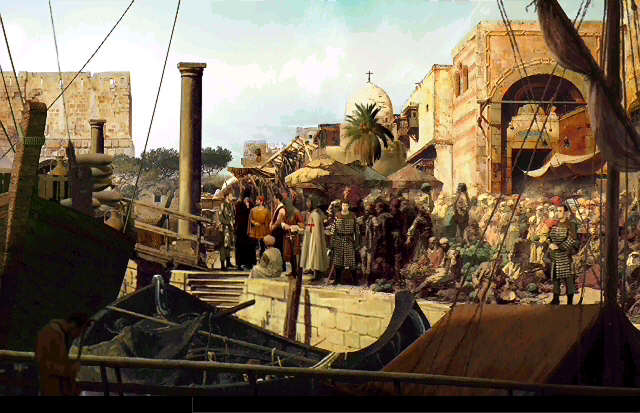  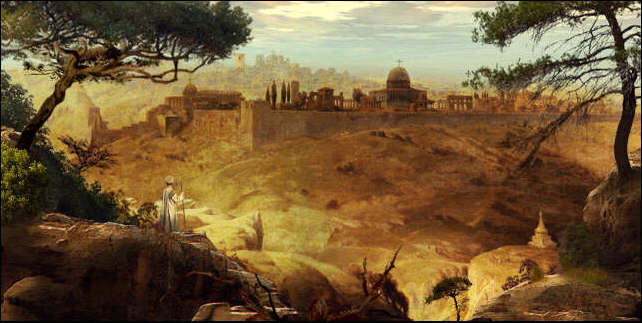 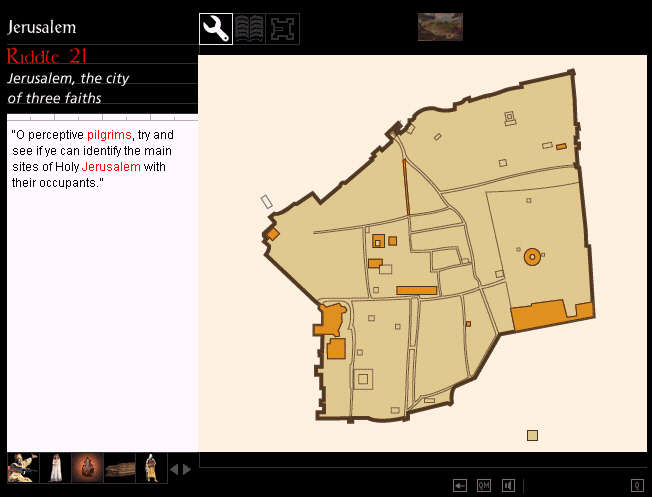 |
Index strikes again! This French game company, which has been wowing me all summer with their superb historical adventure games, has once again provided this history buff an absolute love-letter of a game.
Created by a few xenophobic Popes and a social system that left way too many disenfranchised sons with nothing better to do, the Crusades were one of the biggest catastrophes in the history of Christian civilization, and the bitter legacy of them lives on today in the strained relations between the Christian West and the peoples of the Middle East. It’s also a completely fascinating period of medieval history.
Crusader takes place during the 12th Century, and it’s the story of Arthaud, a disgraced and irreverent French knight who has really gotten on the bad side of the French king Philippe-August. The king offers Arthaud one slim chance to get back into the royal good graces–a wildly ambitious crusade to Jerusalem. The mission? Nothing less than to steal the Holy Relics from the royal Frankish court in the Holy City and return them to France.
Easy, right? Right. The story begins in southern France and follows Arthaud’s adventures (and misadventures) through the Mediterranean and to Palestine. First he has to outfit his ship, deal with pirates, and finally try to survive a dizzyingly complicated situation in Jerusalem. He finds himself caught up in a struggle for power between various branches of the royal family, as well as several factions of local Muslim strong men. Never the sharpest crayon in the box to begin with, it’s not at all clear whether Arthaud will be able to survive this nest of human vipers.
An intriguing narrative element is the game’s narrator himself. For the first few chapters of the game, you think he’s just a disinterested, faceless voice. But soon he reveals himself as Al Harawi, an Arab who becomes an active character in the story. Far from being a passive commentator, he’s an active participant in the story, and he even turns out to have a few surprises up his sleeve.
Index continues to play with interface and structural game conventions and amazingly seems able to do this without annoying the living daylights out of the player. The gameplay format of Crusader is a series of twenty-six riddles, all of which have to do with the lives and times of the characters. Since it’s based on actual historical events, these riddles cover some very interesting territory indeed, from the dynastic struggles in the Frankish Jerusalem court to magic squares to the medieval arts of war on land and sea.
Visually, the game is presented in a series of tableaux consisting of beautifully rendered scenes punctuated by effective animations and populated by costumed video characters. The actors are very solid, and the overall effect is quite nice, especially considering the picaresque nature of the story. One of the scenes (the port of Acre at night) was so lovely that I copied it and placed it on my computer desktop!
To solve the riddles, you make use of the in-game encyclopedia, as well as many visual clues and character dialog in the scenes. As you find the answers, you actually help build the current tableau. In other words, each new element you discover gets added as a visual component of the scene. Whenever you complete a riddle, the story then moves forward. The overall effect feels like the most fun history report you’ve ever had to work on.
How good is the story of Crusader? Well, it’s one of the few games I’ve played where I kept thinking as I played, “This would be a killer movie!” Plus it’s such an intriguing story that the game left me wanting to head off to the library and read more about the medieval Latin kingdoms of Jerusalem. How many games have that effect on the player?
This is the fourth Index game I’ve played (after Paris 1313, Louvre: The Final Curse, and Dracula Resurrection), and with each one I’m more impressed by this team. They have an ability to create historical dramas that have all of the zing any good adventure game needs. I can’t wait to get my hands on their Vikings. They give the terms “edutainment” and “infotainment” a very good name indeed.
Final Grade: A
If you liked Crusader:
Watch: The Crusades
Play: Paris 1313
Read: Eaters of the Dead by Michael Crichton
Minimum System Requirements:
PC:
Pentium 100
16 MB RAM
256 colors
16-bit sound card
4X CD-ROM
Windows 95Mac:
Power PC
16 MB RAM
256 colors
16-bit sound card
4X CD-ROM
System 7