Crusader: A Conspiracy in the Kingdom of Jerusalem
|
Crusader: A Conspiracy in the Kingdom of Jerusalem Developer: Index+/France Telecom Multimedia By Tom Houston   |
|
By all accounts, it was November 1095 in a field in Clermont Ferrand when Pope Urban II called for the first Crusade with the words “Dieu Le Volt” (God Wills It), thus setting a course that would have a profound effect on the history of civilization in Europe and the Middle East that exists in many respects even today. For nearly two centuries and over the launching of eight Crusades, the relationship between the Christian West and the Moslem East was to be in a constant state of military, geographical, economic, political, and religious turmoil and change.
Pope Urban II unfortunately didn’t live long enough to record the reasons why he proclaimed that the Crusades were necessary. However, it is thought that the reasons may have included unification of the Eastern and Western churches, providing safe passage for pilgrimages to the Holy Land, redirecting feudal hostilities in the West towards common enemies (the infidels in the East), and increasing the power and influence of the Roman Catholic Church.
What to Do with a Troublesome Lord?
The prelude to our story begins in the year 1180, a time between the second and third Crusades, at the Fiefdom Dun-Le-Roy in France, where the violent Lord Arthaud has incurred the wrath of the King of France by burning the fief’s monastery to the ground and killing its occupants because they balked at paying his taxes.
The king, Philippe Auguste, is displeased and, under pressure from the Roman Catholic Church, decides to punish Arthaud and strip him of his rights by attacking his fortress. Arthaud’s defenses quickly collapse under the might of the Royal Army of France. Philippe judges that death would be too kind for such rebellion and instead chooses to have Arthaud placed alive in a crypt-like tomb, where he will remain for three years.
One day, William of Tyre, chancellor of the Kingdom of Jerusalem, sends word to Philippe that the situation in the Holy Land is becoming more worrisome. Saladin, the Kurd war chief, seems on the verge of uniting Syria and Egypt under his domination and is threatening to overtake the Kingdom of Jerusalem, which is ruled by the incompetent and unfortunate 20-year-old leper king, Baldwin IV. The relics of the Holy Cross on which Christ died and the symbol of the unity of the Christian world are in danger.
Philippe shrewdly considers the alternatives and decides that Arthaud, the consummate hothead, would be an ideal choice to send on a perilous mission to the Holy Land. Arthaud is freed from his prison and offered a pardon for his crimes in return for his agreement to embark on a pilgrimage to Jerusalem in order to steal and bring back the relics of the Holy Cross.
But Arthaud will have to employ great care in carrying out his mission, because in the volatile Latin lands of the eastern regions, there are many shadowy forces also lusting after the holy relics.
Who Gets the Credit for Telling the Story?
The producers of Crusader, under Credits for Original Scenario, list the name Al Harawi. The story within the game itself is told by one Al Harawi, who not only chronicles the historical events as they unfold but also becomes an active and important participant.
Gerard Milhe Poutingon, a lecturer at the University of Grenoble, says “being introduced to history, discovering the facts and, simultaneously, taking part in their development is a method that the subtle Al Harawi, who knows how to reverse roles and wear every mask, could have invented for our great delight.”
A little research reveals that Al Harawi, the Chief Qadi of Damascus at the time of the first Crusade, preached to his Islamic followers about the impact that these “invasions” would have on their lives and their beliefs. Could this Al Harawi be our storyteller?
Richard Lionheart … Where Are You When We Need You?
If you like edutainment games, and particularly historical adventures, as much as I do, then this game is for you. I can’t imagine a more interesting time than the span of two centuries, during which the Crusades took place, and this game accurately and effectively captures the unparalleled passion and drama of events that would permanently upset the cultural balance between the Christian West and the Moslem East.
As the end of the Twelfth Century approached, the exploits of Richard Lionheart, Saladin, and others would form the historical backdrop for the adventures of Arthaud, which will take the game player on quests set in five different “worlds” that were of critical importance to the documentation of the Crusades period.
Built on historical facts, you will follow Arthaud from the dark fortress of Dun-Le-Roy to Saint Gilles, the pilgrim’s embarkation port, then to Saint Jean d’Acre, an important port city in the Kingdom of Jerusalem, leading you to travel over treacherous routes to Kerak de Moab, the eerie Frankish fortress of the terrible prince of Outer Jordan, Renaud de Chatillon, and, finally, to Jerusalem, the Holy City.
Riddles and More Riddles … and Your Final Answer Is?
The gameplay for Crusader is somewhat unusual, in that to move ahead you must solve riddles. There are 26 riddles, in all, and each of these riddles will lead the player to one or more interactive puzzles that must be completed in order to solve the riddle.
The puzzles require the player to find key inventory items that can be found within interactive views that contain video and animated scenes related to the events that are taking place at a particular time in the story. There are often up to four of these interactive views for each riddle, and they are presented in a unique fashion that I will briefly describe later in this review.
In addition, puzzles may require the player to search through the documentary contents of 165 data sheets that describe the history of the Crusades, the participants that are important to the story, the maps, the weapons, the objects of everyday life, and many other relevant facts about the times. Information, items and people can be selected from the documentation, brought into your inventory, and used to solve a particular puzzle and ultimately a riddle.
The game will advance in a very linear manner, because progress can only be made by an orderly solving of the puzzles and riddles. Most of the puzzles are easy, but a few are more difficult and will take some time to complete. In any event, I found the puzzles and the riddles to be fun, as well as educational, but I would caution that others might find them to be tedious. Perhaps I lean a little toward anal-retentive.
Are You Ready for an Unusual Game Interface?
Wow … is this part hard to describe! But here goes.
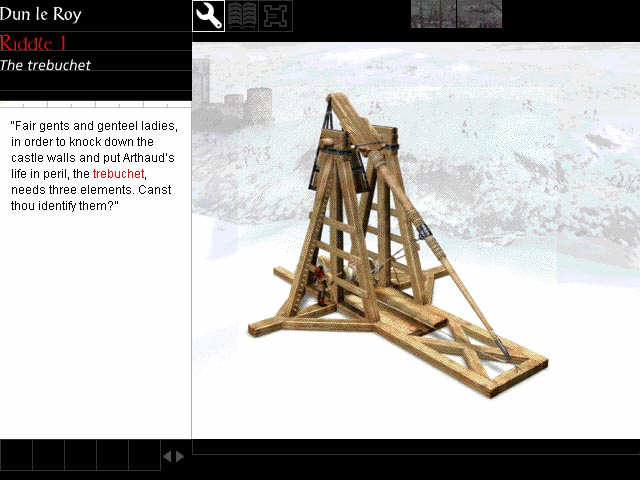
The interactive views or scenes, as well as the display of documentation, utilize about seven-eighths of the computer screen, so you will have pretty much a full view. Along the top of the screen is the toolbar, which will give the player access to the current riddle, the documentary base, the plan of the “world” that you are presently in, and each of the interactive views or scenes that relate to the current riddle (typically, up to four views). Along the bottom of the screen is the wallet (contains your inventory), a captioning display area, and the quickmove area, which is very handy for manipulating between screens and searching through the documentation for specific information.
When you enter into one of the interactive views or scenes, you will experience what Index+ describes as “an atmosphere worthy of a cinema production.” Whether you agree with this characterization or not, what you will actually see is a very unusual cinematic presentation that utilizes live actors, sound bites, animations, and special effects superimposed on 2D sets that have been faithfully constructed to very accurately represent the content of the scenes and the times. Given the French penchant for superb graphics, even though Crusader was made in 1997, the graphical presentation, the accomplished acting (enhanced by always interesting and informative sound bites), over 500 animations, and the surprising special sound effects (i.e., fire bombardments, thunder and lightning, the sounds of battle, flying birds) are all marvelous.
Round out the presentation with a wonderful and memorable original musical score by Olivier Pryszlak and you have a very complete package for a very satisfying historical adventure game that I thoroughly enjoyed.
Is There Anything Wrong with this Picture?
As far as I can determine, even though I played an English-language version, Crusader was never released in the U.S., which begs me to ask the question … Why?
Could it be that, even back in 1997, historical adventure games were being made by European developers for distribution only in Europe? Could it be that these European producers of historical adventure games did not envision the U.S. game buyers as a viable market for these games? Could it be that they viewed the typical U.S. game player as preferring action, shooting, and violence, rather than gravitating toward historical education and entertainment interests and logical thinking?
What About Changing the Picture?
More recently, we have seen the North America-based company, DreamCatcher, form distribution alliances with Index+ and Cryo that have brought more European-made adventure titles to the U.S. (i.e., Dracula Resurrection from Index+, Sacred Amulet and Beyond Atlantis from Cryo), and even more new adventure games are on the horizon.
These changes are not happening by accident. The leadership and motivational efforts of Just Adventure (not shameless promotion … but fact) have worked diligently, often behind the scenes, to promote the viability and interests of the adventure gamer and the commercial support of all of us, representing the hungry buyers of adventure games, who often have sadly had to go to European sources to purchase games, may finally be establishing the credibility and influence required to cause the picture to change.
As I suggested within a recent review of Cryo’s 1997 edutainment game, Treasure Hunter, we need to continue to petition DreamCatcher and the European producers of these games for the opportunity to purchase these back-listed adventure games in North America.
Our Crusade Continues … but Crusader Has Ended
Crusader: A Conspiracy in the Kingdom of Jerusalem may not be for everyone, unless you are fond of historical adventures and interested in the educational values of revisiting a period when West met East and the significance and cultural impact of the collision that would be felt for all times to come … even up to the present day.
The unusual presentation of the story, graphics. and gameplay, which I found to be magnetic and generally enjoyable, leads me to suggest a qualified recommendation for Crusader.
Final Grade: B+
Minimum System Requirements:
PC:
Pentium 100
16 MB RAM
256 colors
16-bit sound card
4X CD-ROM
Windows 95Mac:
Power PC
16 MB RAM
256 colors
16-bit sound card
4X CD-ROM
System 7
Screenshots