The Crystal Skull Review
|
Review The Crystal Skull Some Interactive |
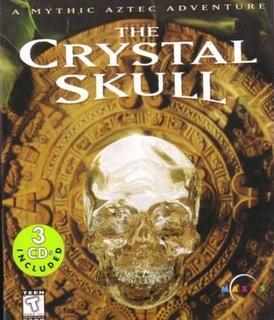
Crystal Skull comes to us from Maxis, a company not usually associated with adventure games. With that in mind, it is, perhaps, not surprising that their first entry in the field is somewhat weak.
The story is set in the time of the Aztec empire, during the reign of Motecuhzoma II, known more familiarly (though incorrectly) as “Montezuma II”. It is just before the arrival of the Spanish, and Motecuhzoma sees bad omens everywhere, including his dreams.
A recurring figure in the dreams is Quetzal, birdkeeper in the royal zoo, and our hero. The emperor wants to see him, and orders Snake Skirt (his trusted advisor) to bring Quetzal to the palace. Snakey has other ideas, however; he orders the guards to kill Quetzal instead.
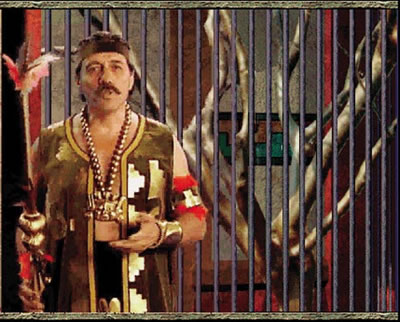
So at the start, Quetzal must avoid the guards and come up with a safe way to visit Motecuhzoma to learn what’s going on. When he gets there, the emperor orders him to find the crystal skull, and the rest of the game is taken up with Quetzal’s efforts to obtain the mysterious artifact.
The interface is very simple. The main cursor changes shape as it moves around hot spots on the screen: a pointing arrow for movement, an eye for something to look at, a talk balloon for people to talk to, and a hand for items that can be picked up or manipulated.
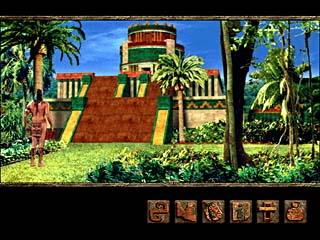
At the bottom of the screen is the toolbar, where you can save/restore, examine your inventory, pick up some info on Aztec culture, bring up a map, shapeshift, or get a hint for a difficult situation.
The map is not a typical automap; it is complete when you look at it, and some locations are “enabled”, meaning you just click on them to go there. Only a few of these locations are enabled on any section of the map. While this cuts down on some travel time, for the most part you’ll still do a lot of walking around.
The inventory pouch shows everything Quetzal is carrying. Using an item is simply a matter of picking it up with the cursor, then clicking the cursor where you want to use the item. If an object can’t be used in a particular situation, you can’t take it from the inventory.
The in-game hint system is extensive, with clues and answers for just about every puzzle or difficult situation. Each set of hints begins with a vague nudge, and proceeds on, becoming more obvious until the complete answer is revealed. You must choose at the start of the game whether or not the hints will be active. If you decide not to have hints, the only way to get them later would be to start a new game.
Conversations are usually begun by clicking on a person, although occasionally they happen automatically. Sometimes, there is no real dialogue; the person just tells you something. At other times, Quetzal must say something or respond to a question. When this happens, three small pictures of Quetzal appear at the bottom of the screen. Each represents a different response, and you decide which one he gives by clicking on it.
Saving positions is somewhat primitive. You don’t get a fancy screen where you can type in a description. Instead, you specify the actual file name according to standard DOS conventions, eight characters with a three-character extension. The one good thing about this is, the number of saves is limited only by disk space. Since the files are under 2K apiece, you can have as many saved games as you need.
Some people may be worried about scenes of violence, especially as the Aztecs were famous (or infamous) for their blood rites. While they certainly did kill many thousands – both their own people and war captives – as sacrifices, this is not a part of Crystal Skull. There are no gory bodies or gruesome visuals here. One prisoner of war does have his heart cut out, but this is shown from behind the high priest, and more by implication than anything else. In this respect, at least, the designers showed good sense by not dwelling on the unpleasant or sensationalistic.
Graphically, the game is pretty, which is only to be expected as the resolution is 640x480x256. The view is third-person for a change, with Quetzal on the screen all the time, set against a background of authentic-looking Aztec buildings and the like.
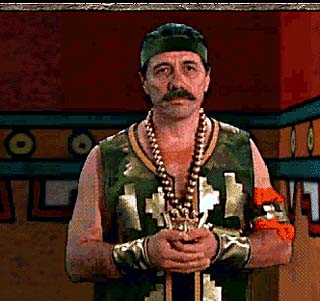
Indeed, a lot of research obviously went into this game. Wherever you are, you can click the codex icon to see a screen or two of information on how the current location relates to Aztec culture. All the characters appear to be dressed in typical Aztec style.
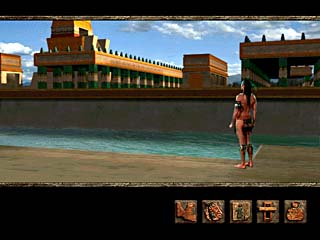
So it’s a great pity that all this effort went for nothing, because while the setting is authentic, the characters aren’t. They run around with twentieth century attitudes and twentieth century speech. When references are made to Swiss army knives, George Harrison, open-heart surgery (meaning the Aztec blood rite of cutting out hearts), and similar, the atmosphere is completely destroyed. Any feeling of being in Aztec times rapidly disappears soon after the game begins.
Perhaps the designers thought this would inject a little humor into the game. If so, they thought wrong. All it does is make a farce of the whole thing.
Not content with that alone, they also bring in time travel, with Quetzal going back to the founding of the Aztec Empire. Much of the game, in fact, takes place during that time period. Why? I don’t know, except that time travel seems to be “in” these days for adventures, and possibly the designers felt they should jump on the bandwagon. Whatever the reason, it doesn’t add anything worthwhile to the game.
There doesn’t, for that matter, seem to be much worthwhile about this game in the first place. Quetzal hunts around, finds the skull, and then he and his girlfriend end up in modern-day Mexico at the finale. Perhaps there is a good reason for this, but if so, I couldn’t say what it is, because of the one techical problem I had with Crystal Skull: the sound.
At the start, everything was fine, although occasionally a word or two was clipped from someone’s speech. A bit annoying, but aside from that, the dialogue was clear and understandable. Partway through the game, that suddenly changed, for no discernible cause.
People began talking high and fast, rather like the Three Chipmunks. I finally traced that down to Quicktime for Windows (which the game uses), where I made some changes in the control panel to bring the speech back to normal. This had to be done more than once during play, but at least the speech worked.
Then, during the last section of the game, I lost the dialogue completely. Nothing anyone said came through at all; there was total silence when they were talking (or supposed to be talking). Oddly, there was no problem with the background sounds or music; those always came through perfectly.
With no text subtitles available, getting through the final portion was difficult, although the hint screen was helpful in this situation. Often, just looking at the questions there was enough to provide some direction. Still, the hints only helped with the puzzles; the final explanation was given by the Shaman in the game proper and was lost to me, since I couldn’t hear it.
As far as the puzzles are concerned, most are no great shakes, and some are just dumb. At one point, you enter the marketplace and do some trading of items you have for other objects. Then the boatman turns up, and the only thing he’ll take as payment is something you traded away earlier…and he doesn’t appear until after you’ve given the item away. So you have to return to the market and trade around again to get the item back.
Elsewhere, you receive a pass from Motecuzhoma to get by a guard so you can leave town. Only the pass doesn’t work; you actually need that for something else later in the game, and have to find another way around the guard. Things like this don’t add much, if anything, to the play value.
Overall, The Crystal Skull is a disappointment. While pretty to look at, the game offers little of substance besides the culture notes. The puzzles are often dreary, and the atmosphere is lacking. This is one of those products that is neither terrible nor good, only mediocre. What could have been a fascinating visit to Aztec times turns out to be merely silly and dull.
Just Adventure + Assigned Grade: C
System Requirements:
PC:
486/DX2/66
8MB RAM
2X CD-ROM drive
SVGA
Sound card
M ouse
Win 3.1, Win ’95Also available for Macintosh