Review: Clive Barker’s Undying
|
Developer: Dreamworks Interactive 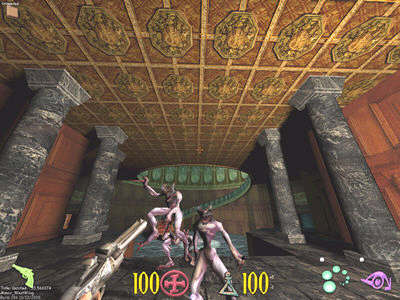 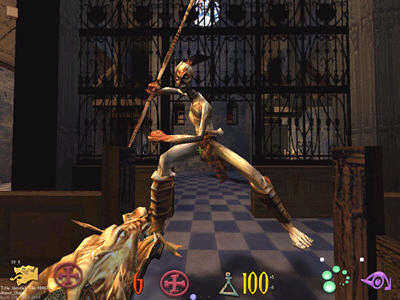 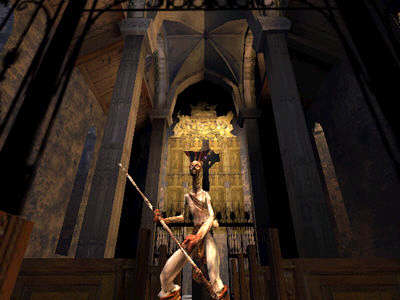 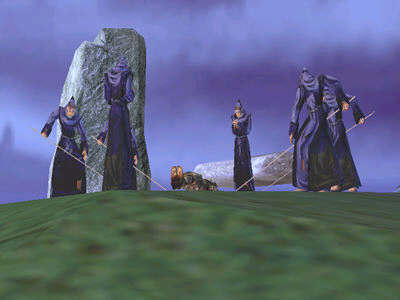 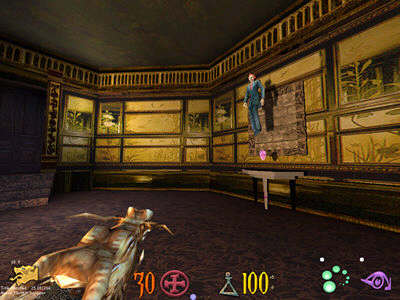 |
There has been a slew of reviewers at some of the major mainstream webzines drooling over Clive Barker’s Undying. And for good reason–it is a well-crafted, fun-to-play game–and in the final analysis, that is all that counts. Nothing else.
Yet all of this talk about the game’s realism, the wonderment over the ability to fire a weapon with your left hand while casting a spell with the right, well, it got me thinking (and we know how dangerous that can be).
What if an adventure gamer were to review a popular action game in much the same manner that many action gamers review adventure games? C’mon, we’re all familiar with the spiel: this genre is stagnant, some of these puzzles wouldn’t make sense in the “real” world, the game is too linear. What if indeed.
Before we go any further, though, some of you are probably wondering why we would even bother to publicize a game that is primarily a first-person shooter on a webzine that concentrates on adventure games. Well, since many adventure gamers are also voracious readers, they already have more than a passing familiarity with Clive Barker. I personally, to use wrestling parlance, am a “mark” for anything that Barker does and own every single one of his books in both hardcover and paperback versions, not to mention his comic books and movies. As far as I am concerned, Barker can do no wrong. Our favorite reason, though, is the wonderfully endearing emails we receive from diehard adventure gamers whenever we cross the boundary of their outdated definition of adventure. These letters usually describe in detail how my death will gain me entrance to the seventh ring of Dante’s Inferno or why Just Adventure is a blight on the industry and a thorn in the side of “true” adventure gamers. But you know what? Games are supposed to be fun, and so should some reviews be fun. So let’s have some.
If Clive Barker’s Undying were an adventure game, the reviewers would rip it to shreds. It is not innovative, nor does it add anything to the first-person shooter genre. We have seen this all before, the only difference being that this time the setting is a haunted house. (Hey, wasn’t this done years ago in an adventure game called Realms of the Haunting? Part adventure, part first-person shooter, ROTH was a game years ahead of its time.) Undying’s fully articulated 3D characters and supernatural creatures are fantastic. The mansion itself takes on the aura of a living, breathing person with its flickering torches, ornate spiraling staircases, and windblown draperies. It seems to have assimilated an ominous, foreboding atmosphere that permeates your mind whenever you enter a newly discovered dark recess. There are some wonderfully spooky scenes involving mirrors and paintings (many of which were reproduced from Barker’s originals). The Scrye spell, in particular, is marvelously inventive, as it allows the protagonist to witness events from the past.
The story takes place in a large Irish mansion and its surroundings circa 1923. An evil curse has enveloped the mansion thanks to satanic ceremonies performed by the five Covenant siblings. On his deathbed, Jeremiah Covenant, the only remain sibling, has sent for renowned occultist Patrick Galloway to exorcize the mansion of its demons. As Galloway owes his life to Jeremiah, he readily agrees, and he soon finds himself facing the vindictive spirits of the Covenant family. Initially, the plot is advanced via conversations and journal entries, yet, strangely, as the game progresses, the plot seems to become secondary to the action. How can this be, in a game written by Clive Barker? Well, let’s take a look at the credits, shall we? There are credits for Animation, Art, Design, Engineering, Production, Sound, Test, and Voiceovers. Hello, did someone forget a scriptwriter? Clive Barker, you say? Well, the only places he is credited is in the Voiceovers, and there is an “Undying Special Thanks to” Clive Barker among many others. Apparently the people on the gaming side thought a little thing like a script wasn’t too important. Even stranger, though, are the puzzles. In a game “written” by Clive Barker, the creator of Hellraiser and Candyman, one would think that the puzzles would be deliciously devious. One would be wrong. According to Barker himself, he was not, before he assisted on this game, much of a computer gamer. So imagine the following: a preproduction meeting between Barker and the Undying design team. Clive has already described the plot and the characters in detail and now the designers want to know what kind of puzzles he envisions. Clive looks them right in the eye and says, “Let’s make these puzzles tough. Let’s have the player search for lots and lots of keys. Hell, let’s really confuse them. Big keys, little keys, silver keys, gold keys.” I don’t think so. Rather, I think Electronic Arts paid Clive Barker a king’s ransom and then probably threw away half of his script because it was too cerebral and then, out of fear of being too original, fell back on the industry standards of linear gameplay and locked-door puzzles.
Some gamers are in awe because you can shoot a gun with you left hand and cast a spell with the right. What’s the big deal? Adventure gamers have been using both hands to solve puzzles for years. Which begs the following question: what have you action gamers been doing with that unused hand? And what’s the deal with the arm holding the weapon constantly thrust in front of you as you walk down a corridor? Wouldn’t your arm get a little tired after a while? This reminds me of a movie I once saw in which marine recruits in boot camp had to hold a bucket full of sand in front of them. Obviously, they could not do it for long, yet these people in first-person shooters run around the entire game with a heavy weapon in their hand and their arm thrust out in front of them. Maybe they get their strength from the nectar of gamers–Cheetos and Doritos.
Pools of blood make a sticky, squishing sound when stepped in. Is this realistic? I don’t know. In real life, I have never walked through a pool of blood, much less seen one. The way so many reviewers talk about how realistic this is makes one believe that must all be moonlighting as homicide detectives. Bloody footprints seem to go on for corridors. When I track mud into my house, there are usually three or four footprints. Yet bloody footprints seem to go on for the entire length of a hallway.
As for those journal entries, why would individual diary pages be scattered about the mansion? Who ripped out these pages, and why are they found only one page per room and in chronological order?! Some of the entries also seem to be a little farfetched. This excerpt is from a letter a daughter wrote to her mother, “Seldom does he want to exercise his husbandly right towards me.” Excuse me? Taking into accord the early twentieth century definition, I still cannot image a daughter writing to her mother and complaining that her husband won’t do the “dirty deed” with her. To a girlfriend, yes, to a sister, yes, but to your mother?
Even stranger is that for some inexplicable reason, health packs and ammunition are scattered all about the mansion. Didn’t any of the maids notice this stuff lying around, and if they did, why didn’t they pick it up? Isn’t that their job? Some ammunition can only be added to your inventory by actually jumping on a table or nightstand or bed. How realistic is that? How many times have you ever said to someone, “Hey, could you jump on that table and get my cup of coffee?” The furniture in that mansion must have some mean scuff marks. And doors–they’re always locked or jammed or just won’t open for some inexplicable reason. Where’s the handyman? Why doesn’t he repair these doors, especially since he damn well knows that his employer asked Patrick to the mansion to eradicate the evil spirits.
Another difficulty with the gameplay is that all movement is controlled via a keyboard/mouse combination. What is this, a LucasArts adventure game? Haven’t these action gamers heard of a new invention called the gamepad? Plugs into your USB port. Has buttons and an analog stick to simplify character movement. Get with the times, guys, adventure gamers have been using gamepads for years.
Worse of all, though, are the reviewers who are complaining about the lack of multiplayer. No multiplayer–lordy! Are you action gamers so lonely and insecure that you can’t play a game by yourself? Maybe if you didn’t sit at your computers all day, you would have some flesh-and-blood friends. What’s the big deal with multiplayer anyhow? Every multiplayer game is the same, everyone runs around and shoots everyone else, the only thing that ever changes is the setting.
By the time you have read this review, I will have finished the game; as of now I have completed about 75% of the game. I would have been finished, but EA wouldn’t send me a walkthrough and some of these open-the-door puzzles are darn tricky. Besides, when all you are doing is shooting everything in sight, how much different can the rest of the game be? Usually, I would never write a review before finishing the game, but this is an action game–does anyone still play these?
During the course of writing this review, I did have an epiphany. Has anyone else noticed that any areas of Undying that were directly influenced by Barker–the plot, the wonderful characters, the framed portraits–are all, in my humble opinion, excellent, and that the game’s unoriginality–its linearity, the feeble-minded puzzles, the bloodshed–can all be attributed to professionals who create games for a living. What does this all mean? I don’t know, I’m just another one of those people who play those unrealistic adventure games.
Make no mistake, though, Undying is a lot of fun and is highly recommended for anyone who loves first-person shooters. Or if you love games with a spooky atmosphere but shy away from action games, set it on the easy level and enjoy the atmosphere. Either way, as a lot of reviewers seem to forget, it is still all about fun no matter what the genre.
Final Grade: B
System Requirements:PIII 500 MHz
Windows 95/98/ME
64 MB RAM
8x CD-ROM
16 MB Direct3D or Glide capable video card
DirectX 8 compatible sound card
Keyboard
Mouse