Review: Aztec: The Curse in the Heart of the City of Gold
|
Aztec: The Curse in the Heart of the City of Gold Developer: Cryo Interactive By Tom Houston |
The year is 1517. The Aztec culture dominates most of the territory that is now Mexico. Their language, religion, and traditions have spread throughout Central America, while their emperors are both feared and venerated. While troops of Aztec warriors keep the territories under control, Aztec merchants provide luxury products, clothing, foodstuffs, jewelry, and other everyday items to the populace. Merchandising and trade do not go unnoticed by the emperors, however, as tax collectors collect taxes and tribute everywhere.
The center of government and commerce for the Aztec culture is the capital city of Mexico-Tenochtitlan, where the Aztec architecture, art, and culture was most prolific. When the Spaniards, led by Cortes, reached Mexico-Tenochtitlan in 1519, they marveled at the splendors but were undeterred in their objective to conquer the Aztecs. In just two years, they annihilated the Aztec civilization, leaving behind only sparse reports from the chroniclers of the time.
Cryo’s latest edutainment game, as those before it, offers three modes of gameplay: the adventure game itself, an exploration mode in which you can visit the sites and simply “look around,” and an encyclopedia mode where you can search through the “authenticated” documentation and refresh your memory or learn about the Aztec civilization.
The encyclopedia mode of gameplay reveals fascinating historical information about the following aspects of the Aztecs.
- The Empire: The origins, government, laws, and heritage of the Aztecs.
- The Society: A look at the social order of the Aztec culture, the warriors, priests, and merchants.
- Religion: The gods, including the two principal mythical kings, Quetzalcoatl, the plumed/feathered serpent, who represented the divinity of civilized, sedentary, refined beings and symbolized the renewal of the earth’s bounty and fertility, and Tezcatlipoca, the jaguar/smoking mirror, who was a warrior god, deceitful and who some say used his powerful spells to conquer Quetzalcoatl.
- Mexico-Tenochtitlan: The capital city, its architecture and palaces.
- Civilized Life: The language (Nahuati), writings, arts and crafts of the Aztecs.
- Agriculture: Food and entertainment.
The Story’s the Thing
In the adventure game itself, you play a young huntsman named Little Serpent who, when out hunting, finds himself in the wrong place at the wrong time. By chance, you observe the murder of a nobleman, and before he dies he gives you information that will prove to be both mysterious and dangerous. The dying nobleman also gives you a strange necklace and an admonition to seek out the poet Tlatli, who lives in the marketplace district of Tlatelolco. The warriors responsible for the murder accuse you of the murder, but you run away before they can arrest you.
Upon returning to your village, you discover that your parents have been taken away as hostages, and you soon realize that the only hope for freeing them and proving your innocence is to uncover the identities of the persons responsible for the nobleman’s murder.
At the same time, a mysterious illness has afflicted the country, and doctors seem powerless to find the reason or the cure. Some of the lords and religious leaders are suggesting that the devastation brought on by the illness is the result of actions taken by the gods, who are unhappy with the emperor.
What has the murder of the nobleman got to do with the strange illness? Is there an unlikely connection? You only have a few meager clues, so you must be able to use them properly.
It is here that they story begins, and Little Serpent embarks on a journey of adventure and intrigue that will keep you on the edge of your seat. You will need to use your wits to escape or avoid perilous situations. You will need to choose your friends wisely in order to learn the identity of and expose the real traitors. The story unfolds quickly, and the pace of discovery and excitement never wanes. This is the best story development of any of the edutainment games from Cryo to date and, as such, you will “enjoy the adventure.” The story receives an A+.
The Gameplay
The game uses the familiar point-and-click interface, where you find hot spots, identified by a change in the cursor icon, then use the left mouse button to move to, act/take, speak to, listen/overhear, or get information about a character, object, or place in the game–very comfortable and convenient.
The right mouse button is used to call up the inventory. You then can select an inventory object and use it in the game environment in the usual way that we are all familiar with.
Right-clicking not only brings up the inventory, but also some other useful features, as follows:
- The Codex: A journal or record of important events, conversations, or threads in the game that can be referred to as you measure and reflect upon your progress.
- The Map: Allows the player to more easily travel or “jump” between the five game locations.
- Documentation: You can access the information on any subject in the documentation mode at any time.
- See: Select an object in the inventory and place it on the eye icon in order to obtain a full-screen view of the object. Allows you to read parchments and poems that are key to the story’s progress.
- Return: Used to return to the main menu.
There is one unique feature of the gameplay that some may appreciate, while others may not–it is the built-in “Omni-Expert” mode. This feature provides guidance or hints at “the most complex moments of gameplay,” whether you need it or not. So while you are wandering around or simply staying in place, you may get a message that nudges you along in the direction that the game wants you to go in.
The main menu is also typical in that it contains the primary functions for the game. You can choose to play the game, the exploration mode, or the documentation mode, as explained earlier. There is a choice of two save modes: automatic (the computer does the saving at certain predetermined times) or manual (you save when you want to). Also, you can load previously saved games, resume the game that you are playing at the point at which you left it, or exit from the game. You can also bring up an options screen that will give you the opportunity to adjust the speed of character movement and scene changes, activate or deactivate the music, and turn on/off the display of subtitles.
The gameplay interface should be a comfortable and convenient one for any adventure game player, whether novice or experienced, and all of the features seemed to work without a problem, so I will give gameplay a rating of A.
The Graphics
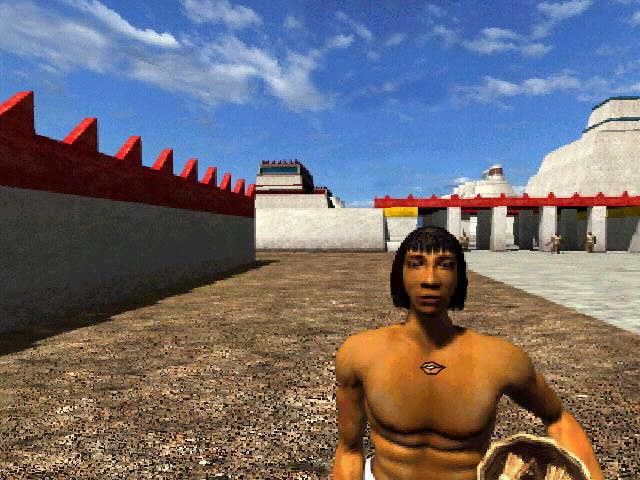
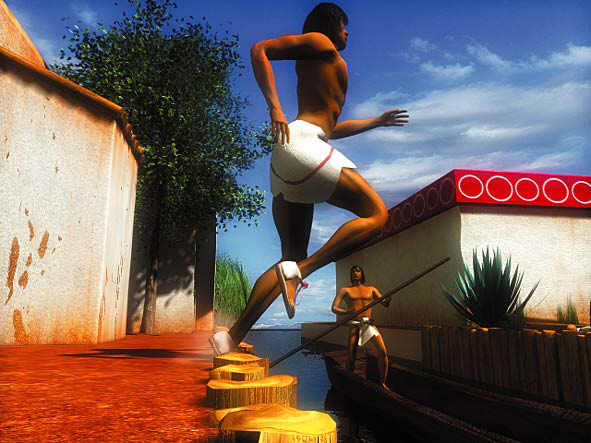
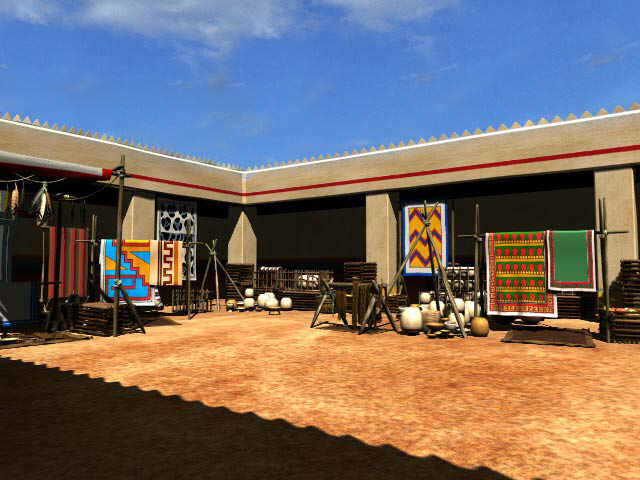
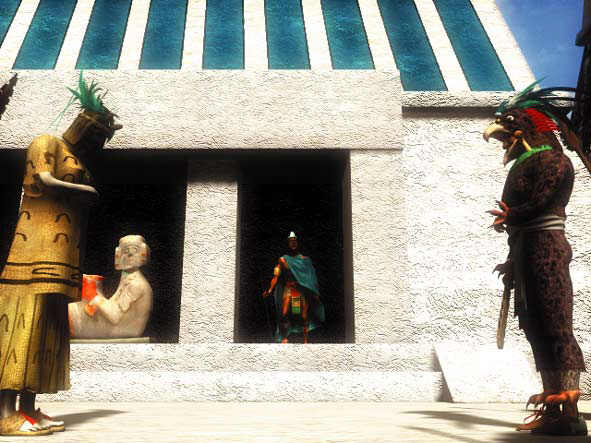
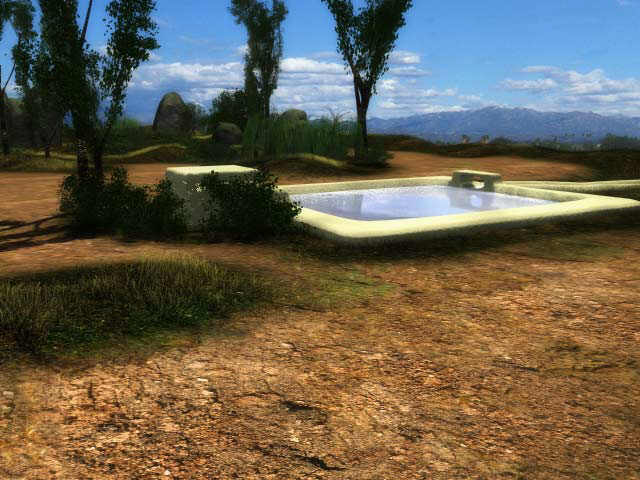
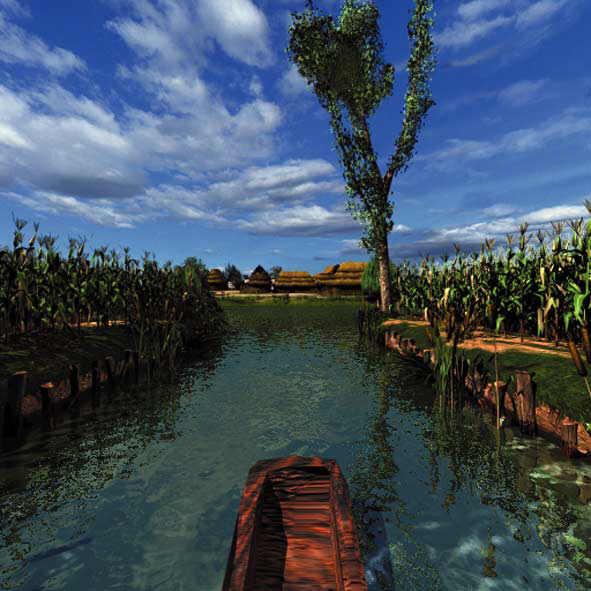
At the risk of repeating myself from previous reviews of Cryo games, the graphics are magnificent. As with previous Cryo historical adventure games, Cryo uses Omni 3D graphics with 360-degree panning that is very smooth and easy to control. The reconstruction of the Aztec world, as typified by Tenochtitlan Square, the merchant’s quarter of Tlatelolco, the craftsman’s quarter, the village with its floating gardens, or the aqueduct at Chapultepec, is breathtaking and realistic to the point of being approved by expert historians. The character movements are a little bit stiff but quite similar to what you would expect to find in any well-made adventure game today. The colors are vibrant with little or no pixelation. The animations were first-rate and always provided me with an enhanced feeling of being part of the environment that I was exploring. All of the above, plus no “bugs,” lead me to give the graphics a score of A+.
The Music, Sounds and Voice Acting
Well … I suppose there’s always room for improvement, and in the case of Aztec, it’s evident that improvement is warranted in the area of voice acting. Aztec was undoubtedly made first in other European languages and then translated to English. While the use of Cryo’s “Omni Sync” has spared us from any discomfort over lip-synching, it can’t cover up for the voice acting, which is the singular weak point of this game. The voice acting and the phrasing of some of the language used in the game is pretty dreadful. Those of you who know me are probably shocked right now that my normally positive attitude toward adventure games would allow me to be this critical. But … I have trouble relating to any conversation between characters in a game when the initial words are “I kiss the earth.” Might be a cultural problem on my part?
Although the music and sounds of the game are adequate, there are no memorable aural experiences that I came away with, as I did in another Cryo game, Faust. The enjoyment of sounds and music in Faust may have been attributable to the involvement of Arxel Tribe, which would account for the different experience with Aztec.
If and when Cryo becomes more focused on reaching the U.S. audience, I trust that they will look at this area of the gameplay experience and accept my criticism as constructive, so that we will see improvement in the future. However, for Aztec I was disappointed in the attention given to the music, sounds and voice acting, which deserve a C.
The Puzzles
Okay, now we can get back on track with the positives of Aztec, because the puzzles are integrated into the game with logic and excellence. You will need to keep your thinking cap on at all times, but the answers are always logical and generally right in front of you. The progression of the story always relies on solving the puzzles, and that is as it should be, so everyone should be comfortable with the puzzles. The only dreaded maze that you will encounter is actually a very simple one, where you must move your canoe through canals that separate the floating gardens near the village as you escape from pursuing warriors trying to capture you. Oh … there is a need to use your hand-eye coordination on two occasions when you are required to aim and fire a blowgun. Fortunately, no one is firing back at you either time.
I think that the puzzles are always logical, thoughtful, and complex enough to keep your brain in the game, which is one of the primary reasons for playing an adventure game, and Aztec delivers in this regard. For those who don’t object to a little nudge, there’s the built-in Omni-Expert, which will minimize the frustration. I am giving the puzzles a rating of A.
My overall rating for Aztec is an A. In spite of my disappointment with the attention given to the music, sounds, and voice acting in Aztec, this is a very good game that everyone should enjoy. The strengths provided by an engrossing story line, excellent graphics, and integrated, logical puzzles far outweigh any criticisms. If you received Aztec for Christmas, you’re probably enjoying it by now. If you didn’t get Aztec for Christmas, treat yourself and buy it now.
System Requirements: P166 Processor
32 MB RAM
8X CD drive
8 MB available on hard drive
2 MB graphics card
16-bit color
Sound card
Direct X 6.0 or higher (supplied with game)