Review: Aztec
|
Aztec: The Curse in the Heart of the City of Gold Developer/Publisher: Cryo By Ray Ivey |
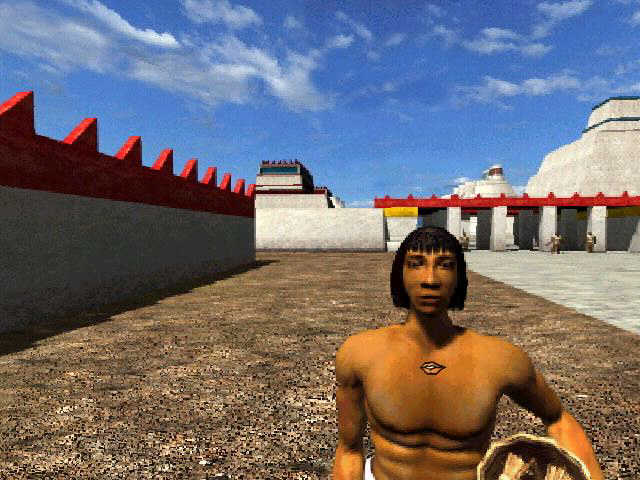
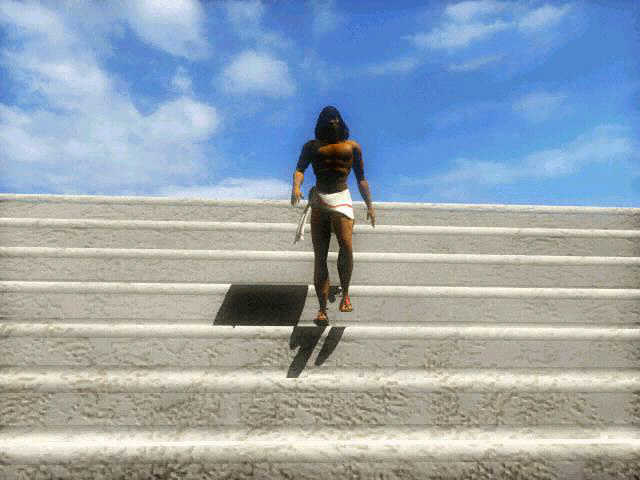
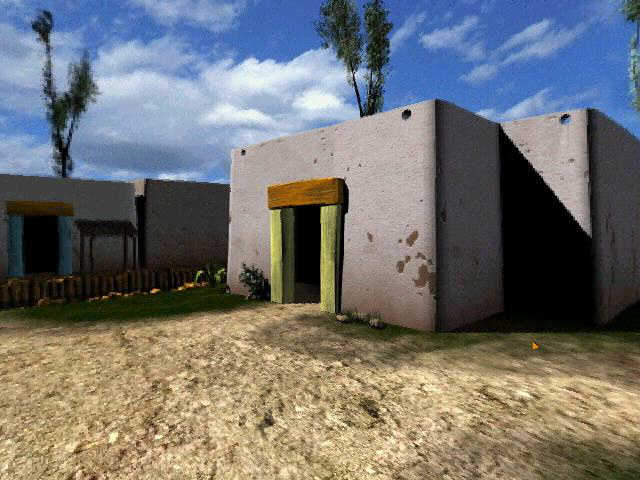

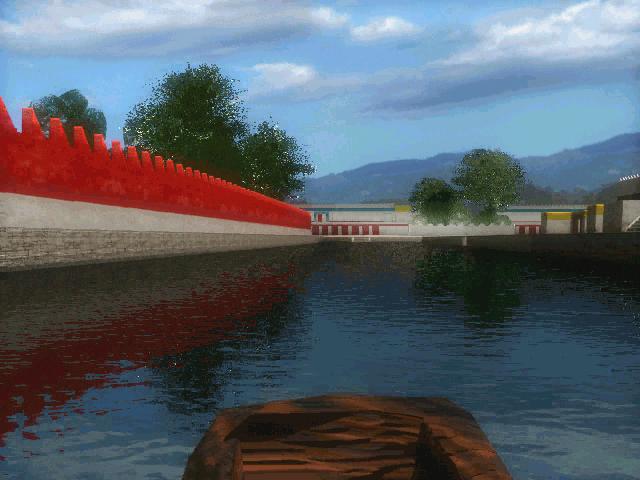
Aztec is the latest in Cryo’s excellent historical interactive fiction series. Like its earlier historical excursions through Egypt, Versailles, and China’s Forbidden City, Aztec is a fictional story in a setting that’s just brimming with authentic historical detail.
The setting of the story is the area surrounding the great capital city of Tenochtitlan in the year 1517, during the twilight of the Aztec empire. You play a character named Little Serpent, a young hunter who accidentally witnesses the murder of a nobleman while out gathering birds for his family’s dinner table. The warrior who committed the murder has poor Little Serpent blamed for it, rendering him an outcast and his parents prisoners bound for the bloody sacrificial altar. If your boy is to free his parents and himself, he has to somehow solve the mystery surrounding the murder.
These days almost all reviews of new adventure games include a few raving sentences about how good the graphics look. It seems each new game is the best-looking game we’ve ever seen, blah blah blah. Let me struggle to be a bit more specific about the look of Aztec. Like Cryo’s China, the graphics in this game have a wonderful deadpan matter-of-factness to them. By that I mean that they are certainly beautiful, with vibrant colors that are vividly illuminated by Mexico’s blazing sun. But the look of the game manages to be gorgeous without ever feeling flashy. It’s as if they game designers are more interested in showing rather than showing off. I can’t stress enough how this adds a wonderful feeling of reality to the game’s atmosphere. Whether it’s a humble village hut, a market square, or a grand temple plaza, each of the environments in Aztec have a remarkable “you are there” feeling. The only thing missing is more of a crowd (more on that later).
One result of such “in your face” visual reality is that it’s sometimes a bit of a challenge finding your way around. Some players of Cryo’s China complained about this problem, as there was a baffling sameness to the red buildings of the Forbidden City. This challenge is much milder in Aztec, and I’m actually not complaining about it. Like Outcast with its aliens that all looked alike, the mundane reality of the architecture in Aztec strikes me as a legitimate and realistic part of the challenge of the game. After all, if I really was humble little Little Serpent, wandering around the great city for the first time, I’m pretty sure all the buildings would overwhelm me and that I’d have to stop frequently for directions. The same with houses, huts, shopping stalls, etc. Again, the atmosphere of Aztec is one of everyday reality, although in a setting that’s exotic to a 21st century person. This balance between the lure of flashy graphics and a desire to create a real-seeming environment strikes me as pretty tricky, and my hat’s off the Cryo team for pulling it off so well.
I enjoyed the story in China: The Forbidden City, but the story in Aztec is a real leap forward for this series. Little Serpent begins to uncover a dark conspiracy that’s infecting the entire empire. The story is fraught with danger and intrigue, and it made it very hard to quit playing the game no matter how late at night it was.
The puzzles in Aztec will definitely be too mild for some. My personal playing style is that I don’t mind mild puzzles, especially in a game with a story this intriguing. But players who pick up Aztec hoping for chewy puzzles a la Black Dahlia will certainly be disappointed. In Aztec, the puzzles are merely pleasant bumps in the road, punctuating a tightly told tale.
The voice acting is pretty good. Most importantly, it’s never distractingly bad, which is enough for me to cheer about.
The interface is a breeze. A simple right-click brings up the interface, including inventory, game menu, note pad, and encyclopedia. Under the game options, there’s even an (welcome) adjustable setting for the speed of the 360-degree panning.
Notepad? Encyclopedia? Yep, remember this is a Cryo historical game. It includes a lovely encyclopedia with information on all of the places, people, things, and concepts that you encounter in Aztec. This is the type of feature you can use as much or as little as you like, depending on your interest. In China you had to use the encyclopedia a few times to research the solution to a puzzle. I enjoyed that and was a bit sorry I didn’t ever need to do that in Aztec.
The notepad. Ah, here’s a feature I wish every game had, and precious few do. It’s a running list of Little Serpent’s mental notes to himself, marking his progress in the game and what his current goals are. As a lazy note taker, I love this feature and want every single game to have it.
Back to the historical veracity thing. The game designers are so serious about the authenticity of the environments presented that the game even allows you to play the game in “visit the site” mode. No, this isn’t a hyperlink to Cryo’s website (yes, I admit that’s what I though it was); it’s simply a game mode that lets you wander around the Aztec environments. This is not something I would want to do as a player, but hey that’s just me. I still admire the drop-dead nerve of the designers that this feature illustrates. How many games have virtual environments so authentic they’re downright educational?
This is a short game, finishable in about fifteen hours or less. Fifteen hours of which I enjoyed every moment.
My only disappointment with Aztec is that I wanted this real-feeling world to be more populated. There’re just not very many people wandering around these beautiful sets. I have this challenge to Cryo. Yo, Cryo designers! Pick up a game from another French company, Infogrames, called Outcast. I’d like to see Cryo develop a game in another vibrant historical setting–say 17th century London, 1st century Antioch, or 18th century Port Royal–using all the wonderful authenticity they’re so good at, but like Outcast have the game absolutely crowded with characters with a vast array of personalities and quests. Wouldn’t that be a game to get excited about?
In the meantime … enjoy Aztec! I did.
Final Grade: A
System Requirements: Pentium 166 (PII 233 recommended)
32 MB RAM
8X CD-ROM drive