Review: Azrael’s Tear
|
Azrael’s Tear Developer: Intelligent Games By Ray Ivey |
Some adventure games delight, some bore, some merely pass the time. And some make you want to stand up and cheer. Azrael’s Tear has me shouting from the rooftops.
The year is 2003 and the world is suffering from a catastrophic plague. During this dark time, the legend of the Holy Grail and its healing powers has resurfaced and caught the public imagination. Perhaps the Grail can save humanity from the brink of extinction?
To find this treasure, a whole new kind of archeologist appears: The Raptor. The Raptor is a sort of high-tech commando treasure hunter, equipped with modern weapons and mobile data analysis equipment. In AT, you play one of these Raptors, and your goal: The Grail!
Now, I know what some of you are thinking. And you’ll just have to trust me that Azrael’s Tear is not Tomb Raider. Though it has some mild action elements, it is very much an adventure game–one of the best I’ve ever played.
The game begins just after you’ve excavated your way into an entrance tunnel into the mysterious complex called Aeternis, the subterranean warren of caverns, temples, and laboratories that supposedly hides the Grail.
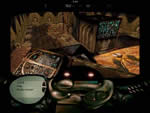
The format of this game is unusual for an adventure game, especially one released in 1996. It’s DOS (DOS in 1996?!) and it’s in first person real-time rendered 3D. You heard right. You move through these mysterious and creepy environments with the complete freedom that only comes with RTR 3D.
Naturally, this format causes a classic problem for the purist adventurer: the navigation interface. And AT has taken a real beating in this department. And it’s true that if you follow the directions in the manual for using the mouse for movement, it’s a pretty frustrating experience. But if you simply take a deep breath and use those friendly little four arrow keys on your keyboard, moving in AT becomes an instant breeze. Toss in Page Up and Page Down to look up and down, and you’re off and running.
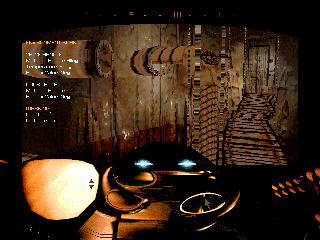
This game is frequently categorized as an action/adventure, and I’m here to tell you that’s just incorrect. AT is an adventure game with some action elements. What are they? Well, yes, there is a little bit of shooting. And I mean a very little bit, most of which can actually be avoided if you prefer. Also, since you are walking through the environment in full 3D, there are times when you have to walk carefully, so as to not fall into the water, or down a steep cliff, or into a pit filled with murderous homicidal mutated scorpions. There’s no jumping, no climbing, no weapon management, etc., all the trademarks of a real action/adventure.
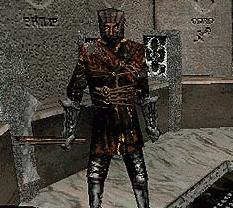
So. What’s this place you’re exploring, and what do you have to do there? It seems that a group of Knights Templar have walled themselves up in this tomb to guard the Grail for all eternity. Nourished by Grailstone, the same substance that the Grail is made of, they have become immortal. Unfortunately, with so much time on their hands (poor guys have been stuck down here nearly a thousand years), there’s been a lot of, let’s say, mental attrition. Madness, conspiracy, jealousy, megalomania, and paranoia have run rampant through this sad group of men, rendering them a complicated and dangerous group to deal with.
And the Knights are just one group you have to deal with. There are also some ghosts, fellow Raptors (and believe me, there’s not much professional courtesy in this profession) and, worst of all, a whole bestiary of mutated and very unfriendly creatures who are not happy you’ve come to the party.
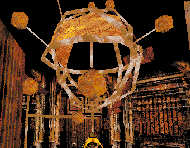
As I began to explore Aeternis, I was quickly mesmerized, thrilled, intrigued, and saddened by the incredible atmosphere in this creepy place. I explored mines, chapels, cathedrals, laboratories, libraries, and living quarters, all accompanied by a beautiful and evocative soundtrack that had a strong liturgical flavor (not to mention an extremely detailed and informative sound design). The characters I met were as fascinating as they were dangerous, and they were presented with some of the very best voice acting I’ve ever come across in a game. I frequently would play a scene several times, just to hear everything one of these characters would have to say. Why, oh why won’t more game developers understand this issue? Having convincing acting does wonders toward drawing you into the story.
Helping you at all times in this quest is your trusty M2 computerized helmet, which is constantly analyzing and reporting on your environment. This provides you with a steady stream of vital information to help you in your journey through Aeternis. This feature was a tad reminiscent of the intelligent Time Jump Suits in the second and third Journeyman Project games, but it provides even more information.
The most standard thing about AT is that the environment gradually opens up as you solve more puzzles. I had no problem with this, as the environment was so fascinating. Along the way I encountered some of the most beautifully organic and logical puzzles I’ve ever seen in a game. Truly, the puzzles in this game are in the Riven class.
My only major complaint? Only five save slots! Not acceptable in a game in which you can die and in which there are so many variables you’d like to try out.
The storyline is rich, fascinating, and sad. The game is quite generous in that there are multiple ways to accomplish different tasks, and each of these paths has its own rewards and hazards. The game has several endings and even several “optional” mini-quests.
How fun was this game? Let me just say this–halfway through I started the game over from scratch and replayed everything I’d done so far. I just wanted to experience it again.
I’m known for being susceptible to hyperbole in my reviews, but my friends, you’ve got to trust me on this one. Azrael’s Tear is representative of the reasons we fell in love with adventure games in the first place.
Final Grade: A
If you liked Azrael’s Tear,
Watch: Any production of Wagner’s Parsifal
Read: The Sign and the Seal by Graham Hancock
Play: GK3
System Requirements: 486/66
8 MB RAM
2X CD-ROM
SVGA with 1 MB
Mouse
Sound board
DOS