Azraels Tear Review
|
Review Azrael’s Tear Intelligent Games Review by Michal Necasek |
Walkthrough |
Learn more about this game at: |
Azrael’s Tear is perhaps one of the coolest sounding names ever used for an adventure game. For Azrael is the angel of death – or, “The angel who separates the soul from the body at death,” to quote the manual. Also prominent on the game box is the inscription “Search for the Holy Grail”, and in this case it’s not just any old holy grail but The Holy Grail. The Knights Templar are naturally involved too – they and the Holy Grail seem to go together, at least in adventure games.
You play the role of a so-called raptor, a future day “archeologist”, or rather professional scavenger, plunderer and tomb robber (we shall avoid the term “tomb raider”– no girls with well-developed chests here). The game box contains two important documents (no, not the warranty information and registration card) that help set up and explain the story. There is a letter from a rival raptor, Colin Scott, who claims to have tracked down the Grail through careful study of Templar documents and asks for your cooperation in retrieving it. Apparently a detachment of twelve Templars had transported the Grail from Jerusalem to Europe in 1146 and finally ended up in Scotland. One of the twelve Templars was Sir Guy of Bramley. Now Colin has found Sir Guy’s tombstone – dated 1763, over 600 years after the Templar ship set sail from the Holy Land. But fortunately Sir Guy was nice enough to keep a capsule with his testament on his body when he was buried.
The testament is the second document. Sir Guy talks about the Grail and the Templars who are guarding it in the underground Temple of Aeternis. The grailstone has remarkable properties – it “heals all wounds and denies the reaper his harvest”. Sir Guy also makes veiled remarks about an evil that has escaped from Aeternis into the world and begs forgiveness for not destroying it.
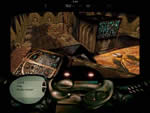
Your next stop is, of course, Aeternis. This is where the actual game starts. You descend into the temple but the last couple of feet you cover in free fall. This means you can’t get back the way you came and will have to find another exit — that is, if you live that long.
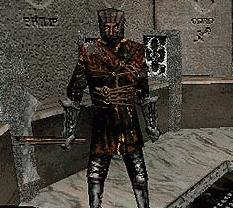
The Temple of Aeternis is far from uninhabited. There are several surviving Templars and some of them are none too friendly. There are competing raptors, mostly hostile. And there are wild beasts, either small dinosaurs or really big lizards, and their only goal seems to be to eat you (poor things, they must be so hungry…). Oh, and did I mention traps? — sharp spikes, nasty sharp pendulums, poisonous gasses, scalding water — that kind of thing.
From the above it should be clear that “save early, save often” is rule number one in Azrael’s Tear. You never know when you will fall somewhere, something will fall on you or someone will kill you. For your defense, you have a rifle but unfortunately it is not powerful enough to kill all enemies. However, you almost don’t have to use the rifle at all, because in many cases you can turn the traps of which the temple is full against your foes. Coupled with the fact that Azrael’s Tear is a 3D game, this might make you think that it’s some kind of action or action-adventure game. But it is not so – the number of enemies you can shoot is negligible and you don’t really have to shoot any. Many enemies can simply be avoided, although you can kill quite a few – if you figure out how to do it.
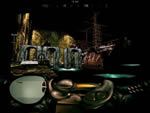
But not everyone wants to kill you, or at least not right away. You can talk to people (and several ghosts too!) to mine some information. There’s a spin to it though, because there are two factions among the Templars and their members will give you conflicting messages. You have to decide whom to trust. Moreover, the grailstone seems to slowly drive most people insane so you might be best served by not trusting anyone at all.
You do appear to have one mysterious friend in Aeternis though. His name (or rather codename) is Cobweb; he seems to be one of the Templars but he is really a secret agent working for the Priory of Sion (or Prieure de Sion if you prefer the French spelling), once a sister order to the Templars that is now intent on obtaining the Grail for itself. Cobweb has left a number of documents for you scattered around Aeternis. These are mostly entries from the journal of Tobias de Treece, leader of the Templars. From certain of these documents you might even deduce Cobweb’s identity – and if you look hard enough, you will find original orders from the Priory that make it quite clear who Cobweb is.
The journal entries and the Templars who talk to you explain Tobias’ vision of the Holy Thief, an outsider (could it be you?) destined to reach the Grail and bring it to the outside world. Only instead of helping this Holy Thief, Tobias has set up something called the Test to weed out impostors. Most puzzles and traps in Aeternis are part of the Test, but that does not make them any less deadly.
The good thing is that most traps can be avoided and many puzzles have two or even more solutions. Aeternis is a maze and navigating it is not easy at first. But once you find your way you can travel between most locations fairly quickly and avoid many dangers. There are even many places that you don’t have to visit at all (but of course then you might miss parts of the story). As a consequence, Azrael’s Tear is fairly nonlinear and for the most part this makes the gameplay easier. The only drawback is that sometimes your actions will have unforeseen consequences that you will only discover much later. But I don’t think you can ever get into a situation when the game couldn’t be won – the solution can just be harder to find.
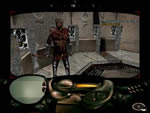
As I mentioned above, Azrael’s Tear is a 3D game. It is from the short period when PCs were already powerful enough to run a fully 3D texture mapped game and hardware accelerators weren’t yet common. That is to say, Azrael’s Tear uses software-only rendering (running at a 640×480 resolution) and will not take advantage of any 3D accelerator hardware. This means that it doesn’t look nearly as nice as more modern games because it does not use the techniques that greatly improve image quality (primarily bilinear/trilinear filtering), but are only implemented in hardware. As a result Azrael’s Tear looks a little pixely – but if you’re only interested in visuals, you can’t afford to play any game older than two months anyway and wouldn’t be reading this review in the first place.
There is a fairly substantial amount of dialogue in the game, all of it with voiceovers. Most of it is not absolutely essential but gives you clues and background information. Sound quality isn’t absolutely spotless but it is very good. There is MIDI music in the game, not too remarkable but still positively contributing to the “feel” of the game. There is digitized music in the opening and closing sequences and that is very good.
The puzzles in Azrael’s Tear aren’t particularly difficult. To successfully solve them you need to depend on your powers of observation more than brilliance. That is to say, looking around carefully and finding things is more important than lateral thinking. There are often multiple clues to the puzzles’ solutions scattered around, so it pays to pay attention – both to what people (or ghosts for that matter) say and what they wrote, in addition to various diagrams, maps, drawings, paintings, pictures and the like scattered around Aeternis.
The story of Azrael’s Tear revolves around props far from unusual in adventure games: the Holy Grail, the Knights Templar, secret conspiracies to rule the world. These all are almost clichés. But like other good games (Gabriel Knight 3 comes to mind), Azrael’s Tear manages to explain them with unexpected twists. There’s even a connection between the Grail and Azrael’s Tear in case you were wondering – but I’m not letting you in on that secret. After all, this game is all about conspiracies and secrets. My final rating of this game is no secret however – I give Azrael’s Tear an A-.
Final Grade: A-
System Requirements:
486DX2 66MHz (Pentium recommended), 8 MB of RAM (optimized for 16MB), 7 MB free XMS memory (may require creating a boot disk or modifying system configuration files), 10 MB free uncompressed hard disk space, 1 MB VESA compliant SVGA video card, MS-DOS 5.0 or above, Microsoft and 100% compatible mouse, driver version 7.26 or higher, 2x CD ROM drive (4x recommended), Sound Blaster or 100% compatible sound card.