Gothic — Part 2
|
Review Gothic Developer: Piranha Bytes |
|

Gothic is half of a brilliant game. This single-player RPG from Germany makes a brave attempt to create a world in which your actions and interactions with other characters have true, story-affecting consequences.
 The setting of the game is a fairly traditional medieval-fantasy world with an interesting twist. The local king (evidently not at all a nice guy) is so focused on his war with the pesky local orcs that he’ll stop at nothing to create weapons and armor for the effort. To this end he has a group of sorcerers create a huge magic barrier around the richest area of ore mines. Into this perimeter he begins exiling criminals, political prisoners and all manner of undesirables. Once through the barrier, there is no way out. And unless the prisoners produce ore in sufficient quantities, no food or materials are supplied from the outside world.
It’s into this grim and rough world that your character is abruptly thrust. Nameless, utterly anonymous, and seemingly without background of any kind (what was your crime, anyway?), you have to find a way to survive in this prison colony.
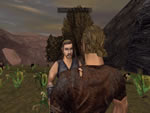
As soon as you come through the barrier, you get accosted by a reasonably friendly man named Diego. He tells you the bare minimum of what’s going on, and then high-tails it back to camp.
That’s pretty much it. Except for a letter you’re supposed to deliver, you really have no idea of what you are supposed to do next. Yeah, just like it might really be like in real life to be in this situation. You stumble your way toward camp, trying your best to avoid some rather nasty ostrich-looking birds, and find your way to the first camp.
I say first, because it turns out the colony has split into three distinct (and mutually hostile) camps. The first one you visit (The Old Camp) is where most of the miners live, and it’s run by a very well-organized self-appointed militia. Then there’s the New Camp, which is much rougher and tougher and less organized. Finally, there’s the Swamp Camp, which is populated by a bunch of drug-crazed religious zealots.
As you begin gingerly making your way around this hostile new world, you gather information, talk to everyone you can, and think about which of the three camps you’d like to join. Things are never easy even after you’ve made up your mind. First of all, even finding the other two camps is a tricky (and dangerous) business. Also, this being an RPG and all, you of course have to prove yourself worthy of getting any group to let you join.
 Gothic is at its best during this early part of the game. I can’t remember a role-playing game that gave me a more vivid feeling of actually having to make my own way in a populated, complicated world. In this world, your choices have consequences, and sucking up to one boss can make you dog meat to another.
There are no official character categories in the game. You develop your character by accumulating experience points and finding teachers to instruct you in various skills. By picking and choosing you can create a thief, a warrior, a sniper, or various categories of mage.
My colleague Cindy KM and I agreed to join different camps and compare our experiences. Never having had any drug experiences in my actual life, I decided to join the weed-smoking lunatics in the swamp camp.
At first I was a little stunned at the frankness with which the drug use is presented in the story. The Swamp Camp worship a mysterious god called The Sleeper, and smoke “swamp weed” in order to “commune” with this deity. Even more outrageous is the fact that the camp’s very economy is based on selling the weed to the other camps! I had various quests that dealt with the harvesting and delivery of the weed. And believe it or not, I even got experience points for helping develop the market in another camp (passing out free samples)!
At first I was a bit concerned. This was immoral, after all, sniff sniff!! Then I reminded myself, “Uh, it’s also immoral to, like, KILL people, and you do that in games all the time.” Comforted by the knowledge that I was actually able to tell the difference between a game and real life, I cheerfully continued my virtual drug pushing.
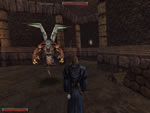
The story of Gothic is rich, long and complicated. As you become more skilled and powerful, you’re able to take on an increasingly deadly variety of wolves, killer ostriches (okay, they’re called “scavengers” in the game, but trust me, they’re killer ostriches), skeletons, giant bugs, trolls, orcs, and many more baddies.
Another strength Gothic has going for it is the reality of the world it creates. The camps are all alive with people, conversation, and action. The wilderness in between feels very three-dimensional and real. This is greatly aided by the fact that, except for about five dungeon areas, the entire game world loads at the same time. So you can sprint from one side of the map to the other without any pauses for loading.
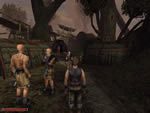 The game is presented in over-the-shoulder third person, and the graphics are quite good (but not great). Luckily, video performance of the game is quite customizable, which is a good thing. About halfway through the game, I swapped having extra-detailed close-up graphics for extremely long-ranged vision. In a game that has you spending so much time outdoors, it’s very important to be able to see what’s in the distance.
I do have a problem with the fact that I had to turn any settings down. I have a 1.7Ghz machine with a serious graphics card and more RAM than you can shake a dongle at. I should be able to play any current game with every setting up to eleven. The way I figure it, if Max Payne can be played on full throttle on my computer, so should Gothic.
The second half of the game, while still entertaining, is not nearly as rewarding as the first half. You can almost feel your character getting funneled into a particular path, and after a while you begin to wonder why you went to all the trouble to pick a camp and a particular set of skills if you’re going to end up in the very same Tomb-Raider jumping hackfest at the game’s finale.
 Gothic has a much more serious problem, however, and only my affection for the game had kept me from burying it this deep in the review. I’m talking about the game’s interface. It’s just the worst I think I’ve ever seen. Early in the game it got so frustrating I almost gave up, and I imagine many other gamers won’t make it over that hump. How many times do I have to say it, INTERFACE IS NOT THE PLACE TO BE CREATIVE. You’re not going to believe the cumbersome nightmare that is the Gothic user interface. To perform the simplest of tasks, such as picking something up, or shooting, you have to use some arcane key combination, like Alt-Arrow Up. Inventory management is a frustrating mess. The capper is the fact that the game menus have a screen that allows you to customize the keystroke commands – but only the default keystrokes work! A very cruel joke to play on innocent players.
However, I’ve played a lot of games, and I’ve struggled with a lot of bad interface systems, so even this glaring fault didn’t ruin the game for me. Gothic is an innovative effort from a team that will get my serious attention in the future.
Grade: B
System Requirements:
Pentium II 400 MHz
128 MB RAM
3D Video card with 16 MB RAM
DirectX compatible sound card
DirectX 7 or higher
See: No Escape
Play: Outcast
Read: Escape from Colditz