Companions of Xanth Review
|
Review Companions of Xanth Developer: Legend Entertainment Company |
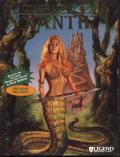 |
The Xanth books by Piers Anthony have long been popular with readers of fantasy and science fiction, so it comes as no surprise that someone finally got around to making a computer game based on one of them.
In this instance, Companions of Xanth, from Legend Entertainment, is adapted from the book “Demons Don’t Dream”, which is included in the game package. Since the game follows the book somewhat closely, and a couple of puzzles have essentially the same solution in each, it’s best to play the game first and read the book afterwards.
Two mundane (i.e., non-magical) teenagers from Earth, Dug (male) and Kim (female) are drawn into Xanth to compete in a game for a mysterious Prize. Neither knows what the Prize is, except that it’s supposed to be something very good.
Under the surface, however, matters are much more serious than they appear. Two demons, E(A/R)th and X(A/N)th, have set the game up as part of a wager. The stake is the existence of magic in Xanth itself. If E(A/R)th’s player – Kim – wins the prize, then all magic in Xanth will disappear forever. If X(A/N)th’s player – Dug – wins, then everything will continue as before. Since the goal is to maintain the status quo, you manipulate Dug through the game (by the way, that is how his named is spelled in the book; there is no “o”).
Because Dug has no familiarity with this world, he receives the Compendium of Xanth and also must choose a Companion to help him before play begins (hence the title of the game). While four are presented to him for selection, in actuality this part is rigged: only Nada Naga can be chosen. Picking any of the other three leads to early disqualification.
This was annoying, and not really fair. As the game is designed for Nada to be the Companion, better to have presented her as such right away, instead of pretending to allow the player choices which lead only to restoring the game, possibly several times.
Once Nada gets Dug and herself out of the starting room, the real play begins. From that point on, Dug must solve the rest of the problems himself, although there are occasions when he can ask Nada for assistance.
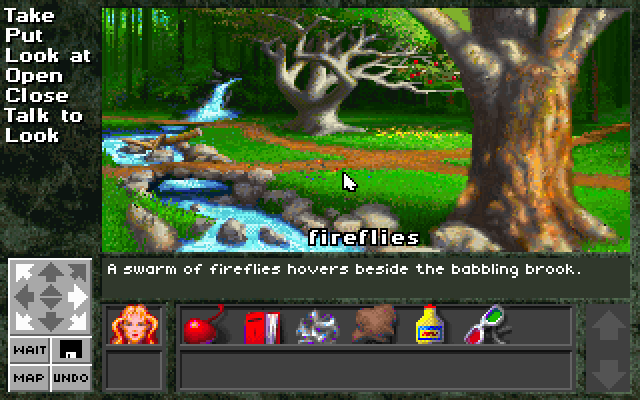
The pair explore the wild and wondrous realm of Xanth, meeting many strange beings, passing through the regions of Void, Earth, Air, Fire, and Water, and running across an unending succession of bad puns (most, of course, taken from the book, which has even more; sometimes, there can be too much of a good thing).
Around three-quarters of the way through, Dug catches up briefly with Kim, and they switch Companions; Nada goes off with Kim, and Dug ends up with Jenny and Sammy Cat. This doesn’t make quite as much sense in the game as it does in the book, so do be sure to read it afterwards to learn what this business is all about.
The game ending is very different from the book, however, and it is not clear why Legend made such a change. It is especially odd as the game’s resolution doesn’t really settle the demon wager at all, making the whole thing ultimately unsatisfying; it’s a loose end that shouldn’t have happened.
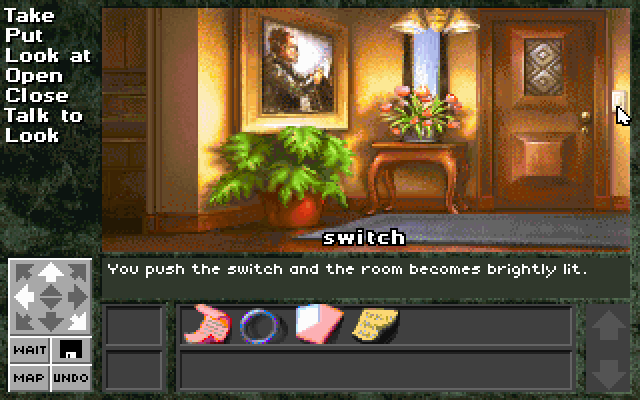
Companions marks a radical departure for Legend from their previous offerings; it is their first true all-graphic product. Players familiar with such games as the Spellcasting Series, Eric the Unready, and Homeworld, may be surprised by the absence of a type-in interface. Except for a few hot keys, there is no keyboard input; all actions are controlled with the mouse.
As the cursor travels over the graphics screen, it lights up objects of interest by displaying the name of the item. So, for instance, when the cursor is on Dug’s computer, the word “computer” appears on the screen. To form a sentence, the mouse is clicked on the highlighted object, then moved over to the list of verbs on the left-hand side, where it is clicked on a verb to complete the sentence. Thus the command “look at the computer” is accomplished by first clicking on the computer, and then on “look at” from the list of verbs.
This system works in reverse, too: you can click on a command first, and an item second. So taking “look at” first, followed by clicking on the computer, gives the same result: “look at the computer”.
The verbs listed are few indeed: Put, Take, Look, Look At, Open, Close, Talk, and Wait. Occasionally, an additional verb or two will appear on the list when using a particular object. For example, if a rock is the highlighted item, the verb “Throw” is temporarily added to the commands.
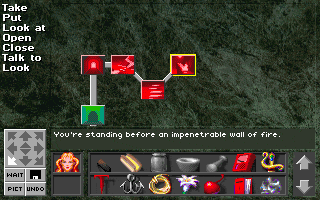
Room descriptions and results of actions are displayed in a small window under the main graphic screen. Below that is the inventory window, where all of Dug’s current possessions are depicted. These items can be acted upon in the same way as anything on the main screen, by highlighting them and choosing a verb, or vice-versa.
While the verb-object interface is simple, it is not used consistently in the game, which can cause some frustrations. Take the matter of Ma Anathe (an anagram of “anathema”). You have to bring her a certain item. Up to that point, when you had an object people wanted, they would recognize it was in the inventory when you talked to them.
Not Ma, though. However much you talk to her, she just tells you to not bother her unless you have the item. Also, the verb “give” doesn’t appear when the item is highlighted, and the regular “Put” doesn’t do much if you try to “put” the item on her. The answer to this dilemma is to first highlight the item, then move the cursor onto Ma, at which point “give (item) to Ma Anathe” appears on the screen.
This sort of thing happens more than once in the game, and to make matters worse, no mention is made in the manual of this special construction. The instructions merely describe the “verb-object” and “object-verb” combinations; nowhere does it tell you that you can make commands in other ways, as noted above.
The puzzle quality in Companions is uneven at best, and in some cases, downright poor. Take the sequence with the evil Com-pewter, for example. It is described in the Compendium as being extremely powerful, and able to change reality in its vicinity. This made it sound as if taking on Com-pewter would be a difficult task.
As it turned out, this entire sequence was a joke (and not a funny one, either). All you do is play a game of anagrams with Com-pewter, who describes something from the world of Xanth, and provides an anagram of the item, lacking one letter. You choose the missing letter from a small pool of letter tiles.
This isn’t a challenge, or even a puzzle; it’s just pointless activity. You merely open your Compendium of Xanth and read through until you find the answer, which naturally tells you what the missing letter is, and that’s the one you choose. The second round is slightly tricky, as Com-Pewter cheats by not providing one of the letters, but Dug has an inventory item to use as a substitute.
After going through this no-brainer, Dug is forced by Com-Pewter to resign (even though he won), but Grundy Golem (a sort of emcee for the Xanth game) puts him back in, and gives Dug the item needed to actually destroy the machine. This is supposed to be a puzzle?
Not much better (if at all) is the rescue of Nada Naga after she’s been spirited away by the demoness Metria. When Dug finds Nada, she’s chained to a wall. Nearby is a type of moss that can eat through anything, including metal. Naturally, you think that the moss is part of the solution to freeing Nada.
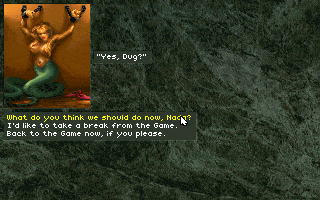
Wrong! The moss is used for something else. You simply talk to the manacles, and they let her go. How are you supposed to know this? How did I know this? Simple. There wasn’t anything else left to try; I had gone through all other possible actions with no result, and that was the last thing available to do.
A voice does whisper at you occasionally “from the vicinity of Nada’s arm”, but that’s where the moss is, so you don’t really have a way of associating the voice with the manacles, and why should anyone think that manacles can talk? None of it makes any sense.
Probably the best sequence is at the start, where Dug must help the village of Isthmus rid itself of the dreaded censorship. While most of the puzzles in this segment aren’t especially difficult, at least the solutions can be reasoned out instead of stumbled over by trial and error.
Companions follows the book fairly closely in what it covers, yet for all that is a quick-playing game. Partly this is because of the mostly simple (sometimes nonexistent) puzzles, and partly because many areas don’t have that many things to do in the first place. The Com-Pewter section is an example of this, as is the Void, a one-location puzzle. It just seemed to me that there should have been more substance to many of the segments.
Overall then, Companions of Xanth is a disappointment. Its poor puzzle structure makes it the weakest Legend game to date, and unlikely to please gamers looking for an adventure on the level of a Spellcasting or Eric The Unready. The relatively short playing time is also likely to leave many with an unsatisfied feeling. Only fans of the Xanth series, or those looking for a lightweight adventure, will find this one worth their time.
Just Adventure Assigned Grade: C
System Requirements:
CD-ROM
Hard disk
640k RAM
Microsoft compatible mouse
DOS 5.0 or higher
VGA graphics card
Real Sound, Ad Lib, Sound Blaster and compatibles, Roland MT-32 with MPU-401 compatible interface