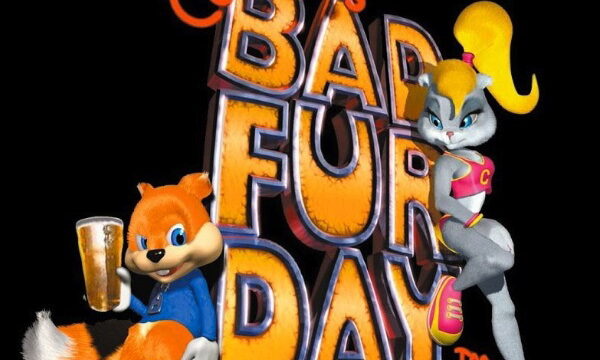
Review: Conker’s Bad Fur Day
|
Conker’s Bad Fur Day Developer: Rare By Erik Reckase |
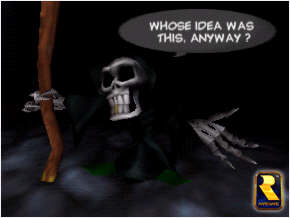
As the GameCube approaches, the red light is fading rapidly on the front of the Nintendo 64, with less than ten new games scheduled for release. In early March, however, that light momentarily stopped fading and flashed brilliantly, signaling the release of a game that stretched the limits of the N64 an order of magnitude further than ever before. Conker’s Bad Fur Day, by Rare, does not just bend the constraints imposed by the cartridge format–it shatters them, flinging the pieces at the game developers for the newer console systems as a challenge. Yes, it’s rude, and gross, and profane, and a whole slew of usually-reserved-for-bad-game adjectives, but that’s okay–I’m an adult. I can take it. Rare has given adults something to play on the N64 after their kids go to bed and achieved gaming greatness.
Can you tell I liked it?
What’s Going on Here?
At the outset of the game, Conker wakes up after having–let’s face it–an incredible amount of booze the night before, with a hangover that could kill lesser rodents. All he wants to do is get home. You heard me–the entire goal is getting home. Simple plot–but the way home is far more difficult than a simple meander. It’s going to take some aspirin, and a bunch of cash, to make it back to bed–and then there’s his girlfriend to deal with. Sure, it’s no War and Peace, but it serves the purpose. It also allows Conker’s BFD to meander freely through different cinematic genres, from A Clockwork Orange to Jaws, The Godfather to Bram Stoker’s Dracula, and so on.
How Did it Sound?
One of the fundamental differences between the Nintendo 64 and other modern game consoles is the media format; while other systems use CD-based games (capable of storing about 650 MB of game data), the N64 uses cartridges, which can only store about 10% of that. Since high quality sound takes up a significant amount of space (even with MP3 compression), sound is usually tolerable–at best–with N64 games. Not so with Conker’s BFD. The background music in this game is the best I’ve ever heard on any platform. The sound is crystal-clear, so much so that an audiophile might even enjoy it. Most of the electronically converted “instruments” in the songs are hard to distinguish from CD-quality samples.
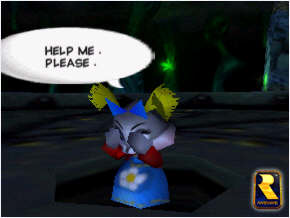
Sound quality is only half of the story, though–if the music you are listening to stinks, it doesn’t help to get a better quality recording. Conker’s BFD has nothing to worry about here, either–the music seems to have not been written, like other games, but actually composed. Many of the songs could stand on their own as monuments to quality. During one sequence, Conker visits a dance club, and the techno-trance theme playing in the background is better than many songs played in real clubs. The “Poo Land” musical score is pure genius–see if you don’t smile while listening to it. At another point in the game, a dramatic orchestral piece accompanies Conker as he enters a room with a huge snake-like statue dominating the scene … at which point Conker comments on the music and asks for something a bit less oppressive. The music then changes to a perfect jungle-ish theme with natives chanting, which truly is more appropriate for the atmosphere. I don’t think I’ve played a PC game with better audio accompaniment.
Amazingly, Rare was able to voice-over all of the speech in the game as well. The characters have very appropriate voices, and the quality can be easily compared to the excellent acting in Fear Effect. Some of the characters have unintelligible-sounding voices, but these are translated in the text balloons for those of us not speaking the native tongue, adding to the humor of the game. Rare went as far as having certain characters participate in the music, humming along with the current world’s theme song. Wear headphones while playing the game, as it’s worth it to hear all it has to offer. Add to this mix the perfect sound effects, and you have a general idea as to BFD’s audio performance. The bar has definitely been raised in this area.
How Did it Look?
We’ve all played action hybrid games on machines that simply did not have enough horsepower to provide a good experience. There have also been times when the machine is only slightly substandard, and the game runs quite well, even though all of the nifty special effects have not been turned on. Even so, in all of the games that I’ve played, I’ve never had the dollars to have a truly screamin’ computer, where the framerate of the game is simply no longer an issue. In fact, I’ve only heard about these machines–I’d never actually seen one in person. Well, when I saw the graphical excellence in BFD, it crossed the line into the category of “truly screamin'” and didn’t look back.
The 3D environments that Conker explores are vibrant, rich with texture and color (much like other games in the Rare catalog). It’s often very difficult to determine where the texture tiles begin and end. These worlds are also very large–so large, in fact, that this game succeeded in giving me some serious vertigo in more that one case. Except for a sequence late in the game where Conker walks on roof beams, I don’t recall a single time that I saw any sort of aliasing or pixelization of the environmental graphics. On occasion, the camera angle did cause me some difficulty, but I think that this was intentional, adding to the difficulty of the sequence by restricting the viewing angles (I don’t approve of this sort of “make it harder” approach, by the way). As with most N64 games, the cutscenes are all generated using the game’s graphics engine, which does a perfect job. In fact, the game is one seamless graphics package, from one mini-game to the next, through all of the different environments.
The animation of the characters is what makes this game go over the top. Watch Conker closely as he runs, jumps, crouches, and gets tired of waiting for you to move him around. The motion is so smooth it’s hard to believe what you are seeing. Some of the animation, like the midair spin during a normal jump, is almost a declaration of superiority by Rare–and they’re probably right. Even the shadows cast by the characters change depending on the light source. Although the other characters in the game have somewhat limited actions, they are all executed with the same amazing style. There are some occasions when the framerate does slow, in the event of a large number of characters or a large, detailed background scene, but it’s so uncommon that it’s not memorable.
Was it Fun?
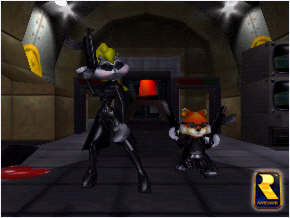
Given my opinions up to this point, you might assume that I enjoyed the game completely, with no reservations. I do have some criticisms of Conker’s BFD, believe it or not, although they pale in comparison to the real fun that can be had while playing. Gameplay is essentially a series of puzzles and minigames that bring Conker closer to his goal. Many of the minigames are divulged in the manual, but there’s still significant uncharted territory to explore. Don’t worry–I won’t give anything away. The best part of Conker is not knowing what’s going to come next–and in this game, absolutely anything is possible.
The game’s controls are a hybrid of the controls used in other Rare games, like the Banjo series and Jet Force Gemini. Control is extremely responsive–almost too responsive. As I mentioned before, there were some camera angle issues that caused a fairly difficult sequence at the top of a tower to be infinitely more difficult–and adding on to that the hyper-responsive controls makes it almost impossible (at least for this adult’s big thumbs). The C-buttons on the controller are used for camera repositioning, the Z-trigger for crouching and a few other functions, etc. The nifty part of the control scheme comes with the “context sensitive” B-button. Depending on the circumstances, the B-button can, among other things, use a frying pan as a weapon, shoot a crossbow bolt, use a flamethrower, drink beer from a giant keg, or even bite a giant on the butt with a dinosaur. Any time the B-button can be used in a different context, a light bulb appears above Conker’s head. The ability to freely change the controls depending on the surroundings is extremely well executed–in fact, the control system is so intuitive that I hardly needed to refer to the manual once I started playing.
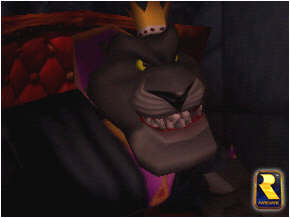
As I mentioned at the beginning of this review, Conker’s BFD is a highly disturbed game. Characters regularly curse, although the most dangerous of the dirty words are replaced with the appropriate #%%@!* marks. You will encounter creatures ranging from Irish-sounding dung beetles to sexually frustrated bees, from cat- and dog-fish (of course, with cat and dog heads) to talking brooms, and so on. You even have an encounter with the Great and Mighty Poo (I heard about this sequence months before the game’s release, and I agree with other reviewers in declaring this guy to be the most unusual boss ever put into a game). The game is also filled with gore, although it is far from realistic. There’s probably something to offend everyone’s mother, and fathers will agree with the mothers while secretly laughing to themselves. There are sequences in this game that I can play over and over again, just to laugh at the amazing gameplay and ingenuity that Rare squeezed into the tiny game cartridge.
As far as negative comments, I don’t have many. I don’t like games that are artificially difficult, like jumping between ropes in Tomb Raider 4–and there are some truly difficult jumping exercises that have to be done in Conker’s BFD. The camera angle changes at just the wrong time, causing a missed jump or worse–a three-story fall to your death. The game seemed inconsistently difficult, as I would play happily for three hours, making continuous progress, and then get stuck for two hours trying to get past a particularly tough area, playing it over and over again until I was successful. The save system deserves some note–the game automatically saves every time you change areas, so you never lose much progress when you die. You have about three lives (you are told early in the game that “red squirrels have as many lives as they think that they can get away with”), and after each death, you are returned to a subpoint within the active level. After all your lives are gone, you must restart at the beginning of the area, which isn’t too painful (most of the time). Again, this sometimes makes the game artificially difficult, requiring the player to repeat the same segments to get to the difficult section, but overall, the save system works very well.
Conker’s Bad Fur Day is probably one of the best games ever, on any console or computer. I have little doubt that this will probably be the N64’s victory lap before retirement, but what a way to go! I hope that other developers take notice of the efficiency and style that make this game great, so that … oh, who am I kidding? Conker’s Bad Fur Day is a %$!*ing great game, and anyone who doesn’t like it can go %^&# a !@!#.
Final Grade: A