THE CHANCES OF ANYTHING COMING FROM MARS…
|
Review Half-Life 2
Review by Ben Bowen |
 |
THE CHANCES OF ANYTHING COMING FROM MARS…
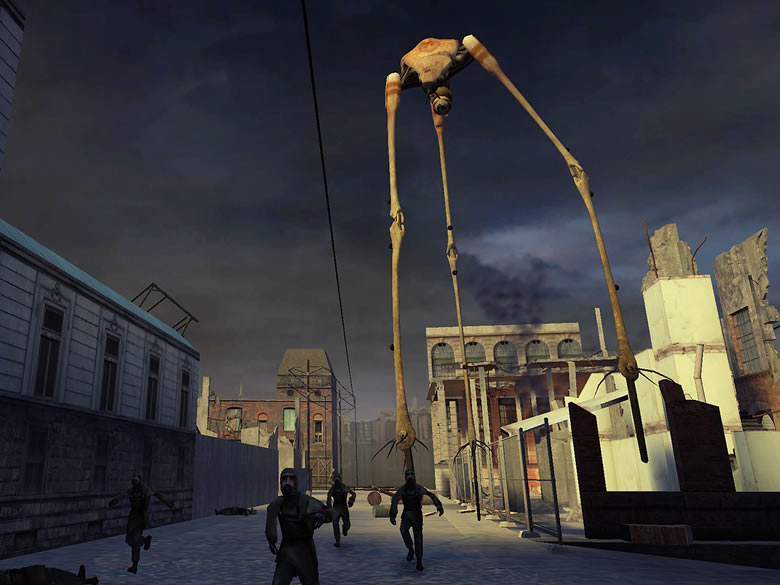
Myst IV astounded with its amazing intro. Half Life 2 scooped me up with it and made me forget it was just a game. Whereas Myst made the mistake of tutoring you directly through Atrus tuning a machine, Half Life 2 lets you learn on the fly as you meet a character named Barney who helps you escape. It even extends the intro to help settle you into the world. Eventually, after circumstances take a turn for the better, you exit from a small door into blinding sunlight and onto the square from the Menu, with the spire in the distance. It’s here where it begins to feel like a futuristic B-Movie, evidently taking it’s cues from H.G. Welles’ War of The Worlds. An inspiration more evident when you round a corner to witness what appears to be a 30ft tripod (Strider) patrolling a nearby street.
Although not perfect, what Half Life 2 does is couple the abilities of the engine with some graceful and very well implemented visual and audio design, be it through the crackling radios of the Combine, the distant threat of the spire or the disconcerting sight of one of the Combine’s strange, organic flying machines. This combined with the excellent voice acting and the physicality of the actors, even if their modeling isn’t quite right, is the first big step in gaming in a while. It also has a narrative that, although subjecting the title to linearity (in a way similar to the adventure genre), pushes you gently onward and relies on your natural instinctive reactions to get through what are, essentially, completely interactive movies. The entire opening 20 minutes is basically a self-directed cut-scene. Myst IV took the game away from you constantly, and it was an annoyance to have these beautiful rides locked up due to FMV constraints as you moved throughout the gameworld. The other advantage is that the space required for such content in 3D is on a far lesser scale.
The game then progresses through City 17 as Gordon manages to escape and eventually meet a woman named Alyx. Alyx is the first fully-fleshed (as it were, no pun intended) character you meet “in the round”. No locked off shots here. As she talks directly to you, it feels completely natural. You can walk around her, and she’ll still act in your direction. Her personality and voiceover is warm and friendly, and moreover, incredibly human. Later on, when she gets argumentative or has dramatic scenes, the emotion that emanates from this digital avatar is truly convincing. Even during action scenes where she fights alongside you, she looks to you and makes quips. She’s the first game character that really, for me, feels almost like a real person. Everything the Source engine does through her facial acting and her interaction with the scenery, coupled with her voiceover and animation, work together in unison to create a truly original and clever simulation.
She is an important step in games characterization because of the talent and time that’s obviously gone into creating her. Although many of you may never play Half Life 2 – and some of you for good reason – one of the arguments for even attempting this review is this one character. She showcases what can be done in 3D without sacrificing realism and is the first digital avatar (yes, including the aforementioned movies) that even comes close to portraying a realistic human. All of the actors in the game are well done – Barney the security guard and his charming quips being one of them – but Alyx, being the sidekick if you will, is truly the standout. Valve even take the time to allow the player to kick back and get to know her, even if no interaction (unfortunate for some, I’m sure) actually takes place. Strong writing and voice acting do play a part here, but the Source engines powerful facial rigging really pull the character out of the screen during arguments with other characters or playing with her 12ft pet robot, Dog. Which, charmingly enough, acts just like its name.
It does showcase some of the essential flaws that the adventure genre suffers from – namely, stiff lifeless acting. Characters run through cycles and mouth everything with no emotion, they don’t emote their lines, they don’t act and the player is unable to relate to them. We as gamers are expected to truly believe in these characters, but they are almost totally devoid of life. That’s not to say characters like April Ryan or Kate Walker are devoid of the proper essence, but if these characters were presented with even half the life (no pun intended…again) of the characters in Vampire or Half Life 2 it would make a massive improvement. Why? We’re being presented with characters in a visual medium. If I wanted a radio play, I’d listen to the radio. A Kate Walker that could emote, act and react to her situations would further involve the player if only developers paid more heed to the importance of physical gestures.
It’s a shame that other genres that rely less on the need to involve the player are now leading the way in things that should be commonplace in adventures. Not that it’s really anyone’s fault, seeing as the adventure genre has dropped out of publishers favor. However, what Half Life 2 does showcase can be learned from or plundered. Troika, the creators of Vampire The Masquerade: Bloodlines, are quite a small developer, but have made great use of the power of the Source engine to create convincing acting in their characters’, which raises the game from being quite average to something rather special. Not that every adventure should necessarily use the Source engine – especially as Detalion made great headway using Monolith’s Jupiter engine with Sentinel: Descendents in Time – but within it it’s hard not to see the opportunity to do something within the adventure genre that truly shines, using its preprogrammed assets.
| Immersion is everything in the Half-Life universe, and the player never steps out of Gordon Freeman’s boots at any time between the game’s introduction and ending. It’s a continuous walk/drive from start to finish. Even the HUD, displaying the necessary health and weapons statistics on the screen, is discrete and interferes with the first-person view of the player as little as possible. Using familiar visual and sound designs from the previous game, the unique Half-Life gameplay feeling is preserved, now polished to near perfection. The vehicle handling part introduced in this game may need some more work, but overall the gameplay is incredibly balanced and smooth. The only significant technological limitation Valve seems to have left to overcome is the occasional pause when the game loads a new map section. |
TO THE GRAVITY OF LOVE
Another thing that Half-Life 2 does is keep the player playing a continuous, unbroken (save for load times) narrative from just one point of view. The direction required to be able to do this is very, very difficult to get right, but Valve have succeeded. You feel like you’re undertaking a journey from one place to another, moving ever onwards towards your final destination. Although the story itself is rather two-dimensional – being a typical science fiction invasion plot – this game is testament to the adage “it’s now what you tell, but how you tell it”. Valve excels at maintaining the player’s interest through the incidental details, be it the non-player characters various utterances (a couple in the apartments at the beginning are almost heartbreaking in their desperation) or discovering information pertaining to the gameworld through in-game reading material. One wall in a later science lab is plastered with newspapers describing how the Combine arrived, and the ascendance of its human administrator, Dr Breen.
It’s also impressive that tightly scripted sequences – such as the Kleiners Lab teleportation scene – retain the player’s interest while also requiring them to participate. In a way, it’s sort of an “action-Myst”. To further this comparison, however indistinct, it also has a decent amount of puzzles for a shooter, many of the early ones involving getting a boat from A to B. Often you find yourself using your head rather than your gun trying to find the best way to solve situations, sometimes with the answers cleverly sitting right in front of you. Nothing is ever rocket-science, but occasionally it knocks you for six, and the exceptional use of an anti-gravity gun introduced partway through the game constantly requires the player to find new and creative ways to get through each scenario – in one scene, rather sickly, pulling buzz saws out of the wall to fling at zombies instead of wasting much needed ammo.
Ah… the zero-point energy weapon. Action freak or no, it’d take a hard person to admit that it isn’t a great idea. It can be used to solve physical puzzles, lift and throw items at enemies, or during one particularly tense scene, create bridges of junk over sands containing vibration-sensitive 6ft insects. It also provides a great game of ball with the aforementioned Dog in a nicely timed out playable cut-scene where you learn how to use it. 3D’s recent move into the physical with all sorts of objects being able to be manipulated, albeit in a rather basic way in this game, is encouraging. Developers are starting to think of innovative ways to use it rather than just being a basic tool for throwing bodies around. Half-Life 2 also has a weighting system for each object, breezeblocks being heavier than cardboard boxes, and animation and specific sounds set for each material. Although personally I can’t think of any possible applications for this kind of technology within the adventure genre right at this moment in time, it does bring another set of tools to the table when it comes to thinking of new ways to intrigue and involve the player.
For one thing, it makes the gameworld much more interesting in it’s possibility, not just it’s presentation, to the player. Stuck in a room you can’t get out of? Pile up those boxes freely, unlike Broken Sword: Sleeping Dragon’s need to push and pull them into place. Can’t cross that gap? Look for a plank long enough to make a bridge or fashion something out of nearby objects to get there. Can’t swim? Use those boxes to create a group of stepping-stones. Need a shield? Rip that radiator off the wall with the gravity gun and hold it in front of you. All quite simple, but until recently something that games couldn’t do. The possible applications are almost infinite.
| The amazing physics effects in Half-Life 2 are the results of collaboration between Valve and a company called Havok, developers of realistic physics software for virtual environments. Their technology implemented in the game has provided realistic physics without arbitrary restrictions. You can tip down a barrel and roll it down a staircase not because it’s programmed to do just that, but simply because it is round and the staircase goes down! Balance a glass bottle precariously on the edge of a table and it might fall to the floor and break. Jump on a cardboard box and it will flatten… The possibilities for physical interaction with the game world to solve puzzles are virtually limitless! Design-wise, Half-Life 2 texture maps can be associated with materials, featuring well-defined physical properties such as weight, density, friction, breakability and sounds assigned to different actions taken on the material. This makes it very easy to build realistic objects in the Source game engine. Valve clearly believe in their new technology, and have already suggested that an updated version of the Source engine will be driving Half-Life 3! |
BURNING LIKE A MONKEY
There isn’t much left to talk about in this game which I haven’t already, unless it’s about the shooting aspect, which – let’s face it – isn’t something that is truly going to appeal to the core audience of Just Adventure +. Suffice to say it’s solid and requires, thanks to the variety and great AI of the enemy you meet throughout, more than a modicum of strategic thinking to get through with a good selection of interesting weapons on offer.
Hopefully, what have been said is food for thought… if not argument and debate. As mentioned, it’s a shame that advances which would be more applicable to the adventure genre are being applied elsewhere, although that said it’s great that such things such as acting, environment, narrative, maturity and thought are now pushing their way into the mainstream culture. Who knows? It could create a need for more titles that require the element of thought, not necessarily with the need for action to go alongside it. Half-Life 2, although not totally without fault, is a game of exceptional merit. It’s not original, yet basically takes old ideas and mixes them up into something distinct and pushes hitherto underdeveloped elements that exist in gaming to the forefront.
As an adventure, I’m sure you’d agree – it isn’t. It contains elements of the genre, but mixes it in with other genres in the FPS format to create something which flows seamlessly from one scenario to the next, from chases to vehicle elements, from survival horror to puzzling, all within the context of one game. What it does do is push important gameplay basics further than before and create something satisfying out of them. If you can get it running smoothly, possible even on basic systems, and get through the painful Steam process, and can play or have a modicum of interest in action games it’s essential. If you can’t, at least rest in the knowledge that there are elements here that are usable in our genre and that the mainstream now recognizes the need for intelligence in gaming.
| The original Half-Life was not only a success as a game, but also gathered a huge mod community that quickly started producing impressive games built in the Half-Life game engine. The most notable offspring of the original Half-Life is Counter-Strike, the biggest and most popular online action game in the world. Valve quickly embraced this mod community and in addition to making Counter-Strike: Source the official multiplayer feature of Half-Life 2, they have released a set of official game editing tools for the Source engine together with the game itself. Several promising fan projects are already well underway and without a doubt we will see many applications of the Source engine, exceeding even Valve’s wildest imagination, in the years to come. The possibilities for a fantastic 3D adventure game using Source are there for the taking. So what are you waiting for? Start modding! |
Final Grade: A+
(find out more about our grading system)
System Requirements:
| Minimum | Recommended |
|
|