*DRUMROLL*
|
Review Half-Life 2
Review by Ben Bowen |
 |
*DRUMROLL*
This is it… possibly the most unexpected review/article of all time.
Half-Life 2 comes to Just Adventure +.
Well, we reviewed Doom 3, so it was felt within the ranks that Half-Life 2 really had to be done. If not a review, a discussion, if you will…
*cough*
Do you know something? I feel pressured here! It’s not easy following up the most publicly criticized review of all time – but luckily, thanks to one Petter Holmberg (whose comments are shaded in gray), I’m not alone. Here we are, collectively staring into the precipice, wondering exactly why the most hyped up action game of all time is being talked about on the biggest adventure site of all time. Well…. why?
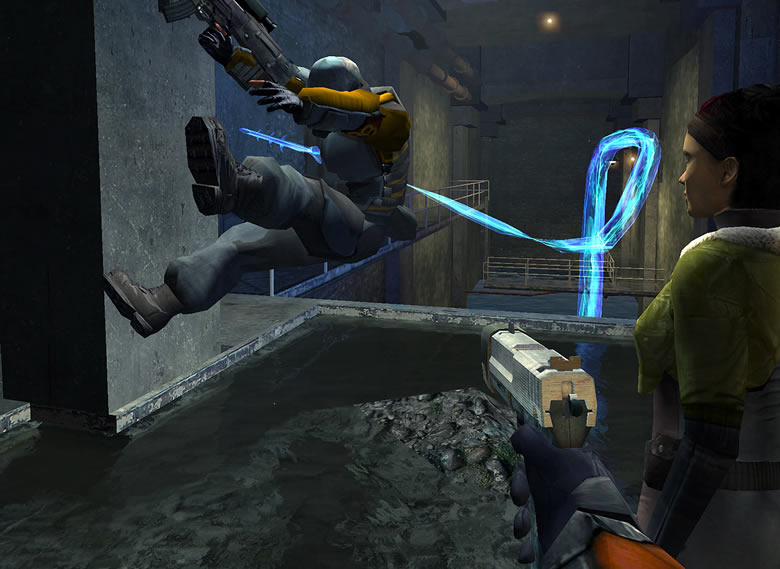
Because we can, because we want to and, frankly, because we need to. Many (not all, of course) adventurers only concern themselves with developments within our own favorite genre and may not know much about this game, either through choice or simply because they don’t follow the mainstream rags. We’re also going to explain why you should be interested about what its developers, Valve, have brought to the table. We’re not going to talk about the action, insofar the story and presentation and how the technology behind it helps to suck you straight into another world, or rather, another time and space.
Throughout this piece, we’re also going to be talking about other recent adventures to see exactly what features the engine that powers Half-Life 2 could bring to them. Although not necessarily worthy of comparison directly, being a completely different genre, we’re going to be talking about them as a counterpoint as to exactly what adventure games could be doing to involve the player further. This doesn’t necessarily mean moving away from 2D, but as far as storytelling and how they do it, Valve have created the “next big leap” for gaming narrative far beyond anything we’ve ever seen so far. Not to say that it’s startlingly original, but the application of the use of narrative and digital avatars are of primary interest and it’s worth looking at the game in-depth to understand what it is we’re on about…
ALL STEAMED UP…
So, onto Half-Life 2. The first thing Valve has concerned themselves with, even before you’ve set foot in City 17 where the game takes place, is modern piracy. If you’re interested in buying the game, you can get it one of two ways – either on a DVD from your local games shop, or by Internet through their own online distribution system, a program called Steam. Either way, if you download it or manually install, it requires registration before you unlock the game in order to play it. Files are then compressed onto your computer for you to play online or off, so an Internet connection is required.
Insofar as stopping pirates and online gamers using illegal copies, so far it’s a system that is only semi-successful. “Warez” copies of HL2 are freely available on the Internet, proving that the system can be broken, but on the other hand Valve has used it to ban illegal Steam multiplayer accounts to great success. There is also the problem that Steam may be down when you register. For me, its just another big barrier in-between the consumer and the product. While I can appreciate a company taking steps to protect itself from piracy, as proved by the pirates themselves it doesn’t work. Where it does work is for the multiplayer element, but for some reason Valve has taken it upon themselves to use it for the single-player side of things too.
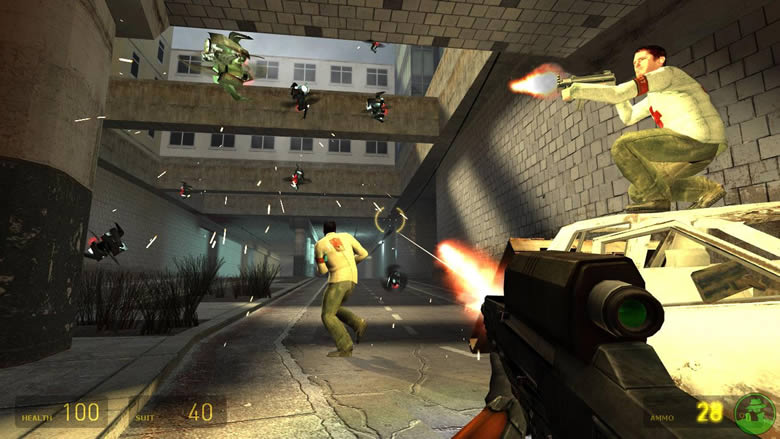
What with recent issues within our community with regards to various copy protection, and the current discussions as to whether it’s needed or not, it’s a bit of a blow to see the big boys playing with even bigger toys. What can be learned here is that copy protection, from this moment on, is only really going to get more obtrusive. Whether that’s justified or not is another matter.
Steam also introduces the concept of automatic updates and patching. Half-Life 2 is not without its problems – a fair few people, including myself, have encountered audio stuttering to some degree in the game, ranging from severe to practically unnoticeable. While one can appreciate the sentiment behind it, the silent patching process often introduces code to your game that doesn’t always improve performance. A recent patch caused my frames-per-second to dip incredibly low, but thankfully the general community manages to find manual workarounds quite quickly. Personally, I’d prefer to have more control of the information being put on my machine, particularly when performance is affected without the ability to rollback.
Unfortunately, to play the game you have to use the Steam program and suffer the consequences should a patch create a problem, at least until a fix is created. It’s a shame, but for multiplayer fans it does provide an easy way to find games and provides access to download other Valve games and free content. I’m really of two minds as to it’s necessity for a single player game, as a recent patch to remove the Securom program – meaning you have to retain the disc to play in the drive – was welcome.
| Steam, Valve’s online distribution system, is at the center of a complicated legal battle between Valve and their retail distributor, VU Games, that has been going on for more than two years. Under a 2001 software publishing agreement between the two parties, VUG allow Valve certain rights for online distribution of their games. However, VU Games were kept in the dark about the development of Steam and Valve’s intentions to provide through Steam a viable online purchase alternative to the retail version of Valve’s games. Every dollar earned through Steam purchases of Half-Life 2 goes directly to Valve, causing a significant loss in the projected earnings of VU Games. Through legal actions, VU Games hopes to seize parts of Valve’s intellectual property, such as the Half-Life brand, and to force Valve to work with them on coming projects. This legal battle covers other issues as well, and is currently a hot topic of discussion in the game industry. The case goes to trial in March 21, 2005. |
ALL ABOARD… THE NIGHT TRAIN!
Now that that’s out of the way, onto the game itself. Valve keeps the presentation slick and clean throughout from the logo up until the extremely clever menu page. Immediately, you’re greeted with a fully 3D view of a square in a city… somewhere unknown, but recognizably European. In the distance beyond a threatening metal gate, a giant black spire rises into the heavens. A crow flies up into the vista, and your eyes are drawn to military guards walking about clad in armor and sporting gas masks shaped like distorted skulls. In the air, small drones fly around photographing everything that moves.
…and that’s just the menu.

It should be noted that my PC is rather midrange, but it was rendering this complex scene in really quite high detail with crisp textures and it looked really quite something. Valve have created a new 3D “engine” named Source which comprises of various programming routines that allow it for all sorts of fancy graphical techniques. This includes the ability to render crisp textures on even medium settings and create multi-layered surfaces (i.e. shiny metal crusted in rust, the reflective surface of the skin) on even a relatively outdated machine, as long as you have a Direct-X 9 compatible graphics card. And it does it superbly. Not everything’s perfect, as load times are quite high, but for what you’re presented with these minor nuances are forgivable.
The other thing the Source engine allows for is the best physical acting I’ve seen from a real-time 3D game. Actually, in terms of nuance, the characters in Half-Life 2 are even better than such recent cinematic endeavors as Final Fantasy and The Polar Express, they’re really that good and the creepy G-Man is one of the first actors you meet. This leering, cold suited figure greets you as you step into the shoes of Gordon Freeman, the eponymous hero the player was introduced to in the previous game. But don’t worry, there’s no actual need to know anything about the original Half-Life other than Gordon appears to now work for this bizarre man. His real-time rendered features are incredible to behold when you think it’s your own PC doing all the work. As he brings you up to speed, scenes from the original and from the game ahead flash in the background.
What’s remarkable is the way he is presented. He feels real. It’s a true step up in game “actors” – true, he’s not quite perfect, but the way his eyes look at you through the monitor and the extraordinarily convincing acting that accompanies it win you over. Unlike a lot of the more static 3D in-game characters, like for example those in The Moment of Silence or Syberia, the G-Man is full of movement. The engine is capable of rendering mouth and lip movements in real time to any soundtrack or language, and the facial rigging is more complex than any other game to date. His skin is created out of multi-layered textures and as he smiles, the corners of his mouth wrinkle… the details make him, importantly, very believable. This is something only recently developed for this engine alone, and it’s something which is also being used in another recently-released Source based game, Vampire The Masquerade: Bloodlines. While comparatively incredibly buggy and less polished to look at, Bloodlines makes great use of this technology to render spoken branching conversation trees with many non-player characters. This is something that would work remarkably in an adventure and really put the player in the game more than just relying on just good voice acting and script and would help make it more believable. A good argument could be that if you had an excellent script and voice-acting (but let’s face it, how often do we see both of those nowadays) you wouldn’t need this. But just the thirty seconds or so spent in the presence of this 3D avatar makes you realize how important graphics can be when creating a character.
As for the mute lead of the title and his use within the game, the way it’s presented does bring to mind Myst IV: Revelations. As Revelations moved on from an otherwise static intro to letting the player explore and get used to the surroundings and comparably, so does Half-Life 2. In fact, the first 20 minutes or so are completely action free and actually supercede Revelations in terms of content. After the G-Man says his good-byes and fades out, a train and two passengers fade in and you take over. Remarkably, the two men stare straight at you through the screen and despite the complexity of the moving train-carriage, with it’s dirty leather chairs and stained windows looking out into the station beyond, have the same great acting as the G-Man – even if the models aren’t as detailed.
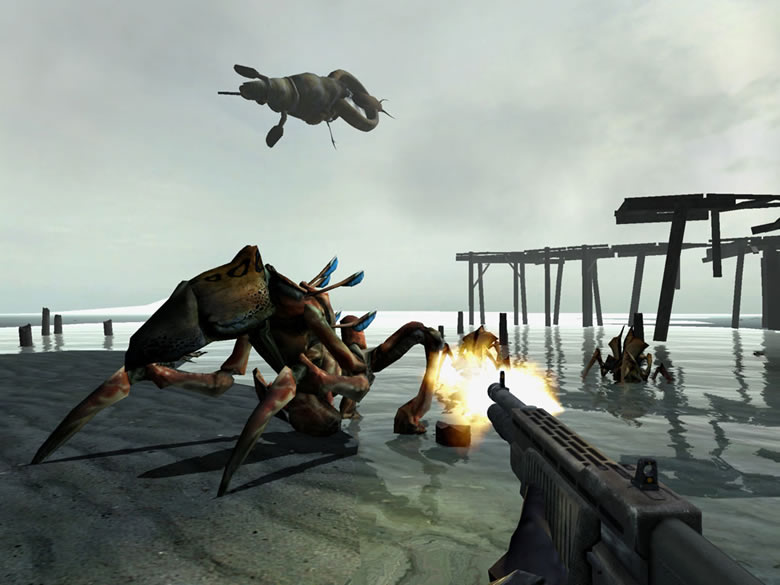
All of this is nothing without great design. Stepping off the carriage, the train station looks grimy and realistic, sunbeams coming through the glass above, posters stuck on the walls and various detritus scattering the pavement. A small flying camera flies towards you and takes a photo, momentarily blinding you with its flash. On high, the main enemy of the title, the administrator Dr Breen, is broadcast via a large hologram and introduces you to City 17. “It’s safer here,” he intones as you round the corner to see a soldier (the alien oppressors are known as The Combine) threaten a man as he tries to take his luggage away. Going to rescue him, you’re pushed back, watched on by a woman clutching at a set of bars calling to see if her lost husband is on the train. It’s a great piece of acting and design – the soldier genuinely seems threatening and when pushed (or amusingly if you throw rubbish at him) chases and attacks you with an electric baton. Moreover, the place where this happens feels real, yet ever so slightly dreamlike.
A game like The Moment of Silence could really benefit from such a realistic and encompassing world. In fact, imagining the TMOS gameworld utilizing the power provided by the Source engine is really quite an exciting prospect. The core gameplay may not benefit, but the detail and illusion of life in Half-Life 2 during these sequences – particularly a little later when a group of apartments are raided by the same soldiers seen throughout the intro – really helps elevate the title above others and transform it into an experience, rather than merely a game.
| A lot of the research put into the Source game engine has focused on the development of realistic, non-generic game characters. Based on detailed photographic references of real people, the Half-Life 2 characters’ faces are incredibly life-like. Through 40 adjustable muscle parameters, modeled from medical research on the muscular activities expressing human emotions, the game characters can express any emotion, subtle or extreme, with incredible detail. The eyeballs are elliptical and oriented at a slight angle, with highly detailed textures and highlighting to give them a life-like, realistic appearance. The mouth automatically lip-synchs itself to any sound clip of speech. Face and body parameters are also designed to be randomly variable, giving even generic game characters individual looks despite a limited set of character models. The characters are also equipped with a convincing AI that interacts with the environment to make them find paths around obstacles, take cover and come up with intelligent attack strategies. Add to this a skeletal system with rag doll physics and various other cool features and you have the most advanced and convincing character control system yet seen in a computer game! |