Uru: Ages Beyond Myst Review — Part 1
|
Review Uru: Ages Beyond Myst
Review by Jennifer Miller |
 |
This was my dream assignment. Plagued by sleeplessness, exams, rehearsals with the New York Philharmonic, and major sickness, I drove through the game like a junkie, furiously scribbling away in my composition book and taking note of every little detail. Neither Beethoven’s Ninth Symphony, nor contracting an unfortunately timed case of mono could stop me.
My friends, I am pleased to announce that Cyan has returned to us.
And returned with a bang.
You all must know me pretty well by now, the opera singer in training from the U.S. that falls all over herself when it comes to Myst and all things Cyan Worlds. So when my devilishly handsome editor, Mr. Sluganski, comes to me and says, “Jennifer, how would you like to have a first look at Uru?” I of course proceed to fall off my chair and then run around my house like a madwoman while my roommates stare in much confusion. With the cooperation of Ubisoft, I soon had an advanced reviewer’s copy in my hands and was hard at work learning the complicated and rich world that is undoubtedly Cyan’s crowning achievement.
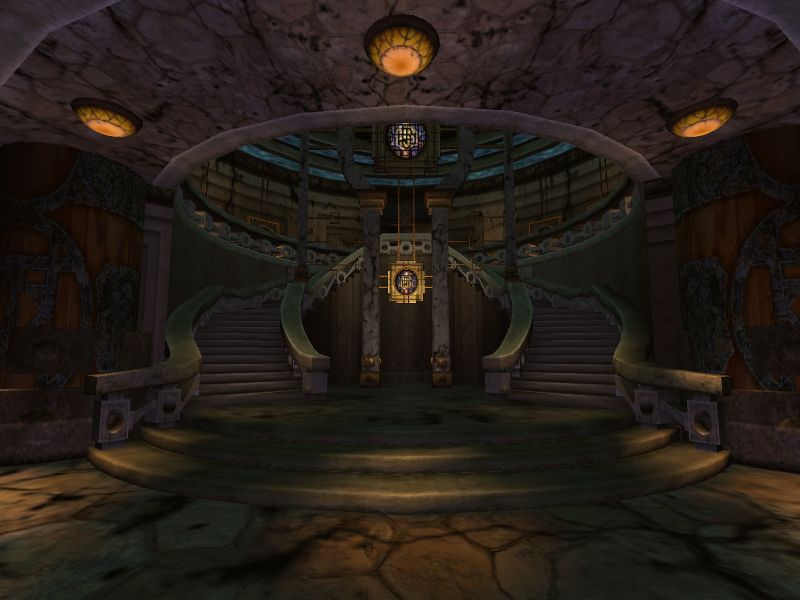
The last time we saw Cyan Worlds, they were busy at work releasing their tech-heavy update of the original classic, Myst. RealMyst gave us a glimpse into the water that Rand Miller was treading into – a world where everything was as three-dimensional as possible. This game introduced to adventurers that the adventure genre can live in a graphic engine that is normally reserved for first person shooters and role-playing games. By using this technology, Cyan showed us what their real intent for Myst was when they developed it back in the early nineties, that this was a living, breathing world full of creatures and stories. After having had extensive experience walking through the Ages of Uru over the last two weeks, I can see now that realMyst must have been an early experiment into employing the engine that would be used with such finesse in its follow-up.
But more on that later. Let me give you some background on where Uru had its roots.
And here is your history lesson. There will be a pop quiz at the end of this review.
The events of the first three Myst games take place over 200 years in the past, with quite a range of back-story surrounding that. Previous to Myst are the novels Myst: The Book of Atrus and Myst: The Book of Ti’ana. In these novels, Rand and Robyn Miller and David Wingrove chronicle the Fall of D’ni, a great city beneath the desert of New Mexico where for thousands of years a technically and culturally advanced people thrived. The few survivors of the Fall link away to other worlds by means of their complicated system of Ages and Linking Books. A few go the surface, and this is where the main character of the first three games, Atrus, is raised by his surface world grandmother, Ti’ana. We learn over the course of Myst and Riven that Atrus marries a woman from his father’s Fifth Age (Riven) named Catherine and together they have two children, Sirrus and Achenar. The two sons become tyrants and all but destroy the lands and the peoples of Atrus’s Ages and in Myst, you meet and punish these two. Riven introduces us to Gehn, Atrus’s power hungry father, and Catherine. After the events of the Riven, Rand and David Wingrove present us with Myst: The Book of D’ni that chronicles Atrus’s attempts to rebuild the ancient city and give new life to the survivors of the Fall. Ultimately, Atrus decides to abandon his plans and write a new Age called Releeshan for all the survivors to live in, a place that would represent the culture of the D’ni, but also represent a new beginning in this chapter of their civilization. Approximately ten years after this are the events of Myst III: Exile in which the Releeshan book is stolen from Atrus by man who had been wronged by Atrus’s sons and had been left in exile for 20 years on the forgotten learning Age of J’nanin. It is also in this game where we meet Yeesha, just a baby and the only surviving child of Atrus and Catherine.
Now, if that isn’t the crash course in D’ni/Myst history, I don’t know what else is. Moving on.
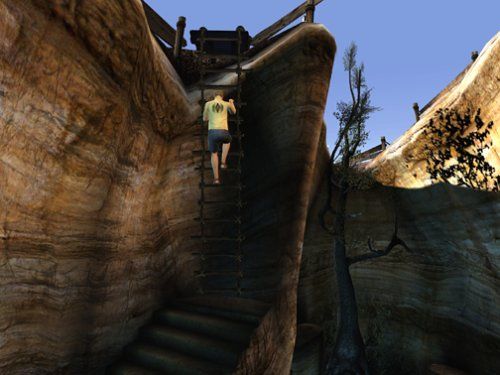
Uru’s story is locked in deep with the multifaceted culture of the D’ni people. Unlike the original Myst trilogy, Uru takes place in the present. Playing a computerized version of yourself (or in my case, something as close as I could get) you start off in New Mexico. Yes, as in east of Arizona, west of Texas, New Mexico. Shortly after meeting your cryptic advisor, Zandi (and grooving out to some brand new Peter Gabriel on his radio), you begin your quest by exploring the area in and around the cleft where both Atrus and Yeesha were raised. Yeesha has left a message for you inside the cleft, saying that life will be returning to D’ni soon and she needs the help of industrious adventurers like you to do that. However, she stresses to you that the journey to D’ni is more important than the outcome. In a voiceover from Atrus at the start of the game, we learn that Yeesha was brought here to be raised by her parents after they both have dreams of a great desert bird (which I’m guessing in D’ni or Rivenese is Yeesha) that will once again bring life to the vast ancient city. Atrus leaves the duty of resurrecting D’ni on Yeesha’s shoulders because he fears the power that it will take to do this. “It changes people,” he says, which can only lead me to believe that he is speaking of Gehn, Sirrus, and Achenar. Atrus does not want the same fate for his remaining child. But let me ask you this: can leaving a child in a cave to raise herself be all that mentally healthy? Or better yet, the task of rebuilding an entire civilization? It’s no wonder that when you finally see Yeesha’s message you don’t wonder why she seems just a little cracked. As you play the game, the story becomes evermore complicated, involving members of an organization known as the D’ni Restoration Council (DRC) that have organized to restore D’ni and its Ages for future generations to explore. And guess what, all the members of the DRC? They are real people you can communicate with on the DRC message board and in D’ni itself. How cool is that?