Is that really me on the screen?
|
Review Uru: Ages Beyond Myst
Review by Jennifer Miller |
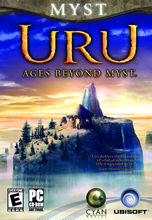 |
You will visit eight major areas throughout Uru, which include the Cleft, six brand new Ages previously closed off to explorers, and restricted areas of the main D’ni city. I can feel your excitement . . . oh yes, I can. And for that drool on the side of your chin, here’s a tissue.
Is that really me on the screen?
One of the most intriguing and personally troublesome aspects of Uru is its use of third-person perspective. Again, this is definitely a me thing, but I have never particularly loved playing adventure games in the third-person (except of course The Longest Journey and Syberia). Doubling this with Cyan’s previously exclusive use of the first-person perspective made Uru a little off-putting when I started playing. The very first thing I was asked to do when I booted up the game was to make a three dimensional representation of myself. This actually was quite fun, as there is quite an array of hair colors, styles, and clothing to choose from. I made something as close to me as possible, but I really think she looks more like my sister, Nancy. They just didn’t have my nose in there. After designing yourself, you enter the gaming world with little to no explanation as to why you’re there and where you should go. Sound familiar?
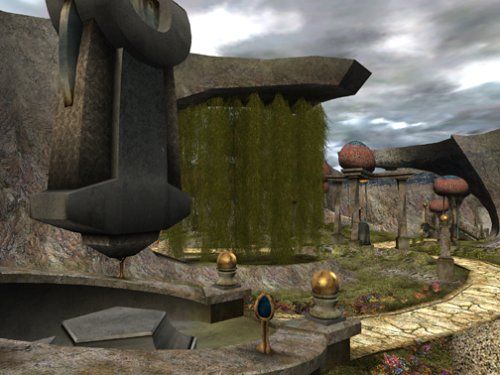
Controls in Uru come in a combination of keyboard and mouse driven commands, which for point and click enthusiasts, might be a turn off. The mouse is used primarily to locate and activate hotspots on the screen and to rotate the camera angle. My one complaint with hotspots in the game is that when your avatar needs to interact with a machine in her environment, the hotspot doesn’t become apparent until you are almost on top of it. A good example of this would be when she needs to look through a telescope, which you will do several times in the game. You can’t actually activate the spot until she is standing directly in front and almost on top of it. The keyboard controls are very sensitive, so your avatar can easily run in doughnuts around the screen if you let her/him. This can also become a problem when you’re trying to cross narrow bridges and walk close to the edge of cliffs. You can fall, and fall far. Also, there are many places in the game where you will have to become as agile with the keyboard as you are with your logic. Puzzles can involve anything from running and jumping across cliffs to small pillars of rock, to running back and forth between pieces of a larger machine in a small amount of time to activate it. I will admit, I had a difficult time getting used to the keyboard controls and puzzles involving physical agility, but rest assured, the other aspects of the game rise above these. So if you want to learn about the D’ni and get another chapter of this award-winning epic, then you are just going to have to deal.
Details, details, details
From the very beginning of Uru, old followers of the series will be presented with some rewarding answers that will only serve to bring up more questions. (If that wasn’t vague enough for you, please feel free to email me.) Since the game hasn’t technically been released yet, I don’t want to give anything away, but let’s just say keep your eyes peeled for some souvenirs from a previous Cyan game that I have reviewed on this site. Traveling to the Cleft was so rewarding for me, to finally have confirmation of where Atrus came from. For me, it gave so much understanding as to just how isolated Atrus and Anna must have been back in the New Mexico of the American 18th century. They had their own world here, and that’s why the reunion with his father and the journey to D’ni must have been so difficult. The ground of the Cleft is covered in Anna’s little blue flowers that she adored so much. In keeping with continuity, these same flowers can be found around her headstone on Myst Island in realMyst. Throughout the Cleft is the fading evidence of Anna’s paintings and Yeesha’s primitive stick drawings. This detail travels to the other Ages you will visit, from the Maintainer Age of Gahreesen with it’s superfluous use of the Maintainer Guild symbol, as one of the DRC explorers notes “just incase you have forgotten where you are,” to the industry Age of Teledahn, where luminescent spores are constantly falling from the large mushrooms that dominate the Age’s landscape.
My favorite detail is that you can push stuff around. Yes, that was a very articulate statement I know, but really . . . you can push stuff around. I especially loved taking the orange caution cones left by the DRC in Gahreesen and pushing them off of cliffs. I suppose this goes back to my days as an undergraduate when I would do quick drive-bys of the St. Mary’s parking lots with my roommate and pilfer those darn plastic cones when public safety wasn’t looking. I think we had a whole family of orange cones by the time I graduated. But I don’t remember if we let them back into the wild or not.
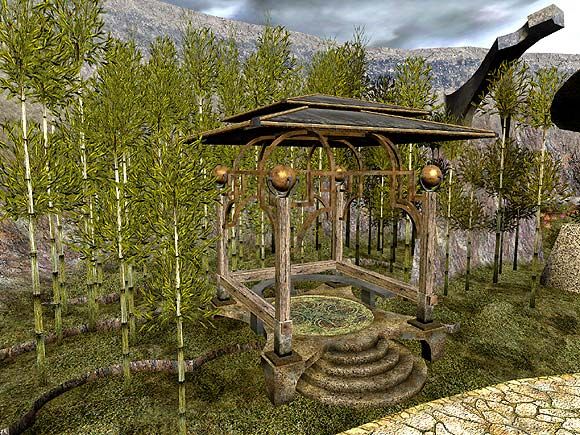
Much D’ni history is also presented to the player in Uru. These come in the form of various notes and journals left throughout the Ages by the DRC explorers. Most of these are translations done by the language specialists on the histories of the specific Ages you are exploring. In Teledahn, I came across a particular journal that chronicles the restoration of the Age over three years. What really struck me about this particular writing was when the explorer went back to surface for a vacation, his return was delayed by “tragic events.” His return date was October of 2001. I’m not one to normally get sappy when I play games, but Cyan really made an effort to make this game as timely as possible and by including such a vague, but very real reference to the heartrending events of September 2001, it only drew me into the story even more and even brought a tear to my eye.
An interesting development in Uru is the use of a small device known as the KI (pronounced kee). A KI is a personal device that was used by the D’ni shortly before the Fall. They are similar to cell phones in that you can communicate with other explorers, much like we would text message someone today. They also are capable of taking pictures and capturing sound samples. In some places, they are necessary to open doors and pass security checkpoints. The KI looks much like watch and fits around your avatar’s wrist. As of this point, I haven’t made much use of the KI in the core Uru game, but from what I’ve read of the online portion, it will become much more important there.