Broken Sword: The Sleeping Dragon Review
|
Review Broken Sword: The Sleeping Dragon
Review by Ray Ivey |
|
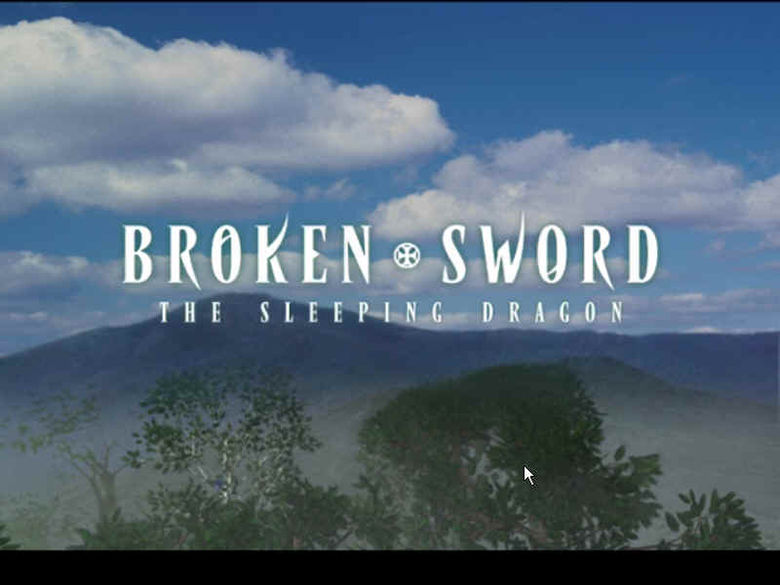
Few adventure games arrive with a better pedigree than Revolution’s Broken Sword: The Sleeping Dragon. It’s the third in a venerated series that began in 1996 with Broken Sword: Shadow of the Templars. Templars was a beautifully hand-animated 2D mystery-adventure, and its storytelling, entertaining puzzles, good humor and great good looks made it a legendary game. In fact, in the spirit of full disclosure I should say from the outset that the first Broken Sword is my favorite adventure game of all time.
The second game in the series, The Smoking Mirror, was perhaps not quite the classic game the first one was, but it was nevertheless well-received.
This third game, The Sleeping Dragon has been controversial from its inception, largely because of the outspoken comments of Revolution’s game guru Charles Cecil.
Since the controversy is such a proverbial elephant in the corner of the room, I’m not going to ignore it.
The Elephant
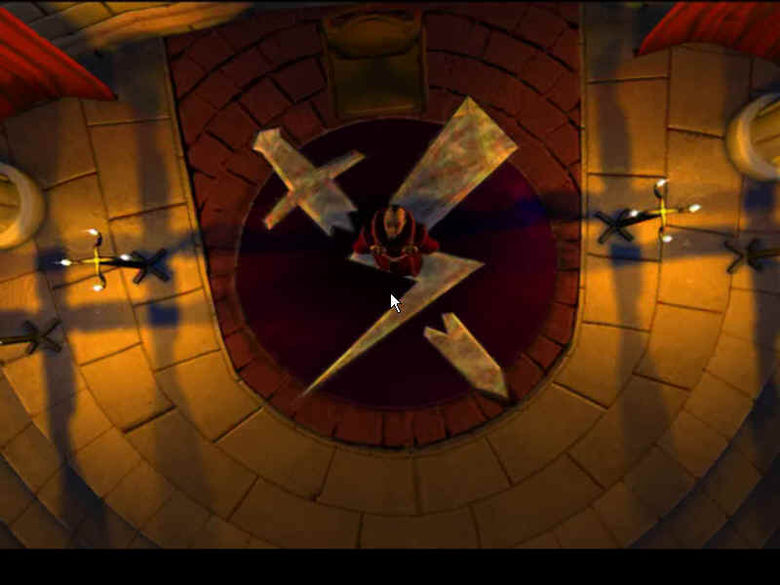
Charles Cecil has a big problem: The guy’s always thinking.
He loves computer games and he especially loves adventure games. Like everyone else, he watched the decline of the prominence of traditional point-and-click graphical adventures in the last five years. All the while he’s been thinking, “How will adventure games keep up? How should they change with the new technology and new gaming trends?”
Cecil’s first foray into the brave new world of contemporary adventure games was In Cold Blood, released in 2000. And while I was fairly critical of that game, the fact is, Cecil and his team were reaching for a new way to present computer game adventures. The game had a slick, cinematic feel, plenty of exciting moments, and fun puzzle-solving. It was largely ignored by adventure game players because (I believe) it was improperly perceived as an action-adventure game. It was, in fact, a pure adventure title.
Later, everyone in the adventure community was thrilled to hear the news that there would be a third Broken Sword game. Unfortunately for his PR, Cecil had no intention of making the third game in the same 2D format as its forbears.
Many players wondered if Revolution would suffer the same difficulties as Jane Jensen did with her brilliant, but much maligned 3D effort Gabriel Knight: Blood of the Sacred, Blood of the Damned.
Even worse, Cecil had the unmitigated gall several months ago to say in an interview that “point and click is dead.” For that unpardonable sin, he was burned in effigy from one end of the internet to the other.
As early descriptions of the third Broken Sword game made their way onto the World Wide Web, some gamers rashly declared the upcoming game to be merely another action/adventure, and turned their backs on it. “Broken Game!” declared one particularly rash member of the cyber-lynch mob.
Their loss.
The Proof of the Pudding is in the Playing
So at last, here we have it. The third Broken Sword game. Maverick adventure game designer Charles Cecil finally has to put his money where his mouth is.
So what the heck IS Broken Sword: The Sleeping Dragon? Is it an action/adventure? A platformer? Is it a disaster?
The answer is: The Sleeping Dragon is a pure adventure game that takes place in a 3D world. And it’s easily the best adventure game since Syberia.
George and Nico Revolutions
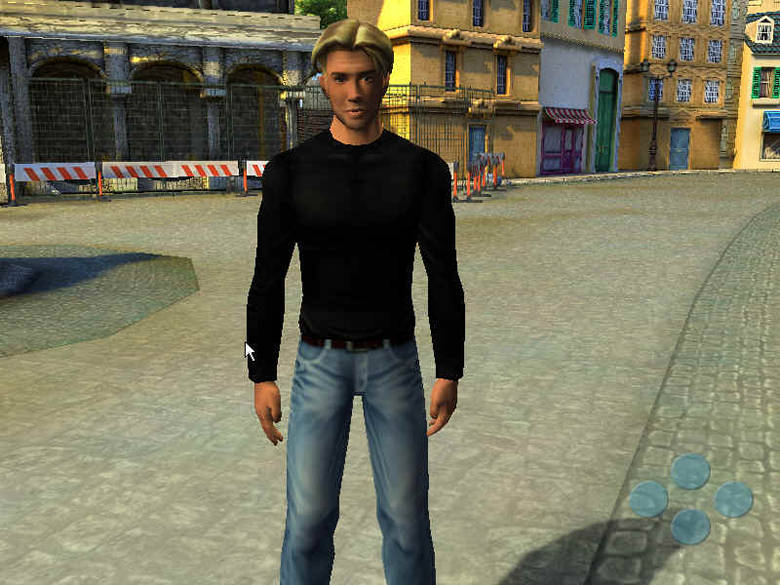
Time has been good to both George and Nico, the intrepid heroes of the first two games. Nico is as lovely as ever, and has a pretty good job at a Parisian newspaper. George has been working as a patent attorney in Idaho, and has grown a bit handsomer and more athletic since he last saved the world.
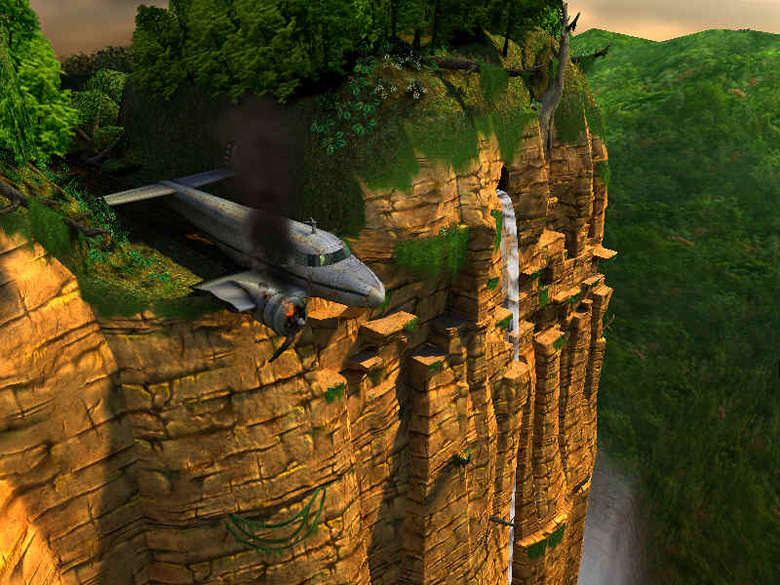
The story begins as George is flying to a remote location in the Congo to meet with a scientist about some patent work. The woefully inadequate plane he’s in crashes, and the adventure is afoot.
The big fat change is, of course, the fact that this game takes place in a 3D environment. Characters are moved using the arrow keys, and there are a cluster of four “action” keys mapped to the WASD buttons (but are fully customizable). This control scheme takes about five minutes to get used to and works very well.
The inventory and conversation systems are extremely similar to the first two games. Inventory is brought up at the tap of the spacebar button, and inventory items can easily be used on the environment or combined with each other. Conversation topics are noted by colorful icons.
The clincher to making this entire system work well is the use of an “active hotspot” feature. As George or Nico move through the environment, a bright little spark appears at any possible point of interaction. Also, the character’s head will turn toward that object (reminiscent of Grim Fandango or the fourth Monkey Island game). You can easily switch a character’s attention between hotspots with the flick of a button.
Globetrotting and Puzzle Solving
Cecil and his team have done a wonderful job of bringing the feeling of a Broken Sword game into this new 3D environment. The handy third dimension actually opens up many possibilities for puzzles that would have been difficult or impossible in a 2D game. Many of the puzzles have to do with using and manipulating objects to gain access. So there’s rock climbing, rail hanging, ledge crawling, etc. Let me emphasize that at no time does this kind of puzzle make the game feel like an action/adventure or even a platformer. The controls are very tight and specific – it’s about choosing the “climb up” or “climb down” action icon, not about running and jumping a la Tomb Raider.
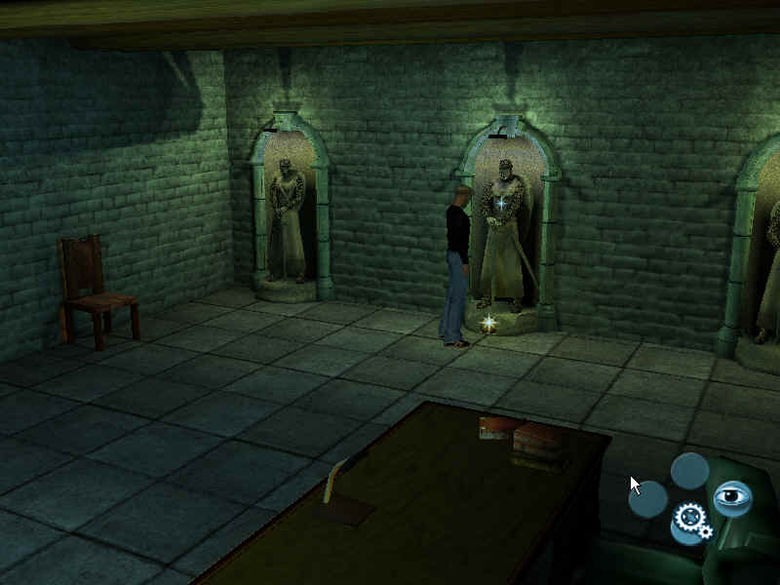
The camera is fixed at all times and usually works very well. In fact, the camera placement and movement often gives the game a wonderfully cinematic feel.
Nico and George begin the game separately, and the story dovetails their separate toward each other beautifully. Once they do hook up, some sections of the game are played with them together and cooperating in the puzzle solving (“Hey, Nico, press this button while I stand on this block!”) and other sections are played with each character separately.
As in the previous games, George seems to have an endless budget for plane tickets. The story bounces from the Congo to England to Paris to Prague and even to that classic mainstay of the adventure game, Egypt.
I am sympathetic to the plight of the game designer’s dilemma of finding new ways to present puzzles in games. Like jokes and murder motives, it sometimes seems like there’s only so many different puzzles in the world, and the challenge is to recycle them creatively. I’m going to single out one particular puzzle in The Sleeping Dragon that does this particularly well. There’s an old puzzle that involves moving different pieces from one side of a board to the other, with strict rules about which pieces can ever be left alone together. Late in the game there’s a puzzle that uses this old chestnut, but in such a beautiful and visually elegant manner that it was a true pleasure to revisit.
The Sleeping Dragon’s Lair
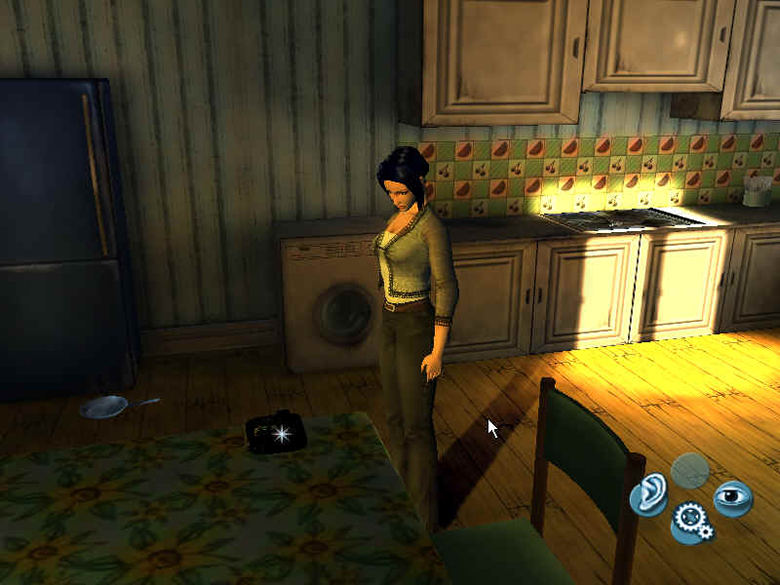
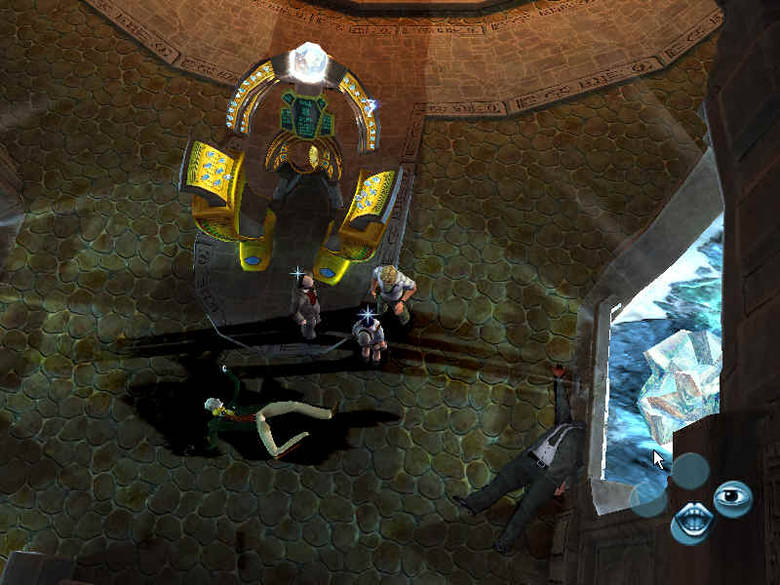
The world of Broken Sword: The Sleeping Dragon is a dangerous place, and you’ll die often. Happily, the game is extremely forgiving, not requiring any reloading of a saved game. The game just restarts right before where you made your fatal error.
Many of these deaths require a quick pressing of an action button to save the day. Adventure purists might be annoyed at these “timed puzzles” but trust me, they’re dead easy. It’s mostly a matter of pressing the only possible button as it flashes on the screen.
These sequences are curiously reminiscent of the old animated arcade game Dragon’s Lair, as a bit of quick timing is required to move the movie forward properly. Let me re-emphasize, however, that these sequences are fun, not onerous.
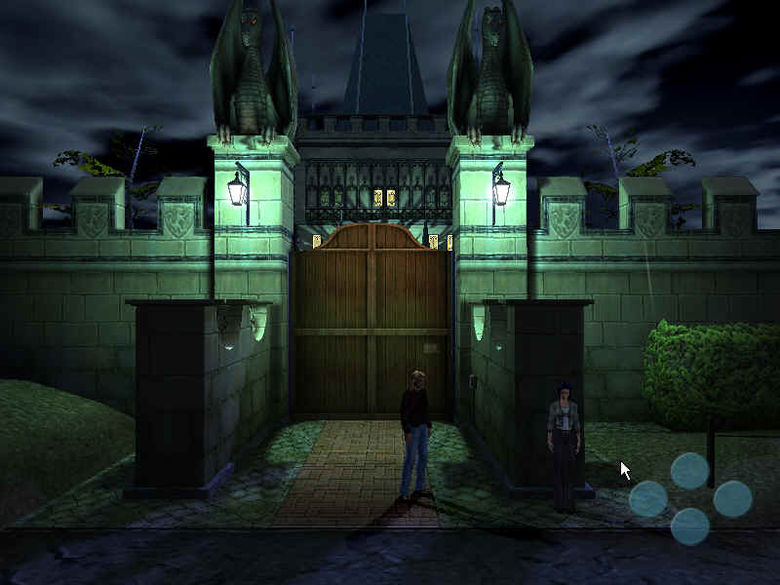
There’s also a surprising amount of stealth involved in the game, and it’s very nice to see this element used well in an adventure game. Both George and Nico have the ability to “creep” and hide in the shadows, which is often necessary to avoid the nasty guards.
The Good
The graphics in The Sleeping Dragon are beautiful and reminiscent of the warmth and detail found in the first two games. In fact, there’s a sequence in which a major location of the first game is revisited, and it’s quite fun to see it in its new 3D glory.
The storytelling is easily on par with the first two games. The story is dramatic, funny, scary and intriguing, and is full of entertaining characters.
The musical score by Ben McCullough is superb: dramatic, moody and atmospheric.
The voice acting is superb throughout. What a relief! Bad voice acting in games is such a pet peeve of mine, and it’s good to see it taken seriously here.
Rolf Saxon returns as George Stobbart, and his performance is totally in-synch with the characters slightly more grown-up persona. Sarah Crooke (an intern at Revolution who convinced Cecil to let her audition) is terrific making her “Nico” debut.
The Bad
I can only picture the crankiest of adventure players having a serious problem with the control scheme in the game. True, there’s no mouse support, which to some players is heresy. But the controls are easy to pick up and work very well. Give it five minutes and you’ll barely be thinking about the controls.
However, for those players who own an XBox, I would recommend playing this game on that platform, as the controls would be even easier. Moving the characters around with the analog stick would be much preferable to the arrow keys on the PC.
Also, I wish the player had control of the camera. While the fixed camera angles are usually solid, since this game involves a lot of stealth, there are times when you wish you could use the camera to get a better look around at your surroundings.
The Ugly
Only two things make the ugly list.
First, although the “move crates around” puzzles are intuitive and fun, there are entirely too many of them. It smacks of serious puzzle fatigue that the designers included this many of essentially the same kind of puzzle.
Finally, there’s one vital hotspot (a rope on an upper level of some scaffolding) that is extremely easy to miss, and without which the game comes to a grinding halt. HINT: Keep your eyes peeled around the pissoir!
Conclusion
Broken Sword: The Sleeping Dragon is a triumph. It’s at the same time a real 3D game and a crackerjack pure adventure. High levels of craftsmanship and designer TLC are evident throughout the game. Playing it is like falling into an exciting movie thriller. This game is recommended for anyone, and for adventure lovers it’s absolutely not to be missed.
Final Grade: A+
Visit the official Broken: Sword Sleeping Dragon website for numerous goodies including game trailers.
System Requirements:
- Windows 98/ME/2000/XP
- Pentium III 750 MHz (Pentium III 1.2 GHz Recommended)
- 128MB RAM
- 8x CD-ROM Drive
- DirectX 8.1
- Sound Card (Sound Card with 5.1 Surround Sound Support Recommended)
- GeForce2 64 MB or Equivalent (GeForce4 Ti 4200 or Equivalent
Recommended) - 1 GB Hard Disk space
- Keyboard and Mouse /Gamepad
- Speakers
This review is copyright Ray Ivey and Just Adventure and may not be republished elsewhere without the express written consent of the author. Republication of said review must also contain a link back to Just Adventure.