Howard A. Sherman Publisher: Malinche Entertainment
|
Review Pentari: First Light Howard A. Sherman Review by Ricardo Pautassi |
 |
Just Adventure is proud to welcome Ricardo Pautassi to our staff. Currently studying for his doctorate, Ricardo is a huge fan of Interactive Fiction.
Back in the golden age of text adventures – before there were walkthroughs, before there were strategy guides, heck before there was an internet – if you were playing a game and were stuck on a certain puzzle, well basically you were screwed.
But anyone who will play a text adventure, is also someone who is determined enough to find someone who has the solution. So is was that I would hang out in the ‘games’ section of the local Singer Sewing Center (In those days there were not Electronic Boutiques or CompUSAs, if you wanted to purchase a new game you went to your local Radio Shack, Sears or whoever sold computers in your area).
It is a testament to the power of the written word that text adventures have survived and even prospered in today’s age of high technology. May developers like Howard Sherman continue to carry the lantern high.
First of all, a question: Would you invest twenty dollars in an Interactive fiction game? Let me give you a modest suggestion: hold your reply until you’ve finished this text.
By the time this reviewer was beginning his elementary school, text adventures were at their highest level of popularity. In the 80’s, companies like Infocom, Magnetic Scrolls or Level 9 produced many high-quality text games that achieved great sale numbers. Two decades later, not only the genre has been renamed as “Interactive Fiction” (IF) but also the length of its realm is now mostly restricted to the amateur developer. Within these boundaries, the genre is alive and kicking, and produces an average of thirty games per year.
Should we say that IF does not exist anymore as a commercial phenomena? While you might be tempted to quickly answer this question for the affirmative, a couple of recently developed games make a case for the contrary. I am referring to 1983: A World’s Fair Mystery and Pentari: First Light (PFL), the latter being the subject of this review.
“Who are these invaders? How could they so easily lay siege to a fortified city like Delphin? Had the city’s armies been completely exterminated? How could such a comparatively small band of mercenaries accomplish this? Where were the Wizards of Delphin?”
PFL has been described as a Zorkian game and it certainly shares many features with the legendary Infocom game. But do not let the tree cast a shadow on the huge and interesting forest that PFL represents, nor think that the game’s proposal is to go back to the 80’s. In fact, Pentari‘s plot is just fine for those who dream about swordsmen and furious fights against wizards, dragons and mercenaries. But those who dream about other issues (for instan
ce, electronic sheep) won’t have to worry since the story is
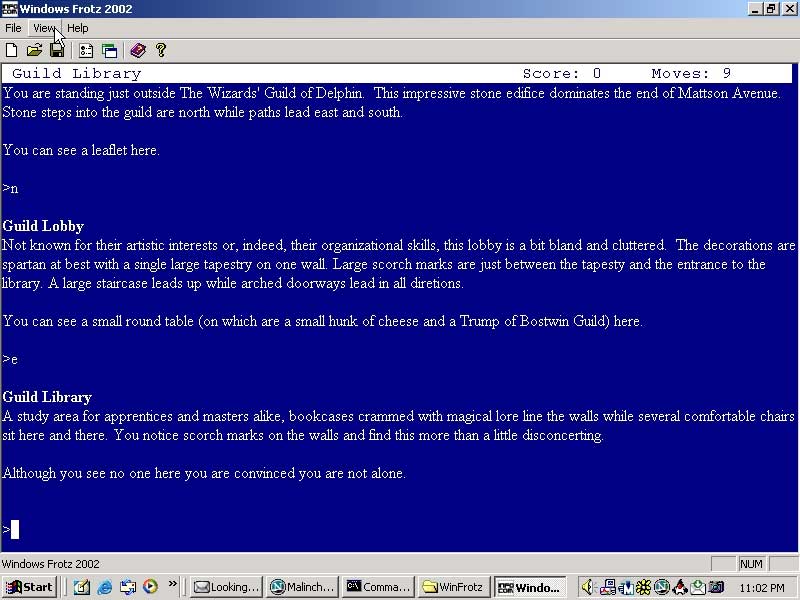
interesting enough to catch every player’s attention. You play the main character, a captain who serves the army of the Great Empire of Pentari. In one of the most important cities of the realm, Delphin, a group of formerly trusty wizards has launched a coup against the kingdom, seizing the authorities and imposing the terror in the streets. It is your duty to travel there and return things to normality. You will achieve this by killing the traitors, assuring the safety of the King and his family and collecting the treasures that remain in Delphin. Along with the description of these objectives, the first part of the game also shows many of Pentari‘s remarkable features. Delphin’s world is described in detail: there are huge quantities of text to read, the writing style is superlative
and, unlike many fantasy adventures, the English employed is quite modern. Reading is not only
enjoyable but also a requirement since many hints are hidden in the prose. Moreover, every object is profusely described and, in certain circumstances, the depiction is action-sensitive. Let’s say, it changes to accommodate to transient changes in the environment.
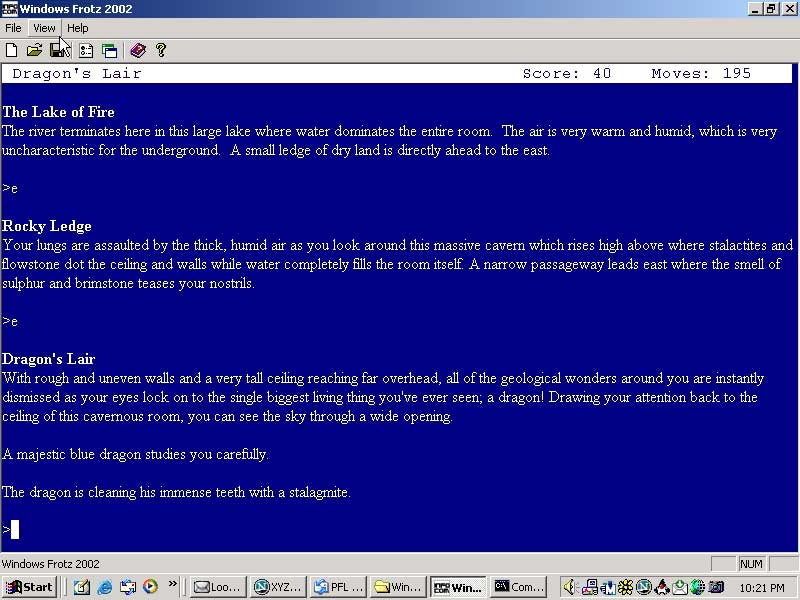
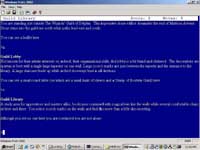
“This large room fairly explodes outward and upward from the passageway you just left behind. Your eyes are riveted to the majestic sight of the waterfalls that dominate this room. A small waterfall in the uppermost portion of the room feeds a medium waterfall which in turn flows into a giant of a waterfall whose white and brown water fairly gushes over a rocky shelf above into a fairly large pool directly in front of you”.
After a warm-up with a couple of straightforward puzzles, the game starts when you arrive to the city under siege. Delphin is really enormous, consisting of almost three hundred rooms that comprise both outdoor and indoor locations. What is more, many of them are components of a vast underground system in which man-made dwellings are mingled with natural attractions such as cascades, cliffs and canyons. To a certain extent, exploration becomes a puzzle in itself and drawing a map a requirement (actually, I filled out five whole pages with maps). As a matter of fact, Delphin can be compared, in terms of richness of diversity, to the virtual city portrayed in A Mind Forever Voyaging, one of Infocom’s jewels.
However, you are not alone in this giant city. As you roam around, several non-playable characters (NPC’s) make their entrance. In fact, there are more than twenty of them. While many have a very narrow vocabulary, you will find three or four exhibiting a well-depicted personality, Vera’s ghost being (a sort of sidekick that has suffered the rage of the corrupted wizards) the most outstanding.
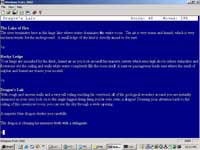
“Swords are not so helpful against magic. Fighting fire with fire will serve you best. You’re not a mage, yet you must be a master of magic. I shall help thee rise…”
PFL has a very comprehensive online help system that will be a great aid for IF newcomers, who also will be pleased to find out that the slope of the learning curve is quite suitable for them. The number and diversity of the puzzles is significant but their difficulty never exceeds a medium level, always assuming that the player has fulfilled a thorough exploration of the environment. If not, getting lost will be the most probable outcome. Interestingly, the game is not linear and you can choose the quests sequence at your own will. Various puzzles are connected to treasure hunting, but I found those related to magic the most interesting. Even though you are a warrior, the virtues of your adversaries make it essential for you to acquire magical skills. After being properly instructed, you should be able to cast a number of spells, which will prove useful to open sealed doors, scan other’s minds and even causing a cardiac arrest in animals and men. While these are the default spells, additional ones are available after finding special scrolls. As expected, inventory related puzzles, riddles and interaction both with the environment and with NPC’s also play a role in PFL. Despite the fact that many puzzles and subquests are optional and not required to end the game, Pentari’s average playing time should be around twenty hours for the experienced player and probably many more for those new to the rich world of text adventures. The game’s vocabulary is extensive and, in most occasions, multiple nouns are available to call for an object. Unfortunately, this is not the case in one key puzzle where a specific word must be employed.
Of course, I’m not saying that no weaknesses can be found in PFL. I felt that the story, while very interesting, is not fully developed. In addition, the end seems a little rushed and many players may feel that several questions regarding the plot remain unsettled. Being a small company project, PFL is extremely polished and I didn’t notice any noteworthy bugs with the exception of a couple related to NPC’s behavior. But these are minor downsides that do not outweigh all the pros described above.
You can buy the game at the author’s web page and, believe me, it’s certainly worth every penny of its price. The CD version includes an illustrated package plus a couple of freebies pretty resembling Infocom’s products.
All in all, PFL is a game that will appeal both the hard-core IF player as well as the casual adventurer and constitutes a must-play for those spellbound to fantasy.
My final word about Pentari: First Light is a clear, solid A.
Pentari: First Light grades:
Final Grade: A
Screenshots