Drawn: The Painted Tower Review
I’ve just finished playing Drawn: The Painted Tower and will admit that it was not quite the experience I was expecting. I enjoy casual puzzle games now and then as light entertainment. However, the flood of Hidden Object Games (HOGs) that have been flooding the casual market had blunted their appeal for me. Many of them simply feel like puzzle games and to me personally, scanning your screen for listed objects becomes old very quickly. 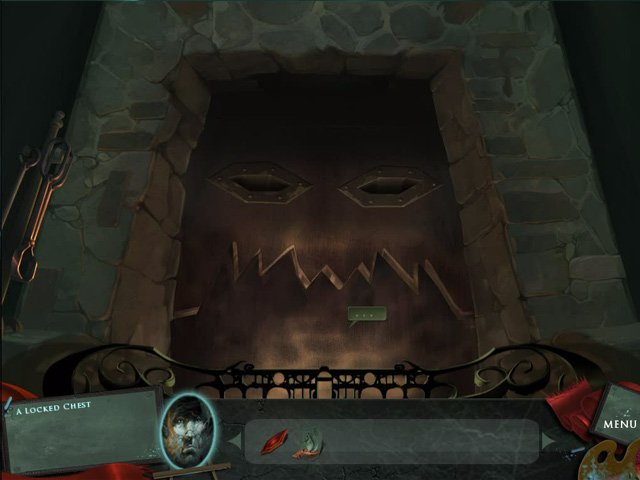 A few of these games, however, have evolved to puzzles built around a real story, such as the Agatha Christie Casual games, and the Women’s Murder Club games. Some also have started to build in a diversity of puzzles, such as Samantha Swift and Return to Ravenhearst – the latter incidentally a game which in my opinion was a great improvement on its predecessor. Then you have puzzle games which attempt to break away from the HOG mold, such as Pahelika Secret Legends and the Dream Chronicles series, the latter of which I personally find quite pleasing as pure puzzle games. I had heard that Drawn:The Painted Tower was such a game as the latter mentioned ones, but still – the game had been released by a publisher that specializes mainly in HOG and casual games. So it was with some reservations that I approached this game. I had to a great extent felt attracted to its lovely-looking screenshots, but I was not quite sure what to expect in the gameplay department. I felt rather sceptical, and didn’t expect much in the sense of true entertainment. When I started up the game, contrary to my expectations, I was rather impressed. The game starts off with an intro that immediately draws you in with its poetically delivered narration, a moving orchestral musical rendition, and a graphical presentation that adds to the dark subtle drama and pathos of the setting. In a world shrouded in darkness A beacon of hope imprisoned by shadows I felt swept along. 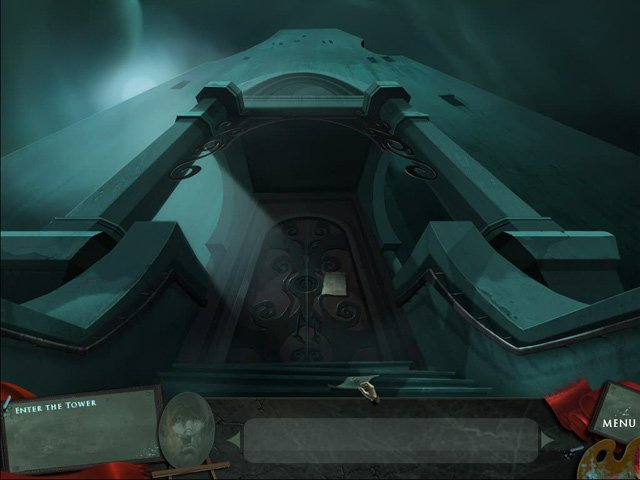 I was still a bit prejudiced and sceptical, though. When this lovely intro ended, and the player was expected to go through motions that were rather simple and obvious, I thought to myself: “Well, then! Just as I had expected… This is just going to be another one of those flat, boring casual games, albeit hopefully not yet another of the already abundant flood of HOGs.” Boy, was I wrong! Let me not get ahead of myself though. This game is not an easy game to classify. …so what does it ‘feel’ like? Drawn is a first person point-and click game, and although it does work on the “slideshow” basis, clever use of sound and animation makes it come alive, making it feel less of a slideshow than many similar games I have played that use the same mechanic. A “feel” of three-dimensionality as far as the areas are concerned, is quite cleverly simulated, firstly by constantly having the player move into new areas that are situated at different elevations (Up to the top of the tree house, then down into the tree’s innards, up to the top of a magic tower, then down into its interior again). In addition, by using clever animations, the player is made to feel as if he actually enters the magical paintings that feature in the story. A feature that I personally enjoyed, is the absolute freedom that the player has to move back to already-visited environments. Gone is the “screen after screen” feeling present in many casual games. The story progression is very linear, but the freedom of movement afforded to the player had the result that I never felt restricted or hedged in while playing the game. Puzzles, puzzles – puzzled?
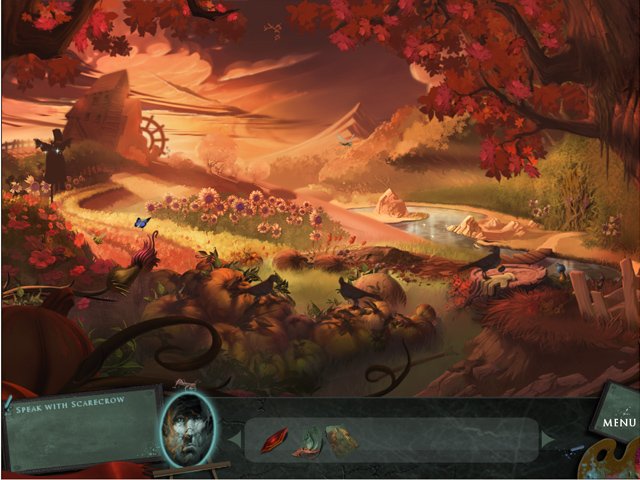 There is a very nice variety of puzzle types, in fact, probably a wider variety than I’ve seen in many “true-blue” Adventure Games. A staple of the game is your usual Adventure Game style inventory puzzle. Many of these are nicely complicated by the fact that you often have to go and search for the necessary item in areas other than the obvious immediate surroundings. Add a few easy slider and jigsaw puzzles, a symbol re-arranging puzzle if not quite a cryptogram puzzle, and a nice little mechanical puzzle or two. Admittedly, most of the puzzles won’t exactly land you in the recovery ward for overtaxed cerebrums – most of them are pretty easy to figure out, but let me warn you… like in any good Adventure Game, there are one or two that might just – yes, just possibly might, have you break into a bit of a sweat. The nice part is, though, that most of the puzzles make sense! Now isn’t that a refreshing thing for an adventure game? If there is anything that really holds this game back from being a true-blue, classic adventure game, it is that most of the puzzles are actually contextual and rely on logic rather than weirdness to befuddle you… In fact, every single one of the inventory puzzles made sense to me. Almost all of the logic puzzles did as well, with a single small exception – in which I had to use the “try everything with everything else” approach. But hey, maybe the solution does somehow make sense and I’m just too dense to see the correlation? You never know. What really impressed me though, is that this game, has not a single “hidden objects” screen. (…or if it had, I didn’t notice.) The user interface (…an Adventure Game? A puzzle game?…or not?) The main elements of the interface are visible at all times, but beautifully rendered and very user-friendly. In the bottom right-hand corner, just above your tag to return to the main menu, you will find a “Help” menu, explaining the different little icons that the contextual cursor may change into, and other similar things like the movement arrows. I really only had a look at that because I was writing a review and not because I would have needed it, since the gameplay is so intuitive. As far as gameplay goes –for me it was effortless, save for one small gripe – I must mention this, because it did irritate me. Often when one looked at a document or similar object in close-up, it was rather difficult to exit the object again, and with a few of them I had to click a few times here, there and everywhere to try and exit the close-up again. This is my one, single gripe though, and one that I hope the developers of this otherwise excellently produced game would take note of. Now for the rest of the interface; and here is where the game’s “causal” roots show a little. You get quite a nicely done “hints” system, in the form of the old guardian of Iris, the girl you are looking for. Your hand is reasonably subtly held by subject headings that appear on a tiny blackboard in the bottom left-hand corner, and I say “subtle” because this is not a situation of the game telling you “in-your-face” where to go and what to do, but just a subject indicator that describes the essence of the problem at hand, that needs to be focussed on. Example of subject indicator: “Sun and rain.” However, if you do then find you have a little problem with figuring out what to do with “Sun and rain” you can click on the tiny portrait of Iris’s guardian, to give you a succession of increasingly more to-the-point hints. Theoretically, one can ignore the blackboard, but I would personally have preferred for it to have been hidden from view, and only accessed by a click. The nice aspect of the hint system is that it really makes finding a walkthrough for this game rather redundant, especially since the logic puzzles are also “skippable”. If you’ve fiddled with a logic puzzle for a number of minutes, a little timer bar above the puzzle runs down and allows you to “skip” the puzzle if you really find it to be more challenging than what you had expected to encounter in a casual little run-through of a game from a publisher that has a history of releasing casual games. The puzzles pick up in complexity and level of difficulty as the game progresses, so do be patient if you’ve started the game and find the puzzles laughably easy at first. ….so what is this game about? In Drawn: The Painted Tower, there is an interesting premise, and a nice little back story; a simple fairy tale on the surface, yet with subtle and interestingly rich tapestry, that is beautifully and cleverly told. It is a story of a missing princess that you need to find in a magical tower in order to save her from an ambitious, avaricious evil that has overtaken her land. The princess and her family have a very special gift – and this is what lends such richness to the game: they can make enchanted paintings that become “real”. Yes indeed, so real, that you can step into them. She has left magical paintings around the tower, and you need to explore them and solve puzzles around them, in order to make your way towards the princess. However, there is less of a meat-and-bones story than there are hints of possibilities. I get the impression that Drawn: The Painted Tower is the setting for more to come, especially if one takes the rather unsatisfying ending into account. Yes, perhaps the abrupt ending is not quite as bad as Still Life or A Vampyre Story’s unresolved and cliff-hanger endings, but… okay, maybe it does come very close, and I’d certainly be expecting at least one sequel to Painted Tower. (In fact, I demand one!) Drawn: The Painted Tower’s story is structured similar to that of Myst, in the sense that you need to unravel a mystery that presents itself in the present time, by working on clues from the past, and only at the end of the story do you get to meet the protagonist and the “real” action takes place. Without having any idea of who you are, (the typical AFGNCAAP), or how you came to be in your current situation, you are drawn into the world of The Painted Tower, by examining the clues, messages and paintings left behind by those you seek to save from a sad fate. In a way this narration mechanic is enchanting and intriguing, and in fact, I have always found that this “back-to-front” narrative technique is one that very successfully draws me in. Overclocked, for example, as well as Zork Nemesis used it to great effect. The style of the game To lovers of the old LucasArts classics : Don’t be looking for any witty, humorous dialogue and razor sharp repartee in The Painted Tower. In fact, there is not much dialogue at all, and what there is, is mostly in text, and functional in nature. So the tone of the game is not humorous, but is wistful and of whimsical and moody beauty, and as such, it holds together well. The upside of this is that, if you are a person who finds juvenile and/or toilet humor something to avoid in a game, you won’t have that problem here. If you are one of those people to whom certain voices are terribly irritating, and/or if you’re really picky about voice acting, well, luckily you won’t be hearing much that is going to chase you up the walls. Music to my ears… To add to the wistful and almost “Arty” style with which this enchanting little fairy tale is approached, is the skilful use of sound editing and the excellent orchestral musical score, which is at times melancholy, at times either delicately enchanting or moody, at times just subtle background filler, but at other times, swells with such passion and beauty, that it sweeps you along, evoking an emotional response from the player, that truly enriches the total experience of the game. The sound special effects, such as rain or a little rabbit munching a carrot, are also well done, and not overly obtrusive, yet “there” enough to add realism to the experience. A picture is worth a thousand words… The rich environments with their varying moods depicted in the Drawn: The Painted Tower, are truly almost like paintings that you had stepped into, but these paintings are alive with sound and animation. You will love the graphics in this game especially if you like the kind of expressive colours and moods that were used in A Vampyre Story, but that is where the similarity to that game ends. Despite the stylised art style which would be suggestive of a cartoon-like style, The Painted Tower is subtly dramatic and enigmatic and wistful, with a charming mystique, all quite tastefully presented, with no aspirations to be a humorous or witty game – just a simple story, rather unconventionally presented. The bottom line …and so, there you have Drawn: The Painted Tower, a charming game with an enigmatic setting, a game of haunting beauty that defies easy description – a game that does not easily fit into the convenient pigeonhole of either “Adventure” or “Casual.” This game is in a class of its own…. – it is poetry. Though probably too “lite” to be truly considered a “proper” adventure game, if the hint system were made harder to access, and if the dialogue and plot were fleshed out a bit, I suspect that a sequel could well be classified as full-blown adventure game. Besides the artistry of presentation, what sets this game apart for me from most other casual games is that it comes across as a seamless whole; the skilful depiction of a single story, in spite of being a loose collection of puzzles. In evidence here is not just adroit game production, but an excellent attempt at producing a cohesive story and enchanting atmosphere. This is a trend that has only recently started with casual games, and whether you choose to see it as adventure, casual, or hybrid, in this particular game, it was very well done. A small warning; this is a rather short game – most probably in part due to the lack of dialogue, and possibly also to the relative ease of the puzzles which allows for a fast flow in the progression of the game; so do not expect to spend quite the same amount of time on it than you would have on a full-length adventure game. The game is not very expensive though, so in my personal opinion, it still remains good value for the price ($6.99) and a delightful experience to boot. The Painted Tower has positively changed my opinion of this “crossover” Casual genre, and I will certainly be looking forward to other hybrids of this type, with interest. In fact, I fell in love with it, and I will be anxiously awaiting a sequel. As a casual game, I cannot have enough praise for The Painted Tower, and if it were longer, I would have given it a solid A at least, since it really delivers in the story, sound, graphics and especially the atmosphere department. Since the game is rather short, I would downgrade that to an A-. As an Adventure Game, I would subtract marks for the short length, lack of dialogue and a thin plot that has an unsatisfying, abrupt ending. Unfortunately, the game might not present quite enough challenge in the puzzle department for a full-blown adventure game, due to the assistance given in the game. However, the game obviously has high production values and a lot of positive qualities, and I would therefore prefer to withhold grading it as an adventure game, although I would certainly encourage adventure gamers to try the game out, depending on what you are looking for in a game. If what you are looking for is artistry and sheer beauty in presentation, then this little gem is for you.
System Requirements:
|