Welcome to Just Adventure + — Part 44
Just ASCII + A Column Covering Interactive Fiction and Other Nongraphical Adventure Games
Adventurer vs. Red Dragon
by Simon de Vet
(click to enlarge)
By Erik Reckase
Part Seven: The Many Angbands
It’s official–I’m permanently hooked on Rogue-like games. Whether it’s a quick game of PocketRogue on my Palm Pilot or a longer venture into the NetHack realm, I’m always up for the challenge. Similarly, I’m curious about the many other Rogue-likes that I have yet to play–could one of them be better? That’s the nice thing about Rogue-like games–I can pretty much guarantee that if you’re looking for one to fit your particular gaming needs, you’ll find one after a bit of searching. In this column, I’ll be discussing Angband, a game based loosely on the writings of J.R.R. Tolkien, which has more variants than any other game I’ve seen.
Angband, like many of the currently popular Rogue-like games, is a descendant of a much older game. Back in 1980, Robert Koeneke, a student of engineering at the University of Oklahoma, was invited by a group of system administrators to play some games on the school’s machines, which included an early Star Trek game, the Colossal Cave Adventure, and Rogue. Shortly afterward, he switched departments and worked as a student assistant on computers–but the administrator of the system was staunchly anti-game, so Robert decided to write his own Rogue. This game would become Moria, a game similar to Rogue but with a Tolkien theme, a top level with stores, and a place to store your booty. The original version, Moria 1.0, was written in VMS Pascal and was finished in 1983. Over the next few years, further upgrades to the game were made, and the source was sent to other universities in 1985. The development of Moria culminated in the release of Moria 4.7 in 1987. The next version, 5.0, was to be maintained by student assistants at OU after Robert went to work for American Airlines, but the new version was never released, and the improved source code was lost forever.
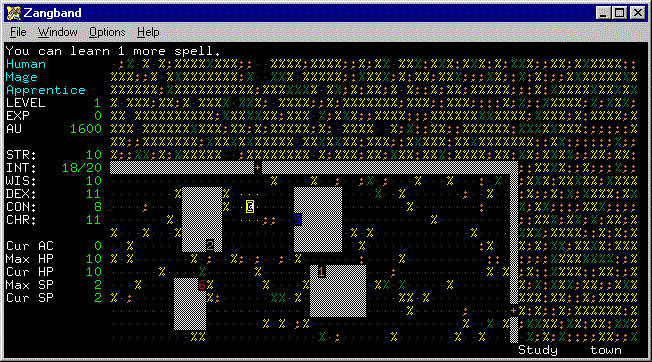
A screenshot from ZAngband, one of the many variants of Angband
(click to enlarge)
However, in 1990, Alex Vutler and Andy Astrand, along with other students at the University of Warwick, created Angband 1.0, which was based on the Unix version of Moria, Umoria, released in 1989. Their goals were to strengthen the Tolkien associations, as well as adding more monsters, artifacts, special dungeon rooms, etc. Further modifications of this version were made until 1992, when Angband 2.4.frog_knows was released. This version would serve as the early baseline for porting Angband to other platforms. In 1993, Charles Swiger took the Angband reins, and version 2.6.2 was released in 1994 with many bug fixes and significantly cleaner code. Ben Harrison, interested in writing an Angband borg (an automatic Angband player), began a major rewrite that allowed easy porting to other platforms. On the first day of 1995, Angband 2.7.0 was released, and Ben became the Angband maintainer by default (Charles got a real job and had to step down). After five years and many updates, Angband was passed to Robert Rühlmann, who fixed the remaining bugs and released Angband 2.9.0. The current release (2.9.1 as of this writing) supports many platforms, including Windows 95/98/NT, DOS, Macintosh, Amiga, OS/2, and Linux, and it also includes graphical tiles if the player prefers graphics over ASCII.
The goal in Angband is to reach the fiftieth level of a dangerous dungeon and defeat Morgoth, the Black Foe of Middle-Earth, as described by Tolkien in The Silmarillion. Along the way, you will fight many foes and find numerous powerful artifacts that will help you in your quest. The structure of the game is fairly simple–the uppermost level is a market, where items can be bought and sold to better prepare your character for the journey ahead. The dungeon below you is randomized, and each level changes every time you visit it. If you explore and clear the first level, and then do the same with the second level, on your way back to the surface the first level will be different than the first time you visited. The dungeon levels are larger than those found in NetHack and ADOM, spanning nine screen areas each, so there’s a lot of exploration to do! Gameplay is very similar to all of the other Rogue-likes that I’ve discussed before.
A great feature that is included in Angband is the ability to define macros. You can redefine keys to perform certain combinations of tasks for you, like wielding a digging tool and digging for a certain number of turns, or alternately attacking with different weapons. You can also engrave items with numbers to make accessing them much easier. There are tons of definable user preferences, vault rooms with special objects, and a very detailed magic system with many different items to experiment with.
I mentioned before that Angband has a huge number of variants. According to the Angband home page, there are at least 32 different variants of Angband, finished or in development, with different features and goals, sometimes significantly modifying the entire gameplay! Here’s a sample of the different games based on Angband.
- Zelazny Angband (ZAngband)–written by a team of nine, this popular variant includes a wilderness, quests, and maps. The objects and monsters are culled from Roger Zelazny’s Amber fantasy series.
- Cthulhu Angband (CthAngband)–written by Dean Anderson, this variant of ZAngband contains monsters from the books of H.P. Lovecraft.
- Multiplayer Angband (MAngband)–written by Keldon Jones and maintained by Alex Dingle, this variant allows multiple players to explore the Angband dungeons, encountering each other and teaming up if they desire.
- Opinion Angband (OAngband)–written by Leon Marrick, OAngband completely reworked the combat and damage system to stress character skills and weapon quality. Other enhancements include a new class (assassin) and throwing weapons.
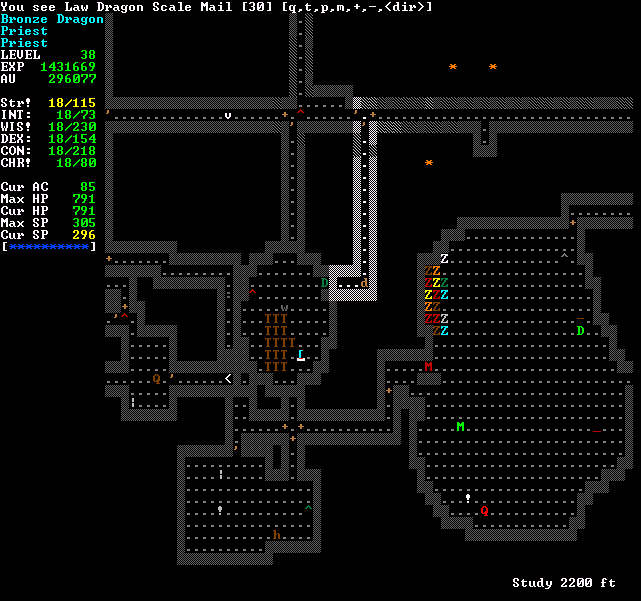
- Dragon Angband (DrAngband)–written by Aaron Mandelbaum and maintained by Tom Morton, this variant allows your character to be a dragon, as well as a Big Screen option and fractal caves.

DrAngband’s Big Screen option in action, with some neat caves
(click to enlarge)
As you can see, there are many different games based on the Angband engine, each slightly changing the game experience to satisfy a different group of gamers. I’ve included a couple of links to quality Angband pages below … Angband and all of its variants are totally free, so grab a copy and try it out!
- Thangorodrim–The Angband Page: This is epicenter of all things Angband, maintained by Robert Rühlmann. Versions of Angband for just about any platform can be found here, along with links to the many variants, help files, and some great Angband humor. Highly recommended.
- The Angband Newbie Guide: Although it hasn’t been updated in some time, this page by Chris Weisiger gives a great introduction to the game and helpful hints for staying alive.
- The AngbandTk Home Page: This site, managed by Tim Baker, hosts the many variations of AngbandTk, a graphical front end to Angband with sound support for Windows platforms. If you really can’t stand the ASCII characters, and the tilesets aren’t good enough, try these versions–you won’t be disappointed.