Welcome to Just Adventure + — Part 43
Just ASCII + A Column Covering Interactive Fiction and Other Nongraphical Adventure Games
Adventurer vs. Red Dragon
by Simon de Vet
(click to enlarge)
By Erik Reckase
Part Six: Magical Infocom Adventures
or
“Is a Zorkmid the Root of Boll Weevils?”
When I set my personal goal of replaying—and winning—all of the old Infocom adventures, I had no idea that it was going to be so hard. I’m beginning to think that I solved a rare few of the games the first time around, fifteen years ago, as most of the puzzles in these games seemed fairly unfamiliar. In any case, I’ll be presenting reviews of the most magical of the Infocom interactive fiction games in this column, namely Wishbringer, Enchanter, Sorcerer, and Spellbreaker. All of these games allow your character to use magic in one form or another, with fairly funky consequences.
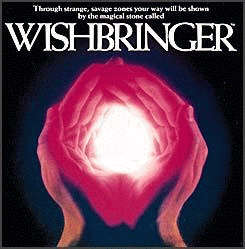 Wishbringer—written by Brian Moriarty
Wishbringer is the tale of a lowly postal clerk in the seaside village of Festeron. Instructed by your oppressive boss to deliver an envelope to the magic shop across town, you discover that the cat belonging to the magic shop’s owner has been kidnaped. Unless the stone Wishbringer is offered as ransom, the cat will surely perish! Your mission is to vanquish the evil and restore the town to its peaceful state.
Although this game was rated “Introductory” on the packaging, I still found it fairly difficult to solve. It is a great introduction to interactive fiction, though, as the game coaches you through the initial set of puzzles before setting you loose. Even though this is not a graphic adventure, I still found parts of this game to resemble “pixel hunting” in that every single thing needed to be examined before progressing. There are a number of objects that need to be retrieved in town prior to delivering the envelope that, if left behind, may force you into a dead end later in the game (one of my least favorite practices in adventure games). On the positive side, some of the puzzles have multiple solutions, so you don’t have to read the writer’s mind to finish the game. (Side note: Unlike the other three games reviewed here, this game is not part of the Zork universe … but you may recognize some familiar places while playing.) As far as nifty packaging goes, Wishbringer included with the original distribution a plastic “rock” that glowed in the dark—neato!
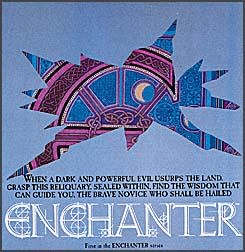 Enchanter—written by Marc Blank and David Liebling
In this first game of the Enchanter trilogy, you start as a fledgling necromancer. An evil warlock, Krill, has taken over the land, and the Circle of Enchanters has convened to try to thwart the dark power. As Krill would undoubtedly notice, and dispatch, any experienced conjurer that came to defeat him, the only solution is to send an inexperienced trainee to sneak up on him. You are called before the Circle and sent on your mission. If you succeed, you will be granted a place at the Circle, but if you fail …
Rated “Standard” on the packaging, there is a balance between fairly basic puzzles and nearly impossible ones included with this game. The best advice, as with all games by these two authors, is to try everything, regardless of the silliness factor. The gibberish spells are loads of fun, and they introduce a stable foundation for all Zorkian magic in the future. I consider the map puzzle in Enchanter one of the all-time classics, mixing limited resources with creative onscreen descriptions … but at the same time, getting past the guarded door to be able to start the map puzzle was far too difficult. Enchanter is not very large, but the inclusion of the spells significantly expands the vocabulary arsenal you are armed with and allows greater depth in exploration. I’m particularly fond of the conversations overheard after “nitfol”ing the frogs, and don’t forget to “zifmia” the Implementors.
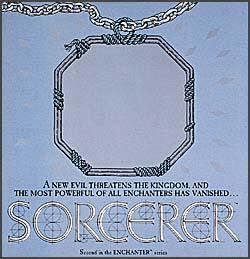 Sorcerer—written by Steve Meretzky
In the years following the defeat of Krill, you take your magical studies to the next level, studying under Belboz, the head of the Circle of Enchanters. Belboz, who has acted very strangely recently, withdrawn and preoccupied with his work, has suddenly disappeared. If evil forces are at work, the entire world may be in danger …
Sorcerer is rated “Advanced” on the packaging, although I found it to be easier than both Enchanter and Spellbreaker. Short of one or two real doozies, the puzzles are fairly logical, requiring careful thought but no creative insight. Maybe I finally reached my stride playing these games while immersed in Sorcerer! This is one of the first Infocom games to utilize a primitive form of copy protection—included in the original packaging was an “Infotater,” basically a code wheel that provided a series of colors for each of twelve different creatures found in the Zorkian world. These colors are used to open a box early in the game—the game randomly selects a creature, and you must have access to the colors to open the box. Sorcerer contains one of the most mind-numbing puzzles I’ve ever encountered in an IF game. I’m still not sure I like how it turns out, and I’m definitely sure that I couldn’t have solved it without a walkthrough. Yes, I’m talking about the time travel puzzle in the gas-filled mine—gee whiz, Steve, how long did it take for you to come up with that one? There’s also some “just-plain-fun” stuff in this game, with a few amusement park rides to relieve your poor necromancer’s tension.
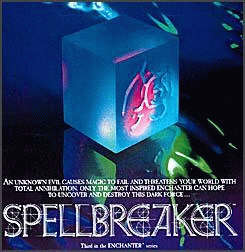 Spellbreaker—written by David Lebling
By saving Belboz from the evil demon Jearr, you earned the right to head the Circle of Enchanters once Belboz retired. With that new position comes great responsibility, so this time it’s all up to you. Magic has become strangely ineffective or erratic over the last months. During a meeting of the Enchanter’s Guild at Borphee, all of the guildmasters, other than yourself, are turned into small amphibians! Your goal is to identify the source of this transmogrification and stop it before everything is destroyed.
The hardest of the Enchanter trilogy, Spellbreaker is rated “Expert” on the packaging, and it deserves every bit of it. You will, in the course of playing this game, come upon numerous white cubes, all of which can transport you to different locations. The cubes were the least of my worries—I simply could not get most of the puzzles in this game. I guess I’m too set in my ways to let my mind stretch in directions that I don’t expect, and this game is built upon that very concept—thinking outside the box. I used a walkthrough for about 50% of this game, probably the most I’ve ever used one on an Infocom game, so I think it’s fair to say that Spellbreaker is just too durned hard. It is fun to try to figure out what it going on, though, and should be played for completeness—just remember, if you can’t figure it out, it’s not because you’re a poor IF player, it’s because Mr. Lebling went to MIT.
* * *
I’ve included a link to the Invisiclues pages below, since I used them extensively while playing these four games. Finding the games, however, may prove much more difficult than playing them! I rarely see the Masterpieces CD that I own available anywhere, but the smaller Collections with four or five games each are much more common at places like eBay and the Game TZ. If you don’t mind electronic distributions, there are downloadable versions of the Collections available from Activision’s store for $8.95, a steal!
InvisiClues: Available in the 1980s, InvisiClues were books of hints for Infocom adventures that were printed using invisible ink (similar to the old lemon juice and candle trick, but a little bit safer). By using the special pen provided, you could get incrementally more helpful hints for all of the puzzles in the games! This actually works better in HTML format, as you avoid the temptation to flip through the book, inadvertently spoiling a surprise that will come later in the game. Highly recommended.