The Greatest Ending Ever
The Greatest Ending Ever
By Jeff Strand
It is our pleasure and honor to feature today’s article by best-selling, award-winning author Jeff Strand. Jeff resides in the warmth of Tampa, Florida, and is the president of EPIC, an international organization for electronically published authors.
His novels include the first two books in the Andrew Mayhem series, Graverobbers Wanted (No Experience Necessary) and Single White Psychopath Seeks Same. Both are dark comedies mixed with mystery and horror, and both involve games as major plot elements. The newest installment, Casket for Sale, Only Used Once, will use computer adventure games as the main focus.
His other novels include How to Rescue a Dead Princess, an over-the-top spoof of fantasy novels, and Elrod McBugle on the Loose, a comedy for kids (and adults who were warped as kids). Upcoming books include the comedy Out of Whack and the killer bug novel Infested.
Jeff is a huge adventure gamer with whom I share a fondness for Spider-Man and games that no one else remembers–like Questron. To learn more about Jeff, please visit his Seriously Whacked website, and while you are there, please consider a purchase before he stows away on a tramp steamer to Alaska.
Like the rest of the world in the early 80s, I was obsessed with Pac-Man. My obsession, however, was less about the game itself than those little intermission skits you’d get to watch after completing every few screens. A giant-sized Pac-Man would chase Blinky, the red monster. Blinky would rip his ghost sheet (or whatever it was) on a needle. Blinky would lose his sheet altogether, revealing the vile slug-creature underneath.
These weren’t anything more than mildly amusing, even to a geeky third grader, but it was the idea that there were hidden cartoons in the game, just waiting to be discovered as a reward to those with superior dot-munching abilities! My speculation ran rampant. How many were there? What happened in them?
Unfortunately, I absolutely sucked at Pac-Man, so I haunted the machine long after my supply of quarters had run out (usually about three minutes after entering any given arcade) and watched, desperately hoping that each new player would have the skills to unlock … the fourth intermission! Since I wanted to be a cartoonist at the time, I drew dozens of them myself as weeks passed and anticipation grew.
Finally, some guy made it, and the fourth intermission just turned out to be a repeat of one of the earlier ones, which fell into the Santa Claus/Easter Bunny category of childhood disappointments. But I got over it.
Around this time my friends and I started to acquire home video game systems, and we spent approximately every moment of our lives not devoted to school, sleep, meals, or unfair punishment to playing them. None of these games were supposed to have endings or undiscovered secrets, but there was plenty of speculation over what would happen if you “flipped it,” meaning you scored more points than the display had room for. This would presumably just reset your score to zero … but not necessarily! One of my friends came very, very close to reaching that goal, but when one of the spectators suggested that such a thing might ruin the cartridge or even the entire system, the owner quickly shut it off.
Then I discovered an Activision game called Laser Blast. You controlled a flying saucer, and three cannons on the ground tried to shoot at you, and you fired your laser and blew each of them away in turn, and then you moved on to the next three cannons and blew them away, and then on to the next three cannons, and … well, that’s pretty much all Laser Blast had to offer. It was so repetitious that if you got a rhythm going, you could probably play the game with the TV off.
But, according to the instructions, you could beat the game! That’s right, if you scored more points than the display could handle, the display would change to “???????.” I wanted nothing more out of life than to see that score display change to question marks. It wasn’t even the idea of winning a prize, although back in those days if you reached a certain score and took a picture of the TV, Activision would send you a patch honoring your accomplishment. I’m sure my mom still has my old, beat-up hat that was covered with patches from Cub Scouts, speech festivals, and most importantly, getting high scores on Pitfall, Kaboom!, and Freeway (the patch for Freeway, which played like Frogger with a chicken, was labeled “Save the Chicken Foundation” and remains the greatest patch ever designed in the history of mankind). There wasn’t even a camera available to record the Laser Blast glory … I just wanted to see those question marks!
My friend and I traded off and made some serious progress toward that goal, but then his older brother made us turn it off over our violent protests because he was sick of hearing boom, boom, boom over and over and wanted to watch TV. So I never got to see the question marks, though of course I wished his brother nothing but the best in all of his future endeavors.
Atari 2600 machines soon gave way to the Commodore 64 (actually, I never had an Atari, I had a crappy Odyssey II, but that’s another story). Suddenly my friends and I had a new wave of games. Adventure games. Role-playing games. And we were not just munching dots or zapping cannons or avoiding chicken fatalities in an endless pattern. You could actually complete these games … and who knew what rewards awaited those who did? What would happen if we finally escaped with the Sword of Fargoal? How long would it actually take somebody to finish Ultima II (“years” sounded like a good estimate)? Did you get a prize if you completed Enchanter? Seeing a display of question marks may have been fine for Laser Blast, but we just knew that these new games, games with actual stories, had really, really cool endings.
In those days, you couldn’t just log on to the Internet and have the complete solution at your fingertips. There were publications that specialized in hints, but we were unaware of them. In fact, the first time I remember acting like an Old Person was years later when I looked at my cousin’s Nintendo Power magazine, which contained an illustrated step-by-step guide to completing (I believe) Legend of Zelda, and I said “Where’s the fun in this? When I was a kid we didn’t have these … oh no what have I become?!”
So there was a mystique to these games, which was probably helped by the fact that most of our games were (with heartfelt apologies to all of the designers of that era) pirated copies without the instructions. We didn’t know anybody who had ever finished them, or even if anybody had finished them. Our knowledge of these games came from each other’s progress, and rumors.
There were lots of rumors. Apparently the all-text Zork I had an astonishing graphics display if you solved the final puzzle. On the other hand, Zork III was reportedly so difficult that nobody had ever finished it, and in fact the game creators had worked independently on two separate halves so that even they didn’t know how to reach the end. Those who finished Ultima II would be given a password and a phone number to call … though it was unknown who would be on the other end. None of us were expecting the Secret of Life or cash jackpots, but we really didn’t know what would happen. Anything was possible.
Then one day I got a frantic phone call from my friend Matt, who was nearly hyperventilating on the other end. “I solved Ultima II!” Within seconds I was on my bicycle speeding toward his house, and I excitedly watched over his shoulder as he replayed the moment of victory. Well, there was no sensational graphics display. No secret password or phone number. Just a brief “congratulations” message.
That put a serious dent into the mystique, but we still loved the games, even as we discovered that there was no prize for completing Enchanter. Zork I had no graphics at the end. Zork III really could be solved. (Nobody ever did find that damn Sword of Fargoal and make it out of the dungeon.)
But then I started playing a 1983 Strategic Simulations, Inc. game called Questron. There weren’t any hints available except for a kid named Scott who you couldn’t ask because the conversations would inevitably go like this: “Hey, Scott, do you know how to find the gold key?” “Yeah, it’s on the fourth level past the dragon. Once you have that, use it to open the black chest and take the sword of jewels and …” “No, no, I just want to know about the key!” “But you need this! Take the sword of jewels and show it to the princess and she’ll give you the powder of chortling and then …” So I vowed to get through Questron all by myself.
Questron was a lot of fun. You have to love a game where you burst into the castle, rob treasure chests left and right, kill hundreds of royal guards, and the king’s reaction (after a brief snit) is to knight you for your courage. As I continued to amass gobs of wealth, massive hit points, superb weapons, powerful armor, and wonderfully efficient transportation, I realized that I could very well win this one!
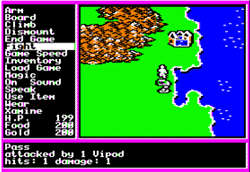
Finally, I was in the last dungeon, Mantor’s Mountain. Anxiety was running high, and the game was genuinely suspenseful. And when I used the magic powder to destroy Mantor for good, I almost cheered (but didn’t, since everyone else was asleep). The game was won, and even though the ending would surely be a letdown, I’d finally beat one of these things on my own.
But something incredible happened. Instead of a quick “Congratulations, now beat it!” type of message, I was returned to the throne room. The guards marched by in formation, though I assume some of them were still a bit annoyed that I’d slaughtered so many of their coworkers. Then (and this was the incredible part) the king’s musicians lifted their horns to their mouths and began to play a tribute. I honestly can’t remember if there was music anyplace else, but this was the only piece of fluid animation in the game. Then the king went on and on about how wonderful I was, and eventually I was allowed to return to the countryside and keep playing, in case I missed anything.
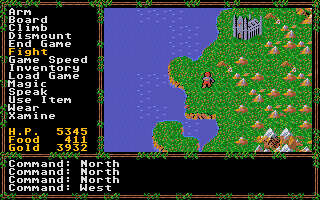
It was the greatest ending ever.
Okay, I’m not going to try to convince you that some marching guards, some music, and a half-second of animation would hold up today, or even ten years ago. But the fact remains that the programmers saved their neatest trick for those of us who made it through to the very end. The ending was a worthy reward for all of the hours spent trying to reach it.
I’m always a little disappointed when I play an adventure game that has a spectacular ten-minute opening, and then rushes through the ending in thirty seconds. I guess from a marketing standpoint, it makes sense … why save your most astonishing technical feat for the part of the game that the fewest players will actually see? And when any player can have a complete step-by-step walkthrough to any game within seconds (and then later complain that the game was too short), the “reward” element is probably not all that important.
But still, I think there’s a wonderful example to follow in Questron. Give us the 21st century equivalent of that musician. Make us go “Wow!” instead of “That’s it?” Make our final moments with the game the very best ones, and show us something really, really cool for a job well done.
And now I need to get back to Stupid Invaders, because a friend told me that real-life aliens track the people who solve the final puzzle …