Review: Vampire: The Masquerade–Redemption
|
Vampire: The Masquerade–Redemption Developer: Nihilistic Software By Cindy KM 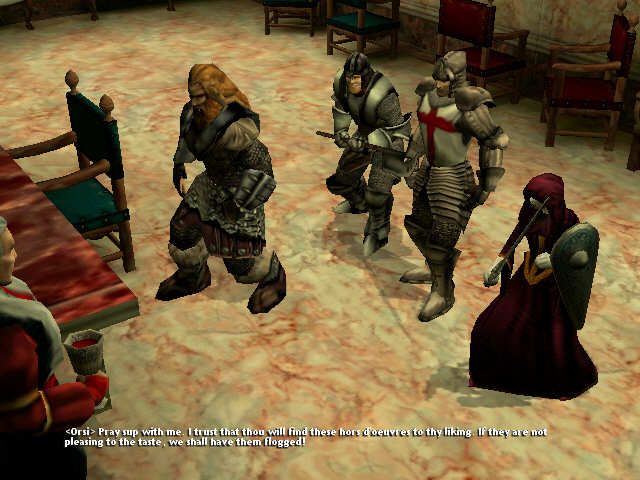 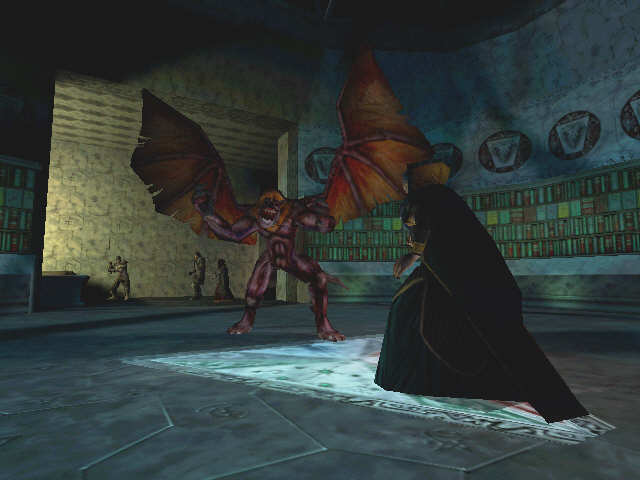 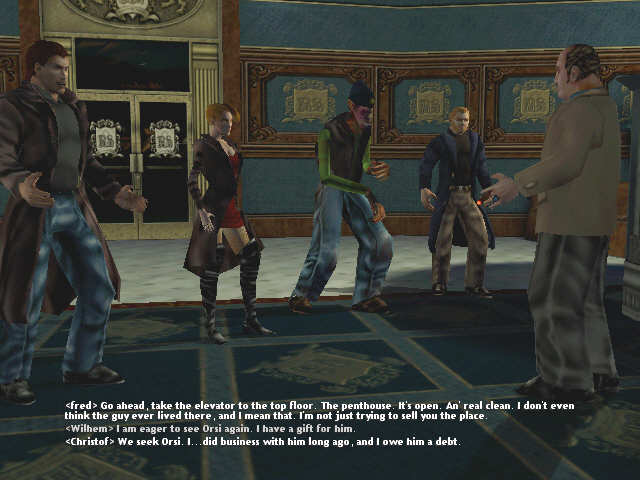 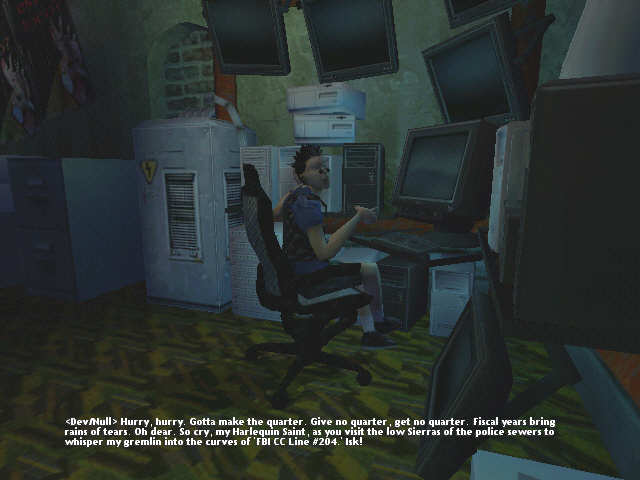 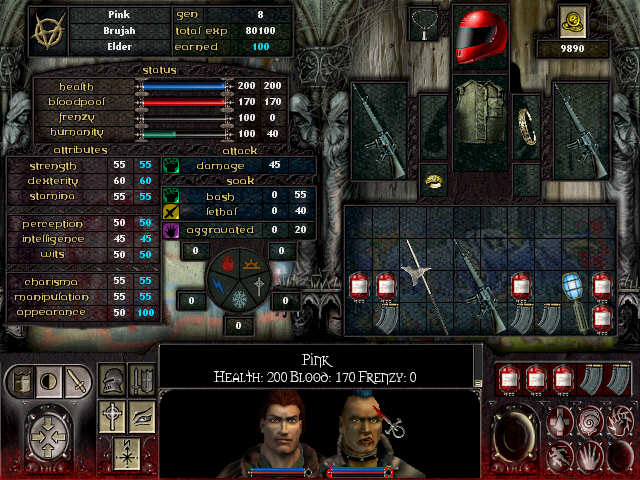 |
Before We Begin
Despite many years of adventuring, I have only recently begun to enjoy the RPG genre and to develop an appreciation for character building and questing. My view of Vampire: The Masquerade–Redemption is formed not as an expert RPG player, but as an adventure gamer in transition.
I should also note that Vampire has two very distinct modes. The multi-player version provides an online parallel to pen-and-paper RPGs. Up to eight players can join with a Story-Teller (the role formerly known as “Dungeon Master”) and play at WON.net. Since I already have one online gaming addiction, this review will focus on the single-player experience.
Of Light and Darkness
The story opens in 1141 A.D. (or, to be politically correct, “C.E.”) with Christof–a young Crusader who has been injured and left to heal at a convent in Prague. He is under the care of Anezka–a beautiful young nun with whom he falls in love. Christof begins his personal fall from grace as he recognizes these feelings and goes out to fight the forces of Darkness to redeem himself and his beloved.
Although you begin as a human, you are soon drinking blood with the best of them. You are not a B-movie vampire, but a noble creature that walks a delicate balance between humanity and the Beast. For gamers not familiar with the pen-and-paper World of Darkness developed by White Wolf Studios, there is a rich tradition of vampire mythology that provides the backdrop for this game. It is worth taking time to read the game manual in order to have some understanding of the sects and conflicts that are discussed throughout Vampire.
“Survive as a vampire across 800 years,” the game box hypes. What it doesn’t say is that you sleep through about 799 of them. You begin the game exploring medieval Prague and Vienna. Then, midway through the story, you awake to modern-day London and New York City. Although feeling a bit robbed (of about eight centuries worth of adventuring), I was still delighted by this transition. Christof swaps his armor for jeans and a flak jacket, his broadsword for a machine gun, and blood vials for plasma bags.
The Nuts and Bolts
Vampire is a richly detailed 3D RPG with a complex story and a cast of interesting characters. Although some dialogue choices are provided, most interaction is through predefined conversations. The third-person perspective is viewed from a lower altitude than games like Planescape: Torment or Fallout so you are closer to the characters and have a better sense of who they are. As one would expect, the game is very dark since sunlight is not a vampire’s friend.
For most of the game, you control a group (or “coterie”) of four–Christof plus three companions. Each member of your party has his/her own inventory, skills, and disciplines. Using a combination of keys and the mouse, each character can be operated individually, or the entire party can be managed as a unit.
Although the base configuration of single-player characters are predefined, you choose how experience points are applied to attributes and disciplines. Blood provides the power to cast spells (including healing) and is managed much like a mage does with “mana” in more traditional RPGs.
Interface Blues
My first week with Vampire was spent getting used to the interface and understanding the implications of the in-game choices I was making. Despite an extensive manual, I still found myself stumped by questions like “how do I feed?” and “how do I heal?” And, of course, “how do I save?” (the answer to which is “not very easily” unless you have downloaded Activision’s patch).
For me, the biggest challenge was learning to orchestrate the actions of multiple characters. Invariably, I would enter a town and find that one member of my party was attacking innocents (not a good thing). Or I would realize that Christof was fighting alone as his companions watched or ran off to battle elsewhere. Things were made worse by glitches in the game that allows characters to get snagged on the landscape. However, by the time I reached London, my group was kicking ass and taking names.
Follow the Yellow Brick Road
In single-player mode, Vampire is a very linear story with clearly defined objectives. New areas open as your tasks require access and old areas tend to close behind you. In short, you follow a predefined game path with little room for creativity except in the way you fight. For those new to RPGs, the fixed storyline may make the game more comfortable. Instead of being faced with a wide landscape to wander in confusion, Vampire pushes you along from the beginning. I suspect, however, that this rigidity may prove to be too restrictive for the RPG veteran.
Despite beautiful graphics and a creative sound track, Vampire is an extended dungeon crawl. Each city has several multi-level dungeons and most require you to wade through a horde of monsters in order to confront a bigger monster. After awhile, the continuous cycle of “hack-slash-loot” wears thin (as does Christof shouting, “To the Abyss with Thee,” through every battle).
The Bottom Line
With Activision’s patch, Vampire provides a reasonable entry point for those wanting to experience the RPG genre. The story is interesting and there is a certain amount of satisfaction that comes from learning to play with a group of characters. However, the mythology is a bit hard to follow and, as the old adage goes, “when you’ve cleared one dungeon, you’ve cleared them all.”
For those new to RPGs, the art of hack-and-slash may be greatly refined through the use of a strategy guide. For those who are truly action-challenged, several web sites have cheat codes to give your characters a preliminary boost and increase their odds of survival.
Despite the single-player limitations, I believe that Vampire will ultimately shine in the multi-player environment. As the kinks are worked out and Story-Tellers build their skills, this game has the potential of providing an unprecedented peek into the World of Darkness.
Final Grade (Single Player): B
If you liked Vampire: The Masquerade–Redemption:
Watch: The Hunger
Read: Interview with a Vampire by Anne Rice
Play: Nocturne
System Requirements: Pentium II 233 MHz processor
Windows 95/98
64 MB RAM
720 MB hard disk space
Quad Speed CD-ROM drive
DirectX 7 compatible sound card
DirectX 7 compatible 3-D Accelerator Card required
Multiplayer supports Internet and LAN play