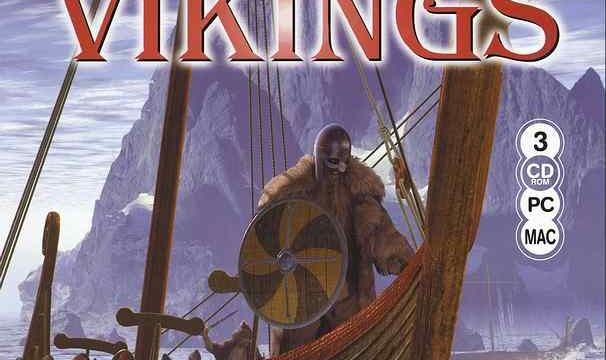
Review: Vikings
|
Vikings Developer: Index+/France Telecom Multimedia By Tom Houston |
Do you speak Viking?
Are you ready to forget who you are and immerse yourself into the economic, political, social, and cultural structure of the Viking society of 1,000 years ago?
Will you be prepared to embark on a legendary adventure on the icy seas of the North Atlantic?
Well … in order to play Vikings, the only solution is to be a Viking. Forget who you are, you will need to live like a Viking … think and react like a Viking. Only if you are successful in so doing will you be able to confront the Forces of Chaos and restore order to the Viking world. Sounds a little like you will be going on a Viking version of The Longest Journey, doesn’t it? Well … as you will see later in this review, that’s exactly what you will be challenged to do.
And … the reward will be that you will thoroughly enjoy the experience, as Vikings is a gem of a historical adventure game. Promoted as a game for adventure gamers who bought Crusader, Atlantis, Versailles, and Egypt, Vikings is easily the crown jewel among these historical adventure games that were released during the 1997-1998 time period.
Sadly, as was the case with Treasure Hunter and Crusader, Vikings was released on a limited basis only in Europe (this game in 1998), so North American gamers never have had the opportunity to play and enjoy any of these unusual and interesting edutainment games.
Because Vikings is an edutainment game, I am compelled to provide some of the “edu” background for the game that served to give the game historical authenticity and contributed to the recreation of the Viking world and the Viking society.
The Viking Age
The Viking Age of exploration is thought to have begun in the year 793, when Viking warriors sacked the Abbey of Lindisfarne in Northumberland, England, and ended in 1066, when Harald the Merciless, King of Norway, was killed in the battle of Stamford Bridge in England.
In between these events, the Scandinavian peoples of Denmark, Sweden, and Norway were faced with a shortage of arable land in their native countries, so they embarked on large-scale migrations to the west and settled in Iceland (about 870) and Greenland (about 983). Thus, the Viking Age prospered and, therewith, the legends of the Viking explorers and warriors were launched and recorded.
Perhaps the most recognized figure of the Viking period is Leif Eriksson (980-1025). The son of the famous explorer, Eric the Red (who discovered Greenland), Leif’s life and voyages have been recorded in many long Icelandic sagas.
Because Leif did not make maps, there has always been much speculation about exactly where Leif’s voyages took him, and his discoveries remain the subject of historical debates.
An enduring mystery has been the time and location of the first European colonization of North America. Journals recount a voyage in the year 1002 by Leif Ericsson that took him and his crew to the west from Greenland, first to an island that he called Helluland (Flat Rock Land), which some historians believe was Baffin Island, and, then, traveling in a southerly direction, Leif found a heavily wooded region that he named Markland (Forestland), which is thought to have been Labrador.
Subsequently, Leif continued further to the south and went ashore at a place where he found grapes growing. He named this place Vinland (Wineland). They spent the winter in Vinland and built houses to live in and shelter for their ship.
It is this last discovery of Vinland that has fostered the greatest debate among historians. Supported by archaeologist’s findings of the ruins of a Viking settlement, some believe that Leif landed in what is now the northern portion of Newfoundland. Others have interpreted evidence of physical findings as proof that Leif arrived in New England, along the banks of the Charles River in the Cambridge section of Boston.
The theories abound and have been argued for centuries, but the role of the Vikings as explorers in the North Atlantic remains an important part of the history and civilization of this part of the world.
When Viking Warriors Sailed the Seas
Our most prevalent images of Viking warriors portray them as sort of wild and ruthless barbarians, but this picture is not accurate. Except for a group of really crazy Vikings, called the Berserks, Viking warriors were predominately farmers and hunters who used their skills more to survive rather than to do battle. However, should they be enticed to do battle, they became fierce fighters who would show very little mercy for their enemies, such that when they attacked villages, they often killed everyone, including women and children.
While well-equipped with weapons, such as the double-edged sword, battle-axes, bows, spears, and daggers, and well-protected with body armor and shields, the real advantage that the Vikings had was their ships, called “knorrs.” These flat-bottomed boats were ideally suited to give them access to shallow inlets and canals along the coasts. They used these boats to attack by surprise and mostly defeated their enemies before the enemy realized that the Vikings were upon them. They did not win battles because they excelled as fighters, they won because they were exceptional sailors and knew how to use the tactic of surprise attacks.
And So … Our Viking Adventure Begins
We are at the beginning of the year 1000, in a world on the edge of chaos, when we, as the player, are introduced to Hjalmar, son of Ingmar, a powerful Viking chief and owner of a rich estate in Iceland, who has been murdered.
Who are his murderers? Where is his ancestral magic axe?
The story is being told by Eldgrim, a shaman, who knows terrible secrets and is to become Hjalmar’s teacher.
Hjalmar has been sent to Norway to be raised by his father’s friend, Leif Haraldsson, where he learns that 20 years ago, Ingmar, Haraldsson, and another friend of his father, Ingolf, who now lives on a large estate in Greenland, conspired to amass their considerable wealth by conducting eventful raids in Vinland (Newfoundland).
As the absolutely fascinating story unfolds, the player, as Hjalmar, travels through four unbelievable worlds of terrifying adventure, where Hjalmar seeks answers to a growing list of mysteries and murderous events. Along the way, as “heads fall all around him,” evidence mounts that would indicate that Hjalmar is the murderer, and the player’s task expands to find evidence that will prove Hjalmar’s innocence.
It seems that this will not be an easy task, however, because things are not quite as they seem.
What are the unspoken consequences of the raids by Ingmar, Haraldsson and Ingolf, and what is their impact on the current tragic events?
How will Hjalmar deal with the adversarial actions of Saeun, a necromancer and the wife of Ingolf, who was abducted during one of the raids on Vinland, and her warrior-beast servant Ragnar?
What about Hjalmar’s fascination with Thorild, the mysterious daughter of Ingolf and Saeun? Will his blind love prove to be his undoing or his salvation?
What is the reason that Eldgrim, the shaman, pays so much attention to Hjalmar? Is he exactly what he says he is, or someone/something quite different?
These are but a few of the questions that you will deal with as you investigate myriad exciting events that propel you along the way in the unfolding of this marvelous story and in solving historically logical puzzles, all of which eventually will lead you to understanding and accepting Hjalmar’s destiny.
If you recall my earlier reference to The Longest Journey, you may now suspect what Hjalmar’s destiny is. There are crucial mythological stakes at risk here, so suffice it to say, you will not be disappointed by the ending of your extraordinary Viking adventure.
Are You Ready for the Total Graphical/Sound Experience?
Without question, Vikings uses the most interesting and satisfying graphical approach to an adventure game that I had ever experienced and totally submerged me into the game, such that I had a very difficult time tearing myself away from it, which resulted in a couple of really late nights of game playing.
First of all, the graphics, whether 2D, 3D, videos, or animations, are all excellent, as should be the expectation from any game originating from Index+ and France Telecom Multimedia.
However, for me, the exciting and unusual use of interactive full-motion video (FMV) was the feature that separated Vikings from any other game that I have played. Using 20 accomplished actors dressed in authentic Viking costumes, there are over 300 video scenes that occur in 3D against a backdrop of 2D scenery, and each of these sequences is simply riveting. Add to this the wonderful use of frequent animations and special effects, and you are ready to experience the total graphical experience in a satisfying manner that you may have never experienced before.
Right up there on a par with the graphics is the musical score and the sound effects. Whether the scene called for a foghorn, a creaking wooden ship, or the clashing of metal swords, the sound effects are breathtaking. Complete the auditory presentation with the memorable original music, composed by Olivier Pryszlak, and you have the perfect blending of sounds and pictures that makes Vikings a unique and immensely pleasing experience for the player.
The result of the combination of high-quality graphic and sound presentations is that the atmosphere and the mood of Vikings are simultaneously beautiful and magnetic.
A Game Interface That You Can Be Comfortable With
The interactive views, scenes, and FMV sequences utilize about seven-eighths of the screen, so you won’t have to squint to see the action. The game is played primarily from the first-person perspective, except in video sequences that involve actions either by or upon Hjalmar, where we see the activities occur from a third-person view.
All of the actions in the game, including the initiation of the FMV scenes, are controlled by your mouse. By passing the mouse cursor over the scene on the screen, you can activate different icons that indicate whether you can interact with an object (pick up or use) or a character (talk).
Along the bottom of the screen are the toolbars that allow you to access the documentary base (the QuickMode bar), your inventory (the wallet), the current riddle/puzzle screen (the key) and the options menu. The escape key is used to get to the main menu, which includes the new game, save, load, and exit screens.
The Puzzles Are Called Riddles
Contained within the four Viking worlds that you will explore during the unraveling of the story are nine puzzles, called riddles, that must be solved in order to advance in the game. The puzzles come in a variety of forms that sometimes require the player to find and use inventory items or to seek clues by talking to the characters in the game and, at other times, require the player to successfully perform a game within the game itself.
Let me explain. An example of an inventory-based puzzle would be one in which you are required to locate and place craftsmen and laborers in their proper places of commerce in the Viking world. An example of a puzzle that is a game would be the Knattleikr Match, which is a kind of baseball game, but with more serious potential consequences.
As an interesting variant and often needed in solving puzzles, in addition to obtaining inventory items from within the scenes of the game, you will also want to capture the images of certain characters in the game and to search for clues in the documentary files that are available to the player, through an onscreen historical search feature, called QuickMove.
The puzzles are always logical, all are unique to the Viking world, they’re fun to play and not too difficult, so I promise no one will become bored or frustrated.
Take Care of Yourself, Hjalmar. Who Knows if We Won’t Need You in a Thousand Years?
With these prophetic words from the sage, Eldgrim, thus ends the story of Vikings and we are left to ponder not only Hjalmar’s destiny and the fate of the Viking world of a thousand years ago, but also what forethoughts or knowledge Eldgrim may have that would suggest that Hjalmar could be needed again in the future.
Vikings is a unique historical adventure game, in that it features a period of time from the past that was packed with exploration, action, murder and mayhem, mythical beliefs, brutality, hard living, and even bawdy behavior … all of which is accurately presented on the three CDs that make up the story of Vikings. Add to that the character of Hjalmar, raised according to his birth rank as a Jarl (Viking nobleman), influenced by the blood of his ancestors, a Berserkir (warrior-beast), who under the tutorage of Eldgrim, toughens with each test of life’s struggles and learns to be a warrior, a leader, and eventually a hero.
The result is a strong story with interesting characters, beautiful graphics and sound, wonderfully integrated interactive video sequences, fascinating puzzles, and an overall edutainment gaming experience that I will not soon forget. I enthusiastically recommend that if you enjoy historical adventures, you consider making the effort to find this game.
Final Grade: A+
Minimum System Requirements:
PC:
Pentium 133, Windows 95 or 98
16 MB RAM
Video card with thousands of colors
4X CD-ROM
16-bit sound cardMacintosh:
Power PC, System 7
12 MB Ram
Video card with thousands of colors
4X CD-ROM
16-bit sound card