Review: Vagrant Story
|
Vagrant Story Developer: Squaresoft By Erik Reckase 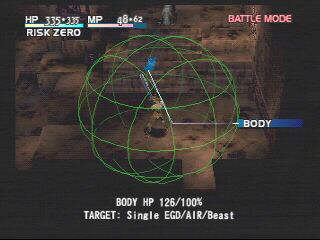 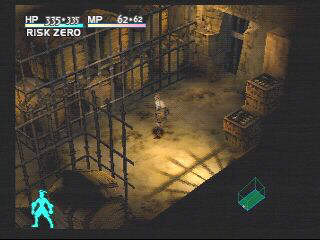 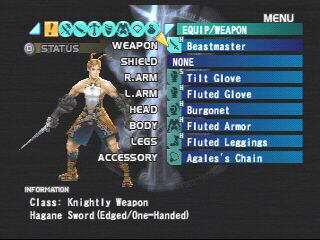 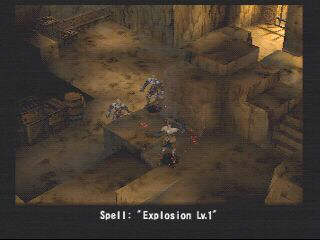 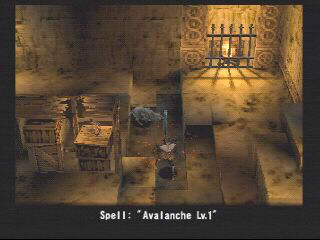 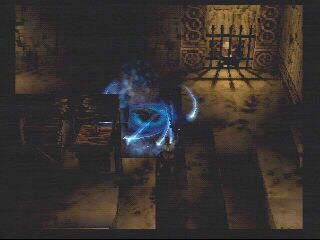 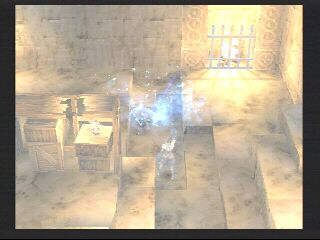 |
One of the great things about my job is that I get a free vacation at the end of the year. One full week without the constant stress of work…I had hoped that I would be able to catch up on my stack of unplayed games, possibly finishing a few of the titles that I’d put off for a few months when new releases took center stage. This, unfortunately, was wishful thinking. I was only able to play a single game during my holiday break–not because I didn’t have time to play more, but because it was such an incredible experience that I didn’t dare take it out of my Playstation console. As the title of this review indicates, the game that stole my free time was Vagrant Story, probably the best game Square has ever made. Just about every aspect of the game made me proud to own a Playstation, so I’ll do my best to fill you in on the greatness of the game.
What’s Going on Here?
The basics of the story: A cult of religious fanatics, known as Müllenkamp, have seized the manor of Duke Bardorba of Valendia Kingdom. The leader of the cult, Sydney Losstarot, was known to have participated in the attack but has not been seen since. The Duke, fortunately, was away from the manor at the time, so he was not subject to the whims of the assailants … but a week later, he was assassinated.
Ashley Riot, a Riskbreaker in the Valendia Knights of the Peace, has been named as a suspect in the killing, although he has also mysteriously disappeared. Strangely, during the week following the incident at the manor, Ashley made a mysterious journey to the deserted city of Leá Monde, a dilapidated ruin destroyed by an earthquake 25 years before. Water entering the earthquake’s wake cut off Leá Monde from the rest of the world, and rumors abound regarding the ghostly fate of the city’s residents.
In Vagrant Story, you play Ashley Riot in the week following the manor incident. Your goal is to find out the truth about the attack, about the assassination of the Duke, and about yourself. Vagrant Story boasts one of the most richly detailed plots in any Playstation game–so complex, in fact, that there have been game guides specifically written about the plot alone. The characters in the story are finely detailed, and they act true to form throughout the game. There is no voice acting in the game, which almost makes the story more believable–it’s like reading a good book instead of having to listen to one being read to you. The plot is revealed in a series of cut-scenes with text balloons, much like a comic strip. I won’t reveal any additional plot details, but I will say that at the conclusion, you question the events that you have just witnessed–this game makes you think. Some of the younger folks might have some difficulties understanding the finer parts of the story, so keep that in mind if it matters to you.
Overall Plot Grade: A+
How Did it Sound?
If a game is really, really good, I don’t usually notice the sound. I was lucky enough, though, to get a pair of wireless headphones from my wife for Christmas, so I was able to turn them up and listen to this game at a much higher volume than I’m used to–and it was worth it. The sounds of battle and magic are excellent, much better than many of the PC RPGs out there. What sold me, though, was the dark, semi-metal background music coupled with the environmental screeching of birds, quiet roar of waterfalls, and distant unholy groans. Music in a game should not intrude into the gameplay; it should complement the actions of the player, unobtrusively adding suspense or a false sense of security at appropriate times. This technique is mastered in Vagrant Story and should not be missed.
Overall Sound Grade: B+
How Did it Look?
Where do I start? There are so many positive aspects to the graphics in this game that I will never be able to list all of them–so I’ll talk about my favorites, and touch on some others.
First impressions are very important when starting a role-playing game–it’s like a first date. If the game seems somewhat dull after a few minutes, chances are that you’ll play it a few times without much optimism and then send it to the only-if-I’m-truly-bored bin and move on. My first impression of Vagrant Story was one of the most amazing experiences I’ve ever had, and I hope that all PSX owners will play this game just for the first ten minutes. Not only is there an amazing cinematic introduction (aside: all of the cinematic sequences in the game are rendered using the game engine, so there’s a sense of continuity in everything that’s seen) that explains the story, but also sequences in the introduction that allow you to participate. When I was suddenly thrust into the action during the opening movie, my heart was pounding and my fingers were twitching as I frantically grabbed the manual in search of control configurations. The ten or so minutes of game introduction are better than many whole movies that I’ve seen in theaters–it’s really that good.
Although Ashley Riot would win a “wildest hair” contest–hands down–the skins on the many characters and creatures found throughout the game are surprisingly detailed given the available resolution of the Playstation. In fact, even the larger boss creatures (dragons, phantoms, minotaurs, etc.) are very finely detailed. The motion of these characters is simply fascinating to watch. The background artwork in the game is unparalleled–the manor, the many dungeons, collapsing mine tunnels, castle walls, and wine cellars are presented with details that raise the bar an order of magnitude for other RPGs. There’s a sense of “realism” that I’ve not experienced often in my twenty plugged-in years of gaming that oozes from every corner of Vagrant Story.
There are also wonderful waterfall and stream effects, lighting tricks, graphically unique weapon and shield models in animation, smooth camera angle motion, a unique and easy to navigate mapping system … I could go on and on. Graphics aren’t everything in a game, however, so we’ll move on to gameplay for the real meat of Vagrant Story.
I have only one complaint with the graphics–sometimes (I’m sure to conserve space on the CD) rooms are repeated within a particular area. After walking into a room, you’ll notice that it looks exactly like a room that you went through a few minutes ago, although it might have a few different monsters in it. I understand the need for this in a one-disc game, but it was plainly obvious that the rooms were repeated (down to the broken furniture and treasure chest placement) causing the only hiccup in my suspension of disbelief.
Overall Graphics Grade: A
Was it Fun?
Vagrant Story has one of the most complex, and yet easy to use, battle systems that I’ve ever seen. At the outset of the game, it’s very simple–there’s a basic targeting system that allows Ashley to hit different parts of the enemies’ bodies. Certain parts are easier to hit than others, and each part has an estimated damage associated with a hit. As Ashley gains experience, he remembers skills that he learned sometime in his past adventures, and he can use them in the form of defense abilities or chain abilities. By pressing the buttons on the controller at the exact moment of contact (whether magical or physical) Ashley can “chain” attacks together (and inflict status abnormalities) or defend himself in many different ways (reflecting damage, absorbing damage, etc.). Using these abilities is not free, however–it comes at a cost of risk points. The higher Ashley’s risk, the less likely he is to hit his target during an attack. Risk decreases slowly over time but can be reduced faster with magical items or by putting his weapon/shield combo away. There are also special attacks available for each weapon called Break Arts, which inflict more damage than regular attacks at the cost of hit points.
The equipment Ashley uses evolves over time as well. By using a particular weapon against a single type of enemy, the weapon becomes more and more powerful against them, causing more damage and increasing hit percentages. Armor and shields work similarly, although they take up more room in Ashley’s inventory and therefore are harder to specialize.
As Ashley progresses, he finds new, more powerful weaponry in the form of blades and grips. In special workshops found in the city, Ashley can build new weapons and armor from the pieces that he finds through exploration. But what about that special weapon that works well against phantoms? Ashley can also combine different blades and shields, resulting in more powerful equipment with similar affinities. He can also combine armor for different parts of the body, sometimes resulting in armor for a totally different body part.
On top of all of this, there is a well-organized magic system divided into four categories–Warlock (attack magic), Shaman (recovery magic), Sorcerer (aid/status magic) and Enchanter (affinity magic). With a simple two-button combination, the player can not only access each type of magic, but different parts of inventory, speeding up the battle process (but only when the player is comfortable enough to use it!). The graphical effects from the magic spells are very good, slow enough to watch but fast enough to keep the action flowing.
But wait! There’s more! Some of the most devious sliding box puzzles I’ve ever seen can be found in Vagrant Story. By allowing different types of cubes (indestructible, magnetic, sliding, move-limited, etc.), an amazing variety of puzzles are present in this game. Make a mistake? Leave the room and come back, and the cubes have reset to their original positions. Want to try to solve them faster? Returning to a puzzle room will allow you to beat your best time. Tired of the darn things? You can set an option to leave the puzzle solved once completed. Many of these are simple, but some took some very careful thinking.
The best part of Vagrant Story is replayability. When I completed the game the first time, I had only seen 75% of the total world map! Certain areas are only accessible during replays, where more monsters and powerful weapons can be found (and you start the game with everything you accumulated during previous games). I’m in the process of playing a second time, and I know exactly where to go for the hidden areas–and I’m loving it even more the second time! I usually hate replaying games, but Vagrant Story is a very notable exception.
There’s only one thing I found hard to deal with in the game–there are a limited number of “Save Points” where your progress can be saved for a later day. There were only one or two places that made me wish for more save spots, but I’m nitpicking. Even the interroom delay was amazingly short, considering that the camera angle can be changed at will–smoothly–to one of eight directions. With games like the horrendous Galerians on the market, developers should take notice.
Overall Gameplay Grade: A
I’m sure I’ve left some things out of this review, but that’ll make it that much more fun for you, the reader, to explore and discover. Vagrant Story is probably the best game I’ve played, or ever will play, on the Playstation console. I may even make it part of my permanent collection (it would be the first in that exclusive club). Highly recommended.
(Note: I felt very deceived after purchasing Vagrant Story due to the prominent “2 DISCS” indicator on the jewel case, when the game is actually only one disc. The other CD is a demo disc containing playable demos of Chocobo Racing, Threads of Fate, and Front Mission 3, as well as preview movies of Chocobo’s Dungeon 2, SaGa Frontier, Chrono Cross, and Legend of Mana. I’d like this to be clearer on the box, but given the depth of the game, I don’t have any problem with it now!)
Final Grade: A