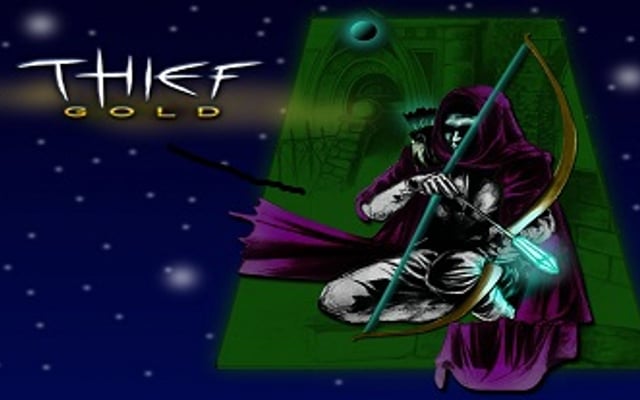
Review: Thief Gold
|
Thief Gold Developer: Looking Glass Studios By Ray Ivey 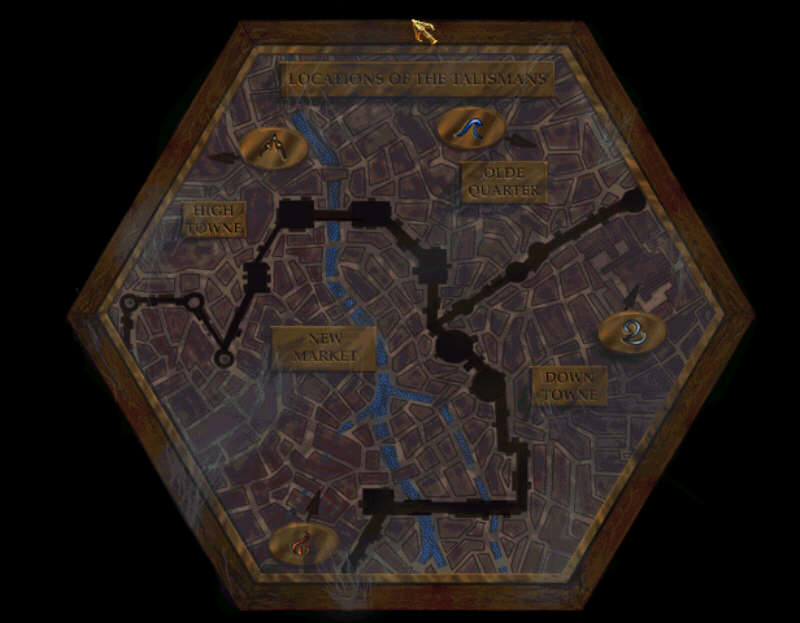 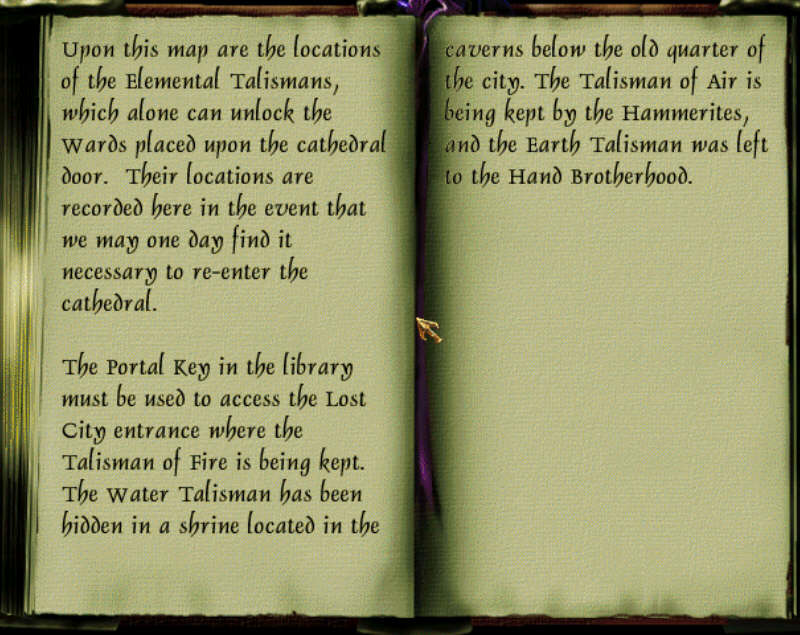 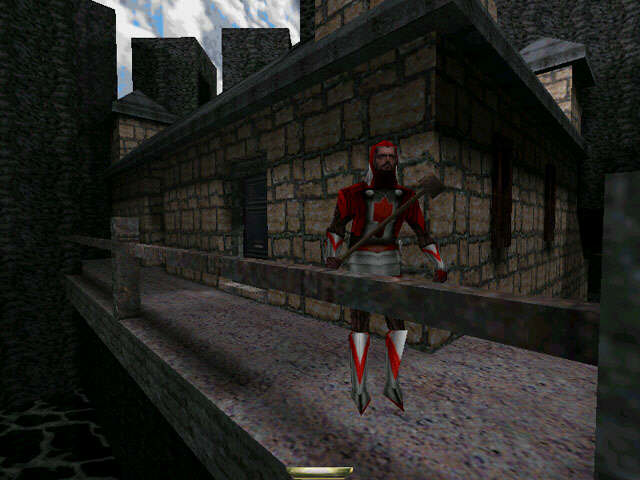 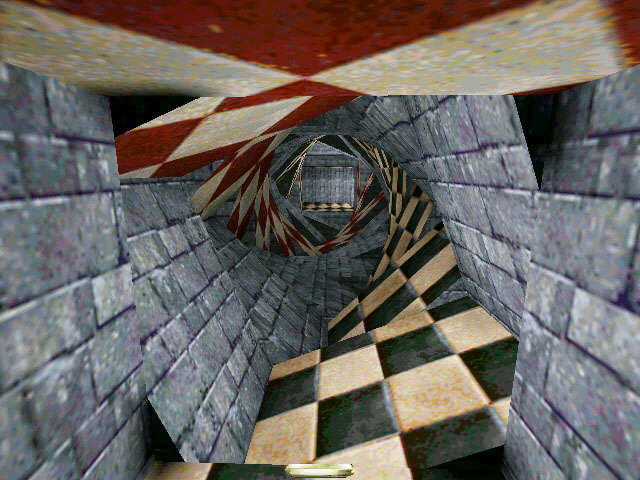 |
I began my gaming career as a hardcore pure adventurist. The first games I played were Riven, Myst, The Blackstone Chronicles, and Amber: Journeys Beyond. I quickly became a fanatic for the genre, and with the zeal of a new convert I pored over internet sites to learn more about these fascinating and almost painfully addictive games.
During this exploration I generally shut out any information about games in other genres. I just considered such information noise. I even became an adventure snob. For a while.
Luckily I came to my senses about eighteen months ago and began gingerly exploring the best of other genres. I played the original System Shock and was terrified and enthralled. I played Lands of Lore: Throne of Chaos and was enchanted.
Then I picked up Thief Gold and was utterly, completely, irrevocably blown away.
Thief Gold is the expanded and tweaked version of 1998’s Thief: The Dark Project, which won many awards in a year otherwise dominated by the action milestone Half-Life. What the brilliant gamebuilders at the (late lamented) Looking Glass Studios did was nothing less than completely reinvent the action genre. And in doing so they created a game that appealed to action gamers and adventure players alike.
Their stunning central idea was simple but powerful: turn the action game on its head by placing the emphasis on stealth rather than confrontation. In a flash they eliminated the central problem many gamers have with action games–they’re not interested in running around shooting stuff.
With this simple change in focus, all of the other traditional mechanics of the first-person shooter suddenly translate into thrilling gameplay: smooth real-time-rendered graphics engine, first-person perspective, and 3D sound.
In other words, Looking Glass built an action game even the most die-hard adventure player could not only like, but love.
The story and setting of Thief Gold is compelling and mysterious. You play Garrett, a master thief who lives in an unnamed city that’s part medieval, part primitive mechanical. Through the game you learn much about the city’s complex social and religious structure, and it’s heady stuff indeed. Even details such as the prayers you overhear guards of the Hammer sect mutter to themselves sound authentic.
After loading up the game, there’s a truly helpful and enjoyable tutorial that teaches you the mechanics of the game. After Thief and System Shock 2, I have to say (the late lamented) Looking Glass had it going on when it comes to training missions.
After the training, it’s time to infiltrate Lord Bafford’s mansion. The first moment I successfully snuck up behind an unsuspecting guard and quietly knocked him out with my trusty blackjack, a stupid grin spread over my face and I was hooked. The whole notion of sneaking into the mansions of the wealthy, absconding with their valuables, and leaving without ever being detected is just insanely fun.
Darkness is your best friend in Thief. In shadow you become virtually invisible, and you can quietly sneak up behind guards or slink past them. Knowing how visible you are is all-important, and to this end there is a handy “visibility jewel” on the screen. The brighter it is, the more visible you are; the darker, the more hidden.
The sound design is absolutely incredible. In fact, this is a game you play with your ears. Standing breathlessly in shadow, leaning against a wall, listening to a guard’s footsteps approaching you, or receding away from you, is quite a thrill. Eavesdropping is a major activity in the game, and it’s through listening in on conversations that you learn much of the game’s story.
The sounds you make are also of paramount importance, since as good a thief as Garrett is, is evidently never occurs to him to wear soft shoes. Every surface you walk over has its own signature footstep, and some are so loud they can give you away in a hurry.
Helping you in your quest is a bow that uses a variety of very clever arrows: water arrows with which to put out torches, moss arrows to soften the sounds of your footsteps when necessary, rope arrows to help you climb, and many others.
Since all of these resources are strictly limited, you have to choose your tools (and confrontations) very wisely. This makes it necessary to use careful strategy during the loadout at the beginning of each mission, when you spend your ill-gotten gains on appropriate tools for the next mission.
Most action games have difficulty levels, but Thief has the most effective use of this device I’ve ever seen. There are three difficulty levels at which you can play each mission. Generally, since I’m uninterested in how good a shot I am, I always dial the difficulty setting down to Easy on an action or action/adventure game. Not so with Thief, because playing on higher difficulty simply adds mission objectives and more challenging (and interesting) restrictions. The most important of these restrictions is that on Expert you generally can’t kill anyone. These added mission objectives add length and complexity to the game, and the “no killing” directive is so in keeping with the spirit of the game that I found I wasn’t interested in playing any other way. I would say that playing the game on Expert adds at least 75% more game time.
I know the Thief engine has received criticism for its limitations, but I found the graphics to be excellent. The real-time 3D environments are quite vivid, and as I swam, climbed, and snuck through the city, investigating mansions, temples, and crypts, I felt a strong sense of reality.
In fact, I would say that the experience of playing Thief was the most intense vicarious game experience I’ve yet had. When I finished a mission, I truly felt like I had physically been through the experience.
Unfortunately, in the midst of all this fantastic news is one big fat turd in the punchbowl. It seems that the daring designers at Looking Glass didn’t quite have the nerve to make the entire game so revolutionary, and so they included several missions in which your opponents aren’t human guards and civilians, but all manner of ghosts, zombies, and monsters. To me the enjoyment level between the “human” missions and “monster” missions was night and day.
Happily, it seems the designers really listened to the players when designing Thief II, and it reportedly relies far less on these much more mundane foes.
Thief Gold has three more missions than the original Thief: The Dark Project, and they haven’t just been tacked onto the end of the game; they’re spliced into various places in the game. The original missions have been tweaked and edited as well, so that the entire sweep of fifteen missions has great continuity. It’s also telling that all three of the new missions are of the “human” variety, and what’ s more, they were my three favorite missions in the game. The first deals with infiltrating the Thieves’ Guild and setting up two rival factions to blame each other for your deeds; the next deals with the Mage Towers, a vast mission with a dizzying variety of challenges. My absolute favorite mission of the game, however, was the third new mission, “The Song of the Cavern,” in which you have to infiltrate a huge opera house.
Almost all of the missions in the game are huge, and they are worth the long loading times for this reason: the entire mission loads. No more pace-breaking, finger drumming pauses for the game to load as you enter a new area. This is a big plus.
I could go on an on about this splendid game, but I’ll shut up now. Time to load Thief II.
Here’s the bottom line: Thief took me places I’ve never been in my gaming experience; it redefines the possibilities of computer gaming, and has forever raised the bar on game excellence. So there.
Final Grade: A+ (despite the monster missions)
If you liked Thief Gold:
Play: System Shock 2 or Deus Ex
Read: Shibumi by Trevanian
Watch: Topkapi or Rififi
System Requirements:
Pentium 166 or equivalent
32 MB RAM
4X CD-ROM
SVGA
4 MB VRAM
42 MB free disk space
Mouse
DirectX v6.0