Review: The Legend of the Prophet and the Assassin
|
The Legend of the Prophet and the Assassin Developer/Publisher: Arxel Tribe 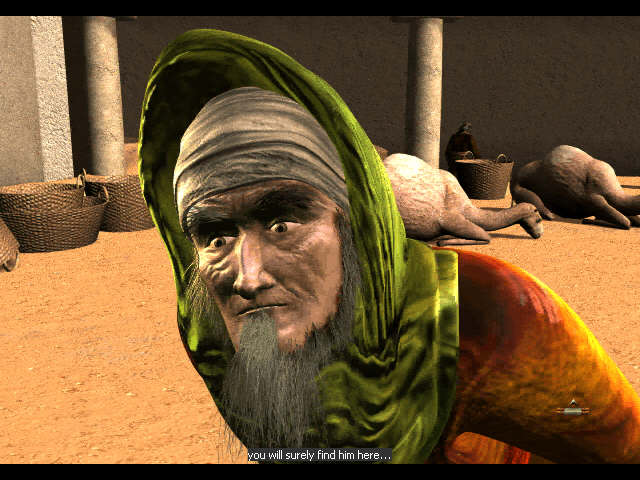 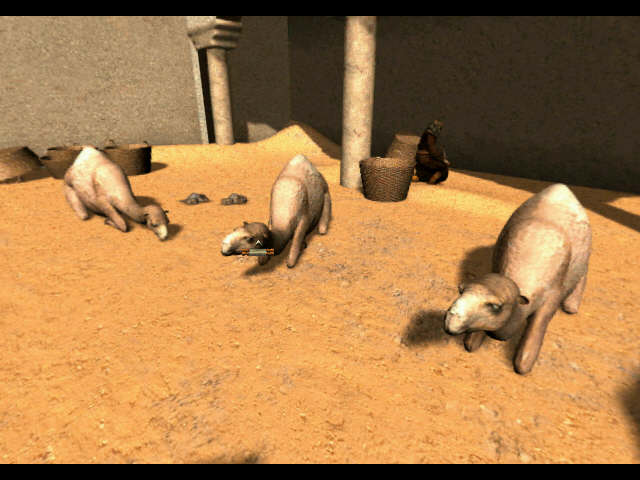 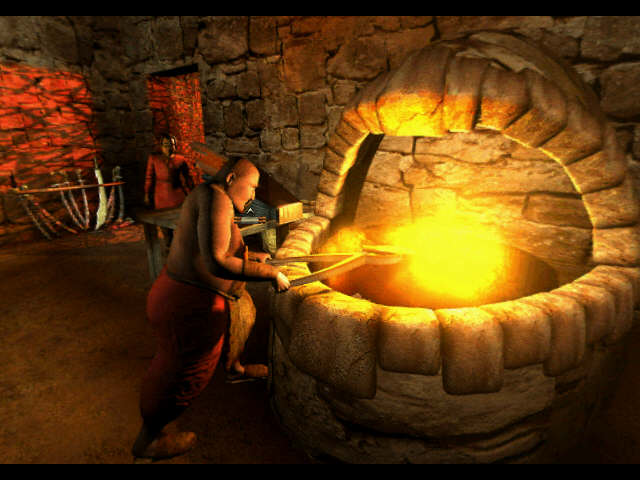 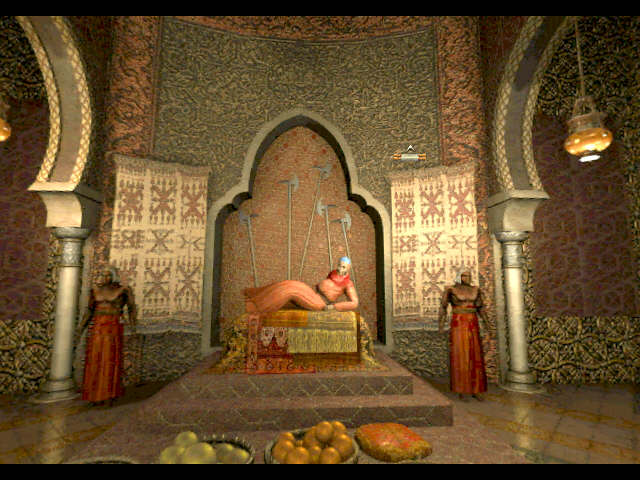 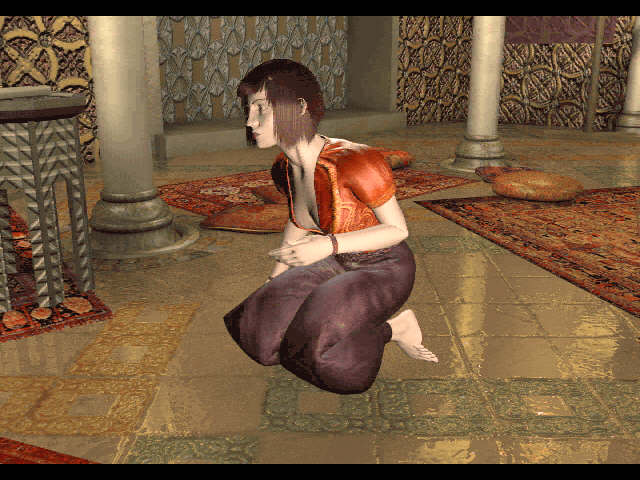 |
The Legend of the Prophet and the Assassin is actually a sequel to a little-known title–Pilgrim–that has appeared on our “Ten Best Games That (Almost) No One Has Ever Played” list. Since Pilgrim was never released in North America (though it can now be purchased here), there was little point in marketing LOPA as Pilgrim 2. Instead, and this is where it gets really confusing, the events of LOPA occur “many years” after the story of Pilgrim, and LOPA itself is the first chapter of a two-part game. If you’re not yet lost, then read on, for LOPA is, if nothing else, a journey into the eternal enigmas presented by life regardless of the century.
Though LOPA is historically based, it is not an edutainment game. It instead focuses on morality and ethics wrapped in a cocoon of thirteenth-century value judgments. Tancrede de Nerac, a Knight Templar, has deserted the Order to create his own personal fiefdom comprised of highway robbers and desert people. He becomes known as As-Sayf, “the Scimitar,” and acquires a reputation as a fearless, and feared, leader of men. After years of a nomadic existence and saddled with a heavy conscience, As-Sayf learns of a man named Simon de Lancrois, a prophet who has constructed Jebus, the ideal city. After five years of wandering, As-Sayf arrives at the gates of Jebus and finds it in ruins. He now vows to exact vengeance upon the false prophet Simon for leading him on a wild goose chase. Thus the backstory has been established, and the game begins as we find ourselves at the locked gates of the ruined city.
The Legend of the Prophet and the Assassin was written by prominent author Paulo Coelho and delves into issues of spirituality and ethics that are practically unheard-of in the gaming community. For this reason alone LOPA would come highly recommended, even though the limitations of twenty-first century gaming attempt to bury the complexities of the thirteenth-century Orient.
Striving for the scope of a Lawrence of Arabia, LOPA instead limits its lofty goals by restricting movement. Though it is on two disks and contains five acts, LOPA is a very short game that at times feels claustrophobic. Wonderful cinema-quality animated cutscenes advance the story from a third-person viewpoint, but the interactive first-person playable sequences are often confined to a small area that cannot be left until all of the puzzles or enigmas in that area have been solved. This not only decreases the difficulty of the game, but also diminishes any replayability.
LOPA features a charismatic cast of characters who have life breathed into them by wonderful voice actors. Dead-on lip-synching and facial animations provide an almost intimidating realism. As-Sayf has a deep, resonant, authoritative voice, as would befit any leading man. Qamar the astrologer, Kahn the tyrant of Jerusalem, and numerous others are presented in all of their ugliness and quirkiness. These people are not meant to be idealized Fabios, instead they are presented in all their ugliness–faces beaten by the weather are so realistic you can almost smell their sour breath. And speaking of ugly, when a game’s graphics excel, any inconsistency is sure to stick out like a prostitute in a monastery, and that is case with one of the few women in the game, a, uh, prostitute in a tent. Her awkward body structure, and a head of hair that looks like a mouse habitat, led me to ask LOPA’s Executive Publisher, Guillaume de Fondaumiere, about this woman. He confided that Arxel had not had a suitable female model on which to base the character–a problem that will be corrected for any sequels.
If you have ever seen Gunga Din or Lawrence of Arabia, then the soundtrack of LOPA will evoke memories of these classic desert movies. Performed by John Leach, it is broad and sweeping and stirs emotions of adventure and danger. Though LOPA is at its core an old-fashioned point-and-click adventure, it has been developed on the Faust engine and allows for 360-degree vision of the surrounding scenery. The problem, though, is that all of this technology, this breathtaking musical score, makes the player want more–more freedom, more opportunities to investigate. Instead, the player is trapped in predetermined areas that many times can only be explored and solved linearly. This serves to render any puzzles as self-contained, and often the biggest obstacle is simply pixel-hunting for an overlooked item. The puzzles are straightforward and logical and occasionally even humorous (Camel dung? Whatever would one do with camel dung?). But this is one of those games where if you’re stuck, you’re stuck, and there is no place else to explore while you attempt to think your way through a puzzle.
The Legend of the Prophet and the Assassin is a game that will encourage you to think and to question the values of its main character. You do, after all, play as a thief, as a knight errant who proposes to seek peace but has no qualms about fighting and killing to obtain a goal. There are even times when thievery will be required to obtain an inventory item. Nor is this a game that will insult your intelligence–I had to look up the meaning of more than one word. Yet even as the game builds to a crescendo, as you hope for As-Sayf to experience an epiphany, at the very end you are left feeling disillusioned and dry-mouthed even after a victory over the Ghouls and a revealing dream sequence. LOPA can only be recommended with the following caveat in mind, for it, like this review, is … to be continued.
Final Grade: B-
If you liked The Legend of the Prophet and the Assassin:
Play: Pilgrim
Read: Seven Pillars of Wisdom
Watch: Lawrence of Arabia
System Requirements:Windows 95/98/00
Pentium 200
32 MB RAM
290 MB free on HD
Soundblaster
Mouse