Review: The Journeyman Project 3: Legacy of Time
|
Journeyman Project 3: Legacy of Time Developer: Presto Studios By Peter Rollo 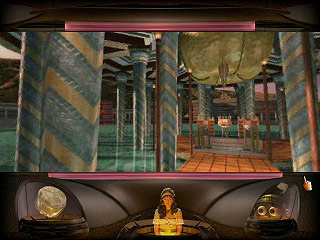 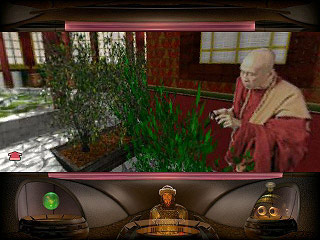 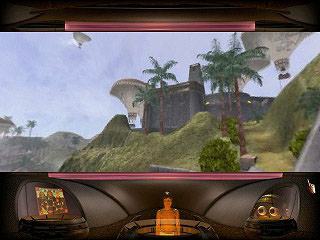 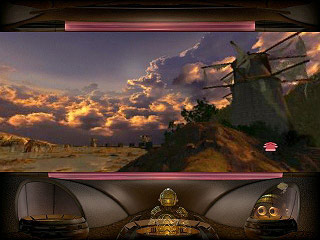 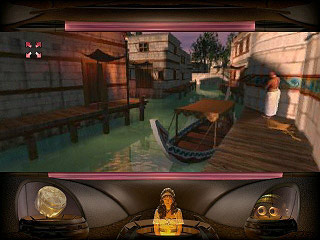 |
This is one great adventure game that tries to take the elements of Myst and make them move. Unfortunately, they took a few bad elements, one of which is the gameplay.
You assume the role of Gage Blackwood, Agent 5 of the Temporal Security Agency. The goal of the TSA is to safeguard history. If anything were to change in the past, it would cause a temporal ripple (which can be detected); in effect, it would change the present. A rip in the time continuum is even worse; if it isn’t corrected, it can have very disastrous results. For this reason, time travel is on the verge of being eliminated altogether.
Legacy many times refers to events that happened in the previous two games. For this reason, people that have played the first two (or even just the second) will love the way everything ties in. But for those of you who haven’t played any of the Journeyman Projects, a full recap is in the manual, and a smaller one is in the opening movie to the game.
After months of searching the time stream for traces of Agent 3, the TSA gives up and presumes her dead. (Agent 3 framed Gage Blackwood in JP2 for crimes against history. Gage caught up with her in the end, but her jumpsuit short-circuited in the process, sending her into the time stream.)
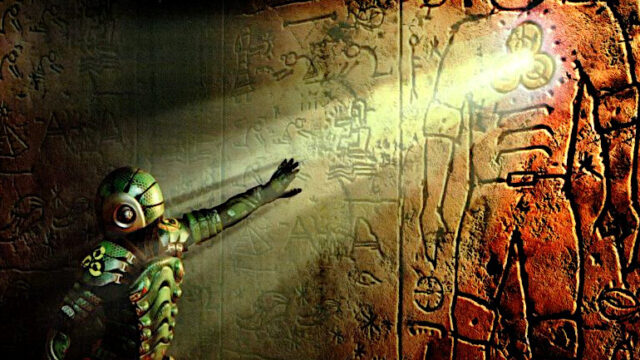
The game starts out when the TSA is about to remove the power cores from the time travel “jumpsuits.” The jumpsuits are, well, suits that give you the ability to travel through time. They are the ones used in JP2.
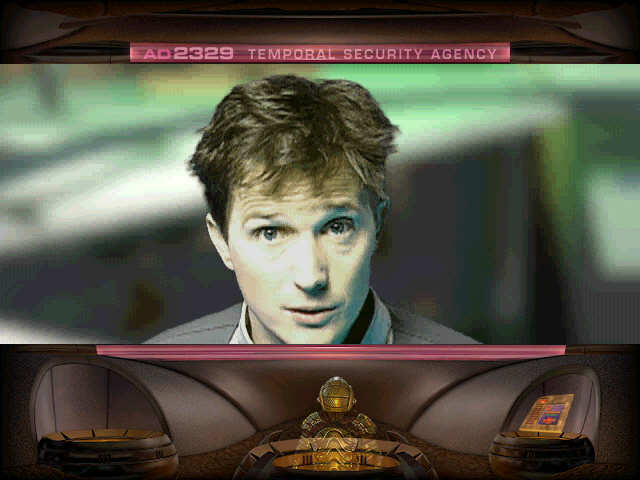
Parts of Gage’s memory surrounding the events of JP2 were selectively erased by Agent 3 after his capture. Now sitting in front of a TV/computer screen, Gage repeatedly watches the video (taken by his jumpsuit) of Agent 3 brainwashing him (which happened at the end of JP2). All of a sudden, a flashing warning appears over the screen. A temporal rip has been detected in the Mediterranean Sea in 1262 BC. The room flashes with red lights, and the alarm fills the air with panic. Agent 3 has made her move at the worst possible moment. As a last resort, the TSA chief engineer (also Gage’s closest friend) reveals to Gage the Chameleon jumpsuit, an unguaranteed functional prototype time travel unit.
The game has a good story (a tiny bit linear though), but its lack of solid gameplay weighs this game down.
First let me talk about the Chameleon jumpsuit. Back in JP2, to be seen in public was a very bad thing (it would cause a change in history if a person from a time before the light bulb was invented saw a big metal man walking around). The Chameleon jumpsuit changes all that. With it, you can assume the guise of any person you see in a certain time period. Whenever you see someone, you can copy his or her appearance and use it (not with the same person you’re posing as, though, of course). This adds a whole new level to communicating with others. Now, instead of hiding from people, talking to them is a key factor in getting information. A person’s response to you is different depending on who you are posing as at the time.
But talking with others is not like in a Monkey Island game. You do get choices for what you want to say (or to ask for most of the time), but most of the time a conversation won’t be directed by your choice of dialog. So pretty much, you get to choose which things you ask first, but no matter what you do, the rest of your choices will always be available to ask. They really could have put the talking parts into cut scenes if it weren’t for an occasional addition of choices depending on your current knowledge. So basically communicating is present for a supply of information, not a puzzle in itself.
One of the game’s biggest downfalls is gameplay. While the game is entertaining and interesting, the puzzles are a little bit too easy. The inventory items only have one use, with the exception of a few bowl-like items. The purposes of the items are pretty obvious for the most part. I think the puzzles are too easy for seasoned adventure gamers, but luckily, the easy puzzles don’t take too much away from the enjoyment.
In the game, you visit three different great cities were mysteriously destroyed: El Dorado, Shangri-La and Atlantis. You walk in these three places before and after their destruction. In the core of the game, you play before their destruction (for several reasons).
One of the nicest features in the game is your artificial intelligence “partner,” Arthur (people who have played JP2 will remember him). Some people hate him, some people love him. Arthur is a funny little guy who travels along with you throughout your journey in the memory banks of your jumpsuit. He has a lot of knowledge and can help you a lot. He can be very funny at times also. His humor helps to lighten up the game’s serious atmosphere. I guarantee one thing, if you’re in a bad mood when you play, you’ll be very annoyed by Arthur. But for those of you who are always in a bad mood (only kidding), there are several settings for Arthur’s dialog. The biggest advantages of having Arthur are, one, he can give you hints if you stuck, and two, he really helps to keep you company (ever have that dead/alone feeling when you play a game like Myst?).
Every Journeyman Project game is literally ahead of its time, graphically speaking. While they weren’t extremely groundbreaking games, they always seemed to be too advanced for your computer. The Journeyman Project series has been developed for the Macintosh, but a PC version has always been released at the same time. When I bought JP2 (1995), it barely ran on my 486.
JP3 is less of a groundbreaker than the game before it. But nevertheless, its graphics are stunning.
The game is really composed of a bunch of QuickTime movies and QuickTime VRs. But when they put it all together, it works beautifully. The game is sort of like a moving Myst. While you don’t have full freedom of movement, exploration is almost as easy as if you did.
The world around you is totally 3D. At each standing point, you can look at any direction imaginable. Up, down, left, right, and every angle in between. Walking around is also wonderful. The transitions from place to place are seamless. Even the sounds of your footsteps are believable.
The animations of walking and moving about are very realistic. Your view moves just like you would in any circumstance. All this makes for a very immersive experience.
Overall, I’d say that Legacy is a good game. If you’re a fan of the JP series, then you should definitely buy this game (but if you are a fan of the series, you probably already have the game by now). If you haven’t even heard of the Journeyman Project series, then I suggest you put a little bit more thought into it before buying this game. Hardcore adventure gamers might not like its simplistic puzzles. If you like a good story with a good ending and don’t mind the absence of deep, involving puzzles, this might be the game for you. The fact that I have played the second in the series beforehand without a doubt enhanced my enjoyment. But I’m sure it would be just as enjoyable for everyone else.
Final Grade: B-