Review: Journeyman Project 3: Legacy of Time
|
Journeyman Project 3: Legacy of Time Developer: Presto Studios By Ray Ivey 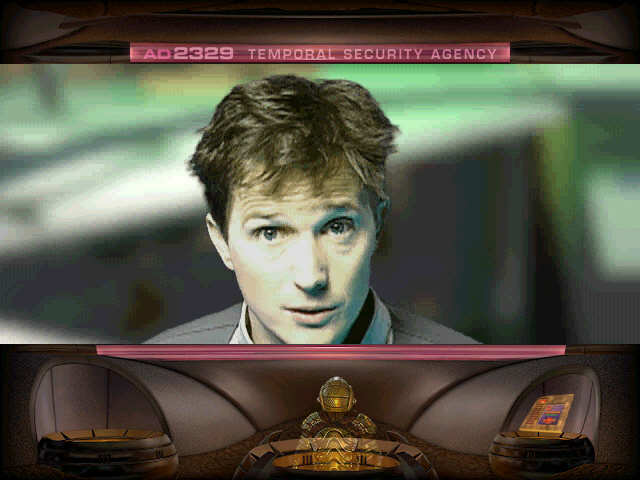 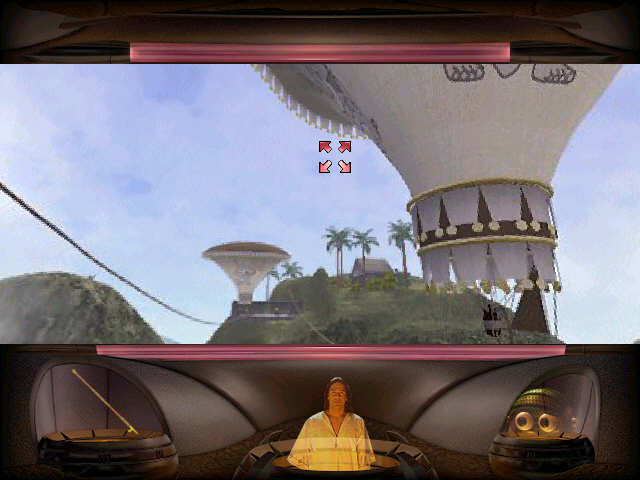 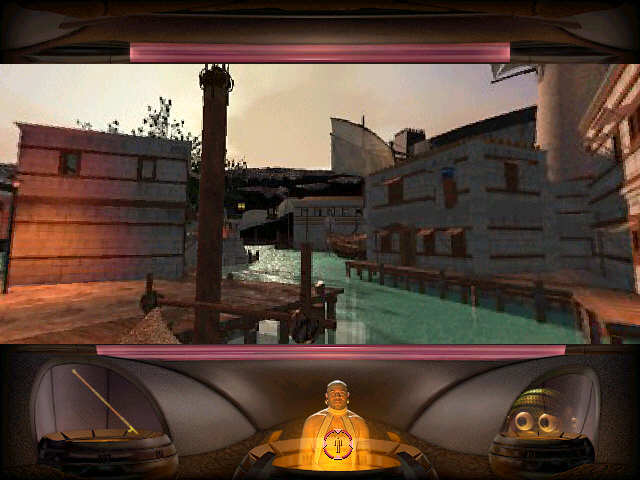 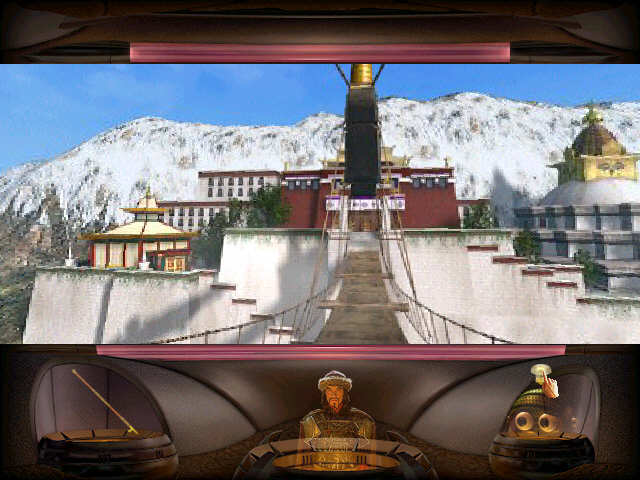 |
Journeyman Project 3: Legacy of Time is the third game in the greatly respected Journeyman Project series from San Diego-based Presto Studios. It’s the continuing adventures of Gage Blackwood, Special Agent 5 of the Temporal Security Agency.
The first game, The Journeyman Project, originally released for Mac back in 1992, was one of the first (if not the first) photorealistic adventure games, told the story of the first uses of the new time travel technology and its political ramifications with regard to Earth’s joining the Symbiotry, an intergalactic group of races that had invited Earth to join its fellowship. The Temporal Security Agency is a governmental agency that protects history from the effects of rash time travel. By bouncing around in time, Gage Blackwood foiled sabotage and assassination attempts and saved the day.
The second game, Buried in Time, is the story of how Gage is framed by another TSA agent and how he cleared his name and once again saved humanity. Helping Gage in his quest was Arthur, a wise-cracking but brilliant Artificial Intelligence that Gage rescued from a doomed space station.
The third game begins with the villain from Buried in Time wandering around the Mediterranean in the 13th Century BC. Arthur is with her (you’ll have to play the second game to find out how), and it turns out she may just not be a bad guy after all …
Cut to the TSA. It seems the Symbiotry has ordered the shutdown of the TSA. Just at this moment, an inexplicable battle seems to be breaking out between two of the alien races in the vicinity of Earth. Gage is contacted by the “villain,” who claims she can help him resolve the conflict. Against TSA orders, Gage grabs an experimental new jumpsuit and heads off into the past.
This is a brilliant setup, told with a series of beautiful cinematic scenes. As in all of the Journeyman Project games, the writing is simply superior to the standard for our genre. Particularly well-done in JP3 is the way in which the stories of all three games dovetail together. It’s a great payoff if you’ve played the whole series.
Another thing I immediately admired about JP3 was the seamless way the player is introduced to the mechanics of gameplay. Since Gage is using an experimental new time travel jumpsuit, it makes total narrative sense that his friend will first show him how to use it. The result is that adventure game ideal–a game that never requires you to even open the manual.
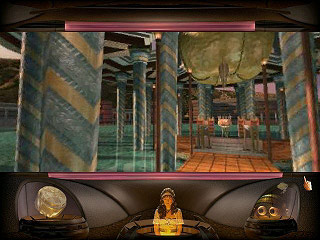
Visually, this is one of the most beautiful games I’ve ever played. Gage travels to El Dorado, Shangri-La, and Atlantis, and each is a feast of visual wonders. Now, any adventure gamer who’s been around the block a few times has been to Atlantis more than once while playing adventure games. The Atlantis of JP3 is hands-down the best-looking and most convincing Atlantis I’ve ever visited.
Because of the jumpsuit and time travel technology, the interface of the Journeyman Project games has never been as simple as many other adventure games. However, with each game in the series, Presto has made the interface easier and more elegant. And in this third game, the view window is much larger than it was in the first two games.
In the first two games, one of the limitations of the time travel technology was that you could never let yourself be seen by someone in another time. You had to either hide or use a special chip in your suit to render you invisible when a “native” was in the vicinity.
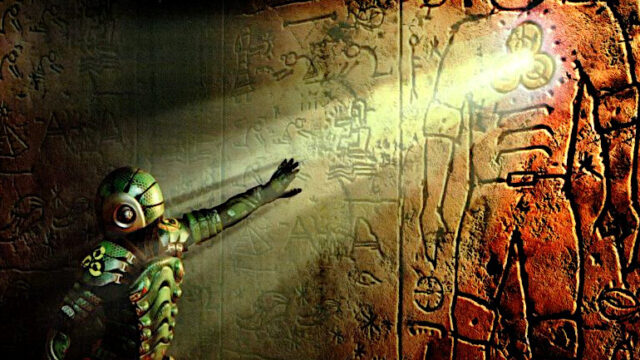
In Legacy of Time, there’s a whole new wrinkle to your exploration due to a cool feature in the new “chameleon” suit. This time around, you can “steal” the image of any person you meet, and then later cloak yourself in a holographic projection of that image. In other words, you can walk around and interact with people for the first time.
I never minded the lack of interaction in the first two games (I liked the idea of sneaking around without being seen), but fans of character interaction will be quite pleased by this new development. What’s even more interesting is that since you can assume many different personas, it becomes a point of strategy when you decide to approach a character: will I get more out of this person if he thinks I’m a priest? His sister? The jolly ferryman? The poor beggar? This adds a fascinating element to gameplay.
Like its predecessors, JP3 is not particularly linear, meaning there’s a lot of to-ing and fro-ing from one location in time to another–you don’t finish one, then go to the next–you’re working on all three of the locations at once. I played the DVD version of this game, and this made a huge difference. There would be a considerable amount of disk-swapping in the CD version.
Speaking of the time travel, another welcome improvement in JP3 is that, when you jump to a time location that you’ve visited before, you are deposited geographically right where you left off. In Buried in Time, you could only return to a fixed “starting place,” which added a lot of frustrating running around.
The format of the game is first-person point-and-click, with 360-degree panning and beautifully animated “steps.” I can’t say enough about the loveliness of the graphics in this game. The environments are so pretty it’s a pleasure to wander around in them.
A visual detail in JP3 that I really appreciated, because I’ve never seen it in any other game, was the way an intense light source would “flare” in your eye if you looked at it directly. In other words, if you looked straight up and stared at the sun, the sun did just what it does in real life–fill your vision with blinding yellow light. A very nice touch.
The characters are all filmed actors, and with the sad exception of the handsome but wooden lead, the performances are excellent. (Long live video!)
This game would actually get a better review from me if it was a standalone title. However, the cold hard fact is that it is haunted by the ghost of its brilliant predecessor, JP2: Buried in Time. As good and good-looking as JP3 is, it is in no way a superior game to the second in the series. It’s much shorter and easier. JP2 was one of the richest, most generous, and fascinating games I’ve ever played (it’s on my top ten list). If JP2 was a beefsteak feast, JP3 is a lovely dish of trifle.
However, that still makes it better than most adventure games out there, and I heartily recommend it, especially for novice gamers. It’s very inviting and user-friendly, and it could make and adventure fan out of anyone.
I don’t know if, after their Myst 3: Exile duties are done, the talented team at Presto will ever consider building a new Gage Blackwood adventure, but I’ll keep my fingers crossed. But I’ll hope that they use JP2, not JP3, as the model for the next game.
Final Grade: B
If you liked Legacy of Time:
Watch: Back to the Future 1, 2, and 3
Read: The Big Time by Fritz Lieber
Play: Journeyman Project 1 and 2, of course!
System Requirements:
PC: Windows 95 required (works with Windows98 with audio acceleration turned off)
Pentium processor, 90 MHz or faster
16 MB RAM
4x CD-ROM drive or faster
70 MB free hard disk space
640×480 display, high color (16-bit)
Sound Blaster 16 or 100% compatible 16-bit sound card
Video and sound cards must be compatible with DirectXMacintosh:
PowerPC processor required
80 MHz or faster recommended
System 7.5 or higher
16 MB RAM (10 MB free)
2x CD-ROM or faster (4x recommended)
60 MB free hard disk space
640×480 display, thousands of colors (users with the latest graphics accelerators should set the game display mode to “line doubling” under the FILE:OPTIONS menu for best compatibility)
Support for 16-bit stereo sound