Review: The Castle
|
The Castle Developer: Blueline Studios |
Note: This game can be purchased on-line from the Blueline website.
The Castle is a stylized HyperCard-like (it was actually made with SuperCard, a program similar to HyperCard on steroids) point-and-click adventure game that pays homage to Myst while avoiding the clone tag by taking the genre in an entirely different direction.
It is an atmospheric romance/horror/sci-fi mix; while not as detailed as some others of this ilk, limited by the Myst-style graphics mostly popularized several years ago, it stands well on its own, and Blueline gets kudos for publishing this genre on the Mac platform, certainly a rarity in this day and age.
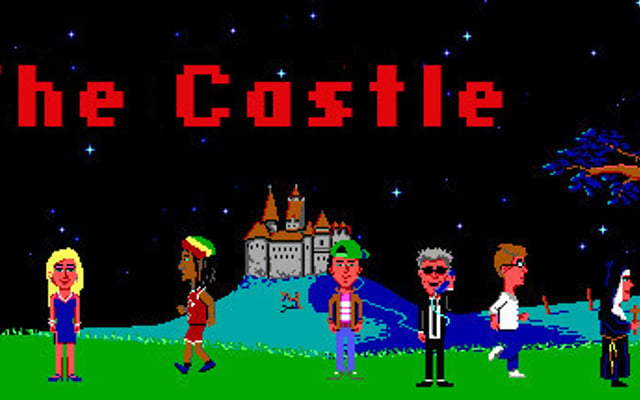
The game is played from a first-person perspective and starts off in front of a castle, which actually has the appearance of a large mansion with two turrets. The player finds a cryptic note from “N” stuck into the gate. The N is for Noemi, the main of three characters in the plot who are involved in a lover’s triangle, trapped in a place they don’t understand. The other two characters are Rod, Noemi’s ex-fiance, and Brad, with whom she appears to be in love. (Okay, I admit I found their names exceptionally cheesy, and in the case of Brad, I couldn’t stop thinking about The Rocky Horror Picture Show.)
You must locate Noemi’s diary, and then throughout the game, collect and read the pages to move the plot forward and get clues to solve puzzles. The plot reads like a trashy dime-store romance novel you just can’t put down. Noemi’s beginning chronicle mirrors yours, and the initial question of where you are and what this place is pulls you forward through the game. Rivalry between Rod and Brad becomes clear. This was all too Harlequin Romance Novel-esque for me, but the story did move well. The action at times gets a little R-rated–this is definitely not for the kiddies.
Gameplay allows you to get your bearings before you get a clue as to who you are or what you’re doing, which I liked. There was no Encyclopedia Britannica to read and absorb before you start out from the opening location, which a number of games seem to resort to (you’ll have to forgive me, I’m now in the middle of Secrets of the Luxor and almost fell over when I realized how many nasty, dryly written pages I’d have to wade through to find clues get through the first few puzzles). The story is cleverly dished out to you one page at a time, as reward for completing puzzles or correctly moving forward, and as you progress, the pages are found and put into the diary–this also gives clues to the puzzle solutions, mixed seamlessly with the developing story. A nice design touch is that the book will save where you were last so you don’t have to go back through all the pages, which adds to the gameplay. The game is for the most part linear, moving forward in sequence. Objects to collect are limited to the diary, its pages, a series of keys, gun and bullets. The plot receives a B.
The graphics are nicely drawn in a nice style, and they add to the overall mood/ambiance and storyline. There are numerous objects throughout the game that are so carefully rendered that they end up being red herrings; in other words, in most games, items you can use are more carefully drawn and this is often a tip-off. In The Castle, there is quite a bit to look at that you end up not using, which I think is a clever touch. One drawback is that it must be daytime to enter the house; it would have been fun to see it at night. The interface was designed to be minimal, which is a strong suit to those of us who hate screen clutter. The graphics receive a B+.
Nighttime gameplay is especially nice with realistic sound effects and lighting. Daylight sound effects were well-done too, and you really have the sensation of walking through a garden. The music is pretty and haunting, and it works well to set the mood and create atmosphere. There is very little voice acting, and what there is would have been better left out, including an oracle reminiscent of the old Johnny Quest cartoons from the 60s. But the worst is one of the characters in the end sequence, who sounds like a Swede in a barrel. Wait, Blueline is located in Switzerland–maybe it was a Swede in a barrel! The sound and music receive an A, but the voice acting, what little there was, gets an F.
I should probably advise all you gamers out there struggling with Maze Redundancy Syndrome to take your Dramamine, because this is going to make you sick. Yes, Virginia, there is a maze, replete with graphics that make it hard to discern where you are and which way you just turned. The other bad news I’ll just shove out of the way really fast is that you don’t just go in there once but, at a minimum, over 10 times to perform key actions or find items such as pages or keys. Okay, now that I’ve gotten that off my chest, the good news is that it is not an overwhelmingly huge maze, and it’s fairly simple to navigate once you get the hang of it and have all the areas explored and mapped out, but the use of it does, obviously, become a bit redundant and unnecessary. There is, however, a certain amount of satisfaction during gameplay upon discovering new objects in old places previously explored, including the maze.
Some of the puzzles are intuitive and meld seamlessly with the gameplay, and the rest are “solve it or you aren’t going any further” straight, old-fashioned puzzles, including one sliding puzzle and one magic square. It seems unusual to me for a game so story-driven to have so many straight puzzles. It seems, in most games with these sorts of puzzles, game designers will resort to a thin “okay, now you’re trapped … figure out the puzzles to get out” scenario such as in Shivers or the Jewels of the Oracle series, and this is a pleasant change in design with The Castle. There is a wine glass puzzle in the Salon that is an exact duplicate of the book puzzle in The 11th Hour, with the same solution, a weakness. Puzzles get a C+.
As far as the gameplay goes, one difficulty I found in design was that you need to change from day to night and vice versa to find items and progress, and although this in itself was a fun twist, the method for changing became quickly redundant and time-consuming, and I felt it was one of the weak points of the game.
Other perks included in the package is a Tidbits file, which contains an After Dark program, desktop pictures, and startup screens. Also available from the publisher’s website is a “Hint Box,” which is a standalone hint application similar to the Universal Hint System (UHS). I found this to be handy, giving just the amount of impetus needed, but not too much, and it also keeps track of how often it has been accessed, gently reminding you to solve things yourself.
Final Grade: B-.
System Requirements: 68020 or newer processor
Power PC 90 MHz recommended
Hard disk
8 MB available RAM, 10 recommended
System 7 or newer
13-inch monitor
256 colors
4X CD-ROM drive