Review: Cassandra Galleries
|
Cassandra Galleries Developer: Kutoka Interactive |
Cassandra Galleries, albeit a dated title by today’s gaming standards, is a fun, puzzle-driven, solidly designed game. Published in 1996 by Corel, it is a first-person, prerendered scene, point-and-click fest (right up my alley), and although it’s an older title, the design holds the game in good stead.
The plot is minimal and mostly unnecessary. You have come to the Cassandra Gallery to discover the truth behind what happened to the Cassandra family, and why the mother died, and where the patriarch and his daughter have disappeared to. The intro to the game is brief, which was certainly fine with me, with an overview given by a character who will reappear to move the story forward as segments are completed. In doing so, the player travels to seven separate worlds, all very cleverly designed to give the gamer the sensation of being dropped into a strange place, wildly different than the last, and the game very much succeeds at this strategy.
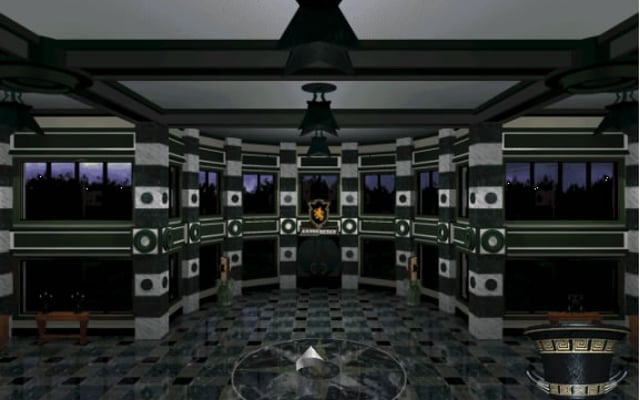
The game itself is designed cleanly, each world in a stylized minimalist fashion, to give the impression of an entirely new world, while coaxing the player into focusing on the puzzles in each area. There is, however, a magnitude of art on all of the walls, in every locale. Part of the fun of the game is that it really does provide an atmosphere of a gallery, from the polished floors and long expanses of covered walls, to the various places to land, pausing to enjoy a particular piece of art and lose oneself in thought, or just sit down and rub feet tired from all the walking.
The puzzles are very clever and fun, and the designs are original (for the most part) and never get redundant. The game, in an unusual move, has puzzle solutions built in, and one of the things so appealing about this title is that thorough exploration and note-taking is required right from the get-go to be able to move through the various worlds. Trying to find what all the puzzle clues are actually becomes a puzzle unto itself. The puzzles themselves are designed to either allow the player to wallow in his or her own wonderful smartness or just click like a nut until dumb luck comes to the forefront and plays a hand. Name that composer, who wrote The Scarlet Pimpernel, and fun with periodic tables–these subjects are certainly not an idiot’s delight. And I am embarrassed to admit to knowing the answers to the majority of the TV quiz puzzles on the first try.
The music is pretty, holds the interest, and fits well with the scenery to create moods and never becomes redundant. The actors, what few there are, aren’t horrible and the segments are short. The game overall is frighteningly easy to maneuver, with a large pointer that is simple to understand immediately without having to refer to a manual for a translation. It also allows for error, and you can try things over as many times as you like without retribution, a nice touch for novice players.
The game did have a few shortcomings. The endgame sequence is quite obtuse and short–basically just bad. This is most likely because the story is negligible to start with, so there was probably no way to roll up a decent ending without changing the whole character of the game. Also, my Power Mac was just a little too hoity-toity for the game to tolerate, and I had to turn off virtual memory and all my beloved hoggy extensions to make it fly like an ace. It had no other bugs, however; it ran very solidly, with only one disk swap, although it had to be started from the first disk throughout.
Cassandra Galleries is just a great old-fashioned puzzle game that I had a lot of fun playing, and it is designed to be playable by players with varying degrees of experience.. I gave a bit of a point off for the expert’s score because, truthfully, most experts will attempt a random click-through of a puzzle on occasion (you know who you are) rather than methodically using notes or figuring out the solution, and this sort of conduct here can shorten the game considerably and is hard to not fall into (okay, I’m not admitting to anything here).
Novice: A
Intermediate: A
Expert: B+
System Requirements:
Mac:
System 7.1
68040
8 MB RAM
26 MB free hard drive space
640×480, 256 colors
2X CD-ROM drivePC:
Win 3.1, Win 95, DOS 5.0
486/Pentium
8 MB RAM
26 MB free hard drive space
640×480, 256 colors
2X CD-ROM drive
8-bit SoundBlaster or 100% compatible