Review: Secrets of the Luxor
|
Secrets of the Luxor Developer: Mojave |
Okay, I’ll admit it, I’m torn. Well, maybe turned into twins. The good twin says that Secrets of the Luxor is why I got into adventure gaming to begin with–fresh and beautiful, extremely well-designed, someone put some serious time, money and love into this puppy. Now, the evil twin says … but why are the puzzles so incredibly mind-boggling?
Now that I’ve gotten that out of the way and finished the game so I might tell you about it (you’re welcome), I’d have to say the good twin wins, as this was the most satisfying game I’ve played in quite a while. Now I’ll admit that at first, I was horrified to discover an incredibly lengthy (71 pages) book to slog through to get clues to solve a few things at the beginning portion of the game, but happily, I discovered, I could toss that away and immerse myself in gameplay (for the most part–I do want to qualify that some–there’s one last surprise you need it for near the end).
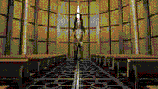
Secrets’ storyline is simple. Through a complicated series of unfortunate circumstances, you are trapped in an untouched tomb deep inside the Luxor pyramid and need to solve the mystery of the pyramid while working your way back out. (Stop me if you’ve heard this one …) Redundant storylines notwithstanding (and I’d defy any shooter fan to differentiate the plots of Quake and Postal for me), this is definitely a game worth playing, if you can lay your hands on it. Storyline, however, does not get in the way of the gameplay, which is the real star of the show here, so I give the plot a B.
The game overall is haunting, mesmerizing. What can you say about a game endorsed by the Miller brothers of Myst fame? The introduction really has a cinematic air (which I love), similar to LucasArts’ The Dig, or Mechadeus’ Daedalus Encounter.

The environment is particularly well-designed, richly detailed in every respect and very immersive. Based on the “Egypt as an ancient space civilization” premise, the graphics nicely mix ancient archeological artifacts with lots of high-tech equipment. There is also a brightness control, which is a nice touch–just don’t turn it up all the way or you’ll lose some of the eerie ambiance. This game gets a perfect score on this point: thoroughly, flawlessly rendered art. I give the graphics an A+.
Now the puzzles. In some instances, I suspect that the game designers themselves don’t even know the solutions to some of these. This is definitely one of the more challenging games to get through that I’ve seen, but in this case, the payoff is definitely worth it–and satisfying (in other words, an excellent endgame sequence, not just a screen that basically say “thank you for playing”). The puzzles are impressively spread throughout the game; intricately incorporated into the artwork/design. There are no old-fashioned adventure/puzzle game puzzles as you know them here–no magic squares, etc.–you have to actually remember what you see and figure out how it works into the equation later. The game makers have thoughtfully given you a Polaroid camera to get you through this, handy as heck (take it from someone that uses one of these a lot), and it works just as well as the real thing. Also, all the inventory gets used, even the toothbrush. The fiendish puzzles get an A.
Let’s talk about the sound and music. This is one of the few games I wouldn’t mind owning the soundtrack of. The music is absolutely superb and mirrors the writing of some of my modern favorites–portions of the music in the first, Ancient Egypt section sound very Rick Wakeman-esque with that big Yes-like organ sound, while a number of areas in the final, third area, Osiris’ Castle, particularly in the Toy room, sound completely like Danny Elfman, really giving the game the feel of a motion picture. Who is the guy that wrote this stuff? I give the music and sound an A.
Okay, here are points to the game I saw as flaws/drawbacks: there is a drawback in the interface design in that when you move your cursor to inventory at the bottom of the screen, the screen goes black and sound is cut off, which I found distracting. Also, there’s a bug in the Mac version: during the disk switch, you have to switch to the finder, change disks, then go back to the game to use the second disk, and I don’t even want to tell you how many minutes I spent trying to figure that out.
And to be fair, here are the perks: you can die like crazy, but don’t bother saving as the game takes you back to the point just before death, so there’s no distracting redundant saving to worry about, and dying becomes fun. There are a couple of fun Easter eggs, such as a man holding a gun you can see in the Constellation room only by wearing the VR goggles, and a great sequence showing the game designers in a secret room under the bridge in the Power Link room. Finally, it packs a lot of punch into a small package and manages to accomplish in two disks what took Timescape five to get done.
My best analogy of the care taken in the production of this game is in the words of the lepidopteran scientist (okay, okay … the guy that studies moths) from the film Silence of the Lambs … “Somebody grew this guy, fed him honey and nightshade, kept him warm. Somebody loved him.” Overall score is A+.
System Requirements:
Mac
68K or PowerPC
256 colors or higher
System 7 or later
5 MB of RAM available
2x CD ROM DriveWindows
Win 3.1 or 95
486 or better
2x CD ROM Drive
8 MB RAM
8-bit sound card or higher
SVGA 256 colors or higher