Review: Scooby-Doo: Classic Creep Capers
|
Scooby-Doo: Classic Creep Capers Developer/Publisher: THQ By Erik Reckase
|
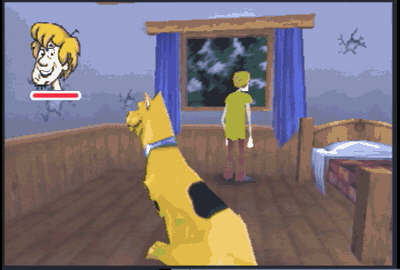
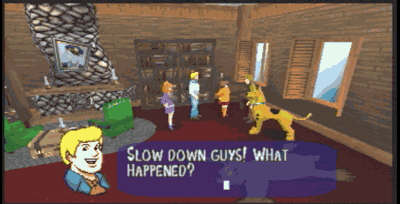
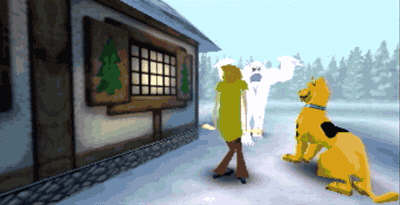
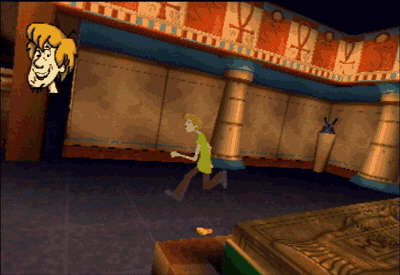
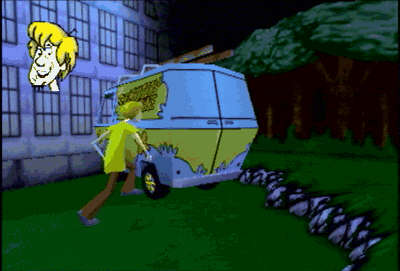
When Randy approached me with the possibility of reviewing the latest Scooby-Doo game, my interests were twofold. First, having been born in the seventies, I watched Scoob every afternoon, and I was curious how the gang was doing, and second, as a new parent, I wanted to see what games for children were like these days, in the hopes that they wouldn’t destroy my kid’s mind. Besides, a game targeted at this audience might be a pleasant diversion from The Longest Journey and Lightbringer, my current PC adventure fare. Well, there’s something rotten in this particular bag of Scooby Snacks, as you’ll find out shortly.
What’s Going on Here?
The game is, of course, centered on Shaggy and Scooby’s adventures as they help the rest of the Mystery Inc. gang solve a series of four mysteries. Anyone who’s watched an episode of the Scooby-Doo cartoons will be very familiar with the plot of one of these mysteries–they’re almost identical, with the names, motives, and locales changed. There’s usually some sort of creature that is terrorizing people that has to be stopped, which requires Scooby and Shaggy to search for clues and trap pieces–alone, of course. Once all of the items are found, Fred always comes up with a master plan to capture the bad guy/creature, using Scooby and Shaggy as bait. The bad guy is unmasked and the motive is revealed, which is never something that you could have come up with given the clues you found. This is a game for the younger set, so the consistency in the stories might be … who am I kidding? The plot stinks, but kids know what Scooby-Doo is like, so if they like the cartoons, the game will be second nature.
How Did it Sound?
Given the limited audio capability of the Nintendo 64, the background music was really quite good. The themes had a tinge of 1970s elevator flair, but they had some toe-tapping segments that I can honestly say were entertaining. I was, however, disappointed in the voice acting, or rather, the lack of it.
There were only a few lines recorded onto this N64 cartridge by the talented Scott Innes, and they are the standard lines that Scooby and Shaggy say in every episode. “Zoinks!” “Scooby Snacks!” and “Reah” (not to be confused with the adventure game), and a few other one-worders are spoken aloud every time they are part of the onscreen conversation, but the rest of the text of the game, including all of the other characters’ conversations, are completely silent. I’m sure that THQ could have put more dialogue on the cartridge had they spent a little more money on memory, but they probably figured that kids wouldn’t care, so they didn’t bother. They’re probably right, but I’m so used to more voice acting that it seemed odd to me.
How Did it Look?
All of the characters in the game look surprisingly good in three dimensions. Scooby and Shaggy are both adequately rendered in polygons, and their animation is reasonable. I didn’t spend much time looking at them, however–I was more surprised by the quality of the static background environments that they traveled through. I must say that I’m very impressed by the similarity to the artistic style in the cartoon series–and there’s some funny stuff in the background, too. In the first episode, “What a Night for a Knight,” there’s a scene in a museum where all of the paintings on the walls are of other Hanna-Barbera characters in costume, which I found pretty darn funny. The graphics in the game are, to be honest, not quite up to par for a system that’s been out for five years, but they won’t bother the kids at all (as long as they haven’t played RealMyst).
Was it Fun?
Unfortunately, everything going for Classic Creep Capers falls apart when it comes to gameplay. First off, the game is very short. I completed each of the episodes in about the same amount of time that the animated series took, about thirty minutes. That makes the entire game about two hours of fun, after which it’s all over. That’s really short, even for a kiddie game. Although all of the items that can be interacted with flash to grab the player’s attention, some of the items are “hidden” in maze-like areas that were irritating to me, so I can only imagine what a child would think about not being able to find a particular item.
All of these problems could be set aside, though, if it were not for the issues that I had with the control system. There are two control schemes to choose from in CCC. One of them, the less confusing of the two, controls Shaggy from his perspective; pushing up on the analog stick causes Shaggy to move forward, regardless of which way he is facing. Pushing left and right turn Shaggy, and pulling down makes him shimmy backwards. Very straightforward, except that turning while running is very cumbersome, and also children might have a hard time figuring out this control scheme. The second method is far more notorious. At first glance, it’s not a problem–pushing in a direction makes the Shagster move in that direction. The problems arise when Shaggy moves between areas or rooms. Oftentimes, the camera angle changes to view the action from a better location … but since you’re still pushing in one direction from the previous room, that might cause you to leave the new room and go back to the old room, even though you didn’t want to. So THQ’s solution (which I’ve never seen before, for good reason) is to keep Shaggy’s movement in the same directions as the original camera view until the joystick is released. For example, if you are pushing forward and walk through a door, where there is a camera angle change to a side view, pushing forward will make Shaggy move right across the screen instead of up. Once the stick is released, pushing forward will now move Shaggy towards the top of the screen. This isn’t a big deal for most of the game, but there is a critical part of every episode–the monster chasing Scoob and Shag–that is virtually impossible using either of the two available control schemes. The easy method is slow to respond and not very intuitive, and the bothersome method eventually has you pushing down on the stick while our hero is moving up, so turning becomes a Mensa problem. Kids will hate this part.
The meat of the game revolves around a “courage” meter (can you say Fear Effect?) that decreases as Shaggy gets more and more scared. The only way to replenish his courage is by way of mouth; Scooby Snacks can be found in the different areas that are explored, and a kitchen (with well-stocked refrigerator) can also be found in each of the episodes. If Shaggy gets too scared, he must restart the episode from the last checkpoint, which tends to be fairly recent. Shaggy never dies, no one ever gets hurt, and there’s very little violence besides getting “scared,” so this game is about as innocent as they come, which gets a little credit in a children’s game–but the camera angle/control issues far outweigh this benefit.
So What Did I Really Think?
There isn’t much to rave about in Scooby-Doo: Classic Creep Capers. Given the amazing depth of play (two hours) and the control issues in the previous paragraphs, I can’t recommend this game to anyone but fans of the cartoon series, and I’d be hard-pressed to tell them about it out of respect for their wallets.
Final Grade: C-