Review: Rome: Caesar’s Will
|
Developer/Publisher: Montparnasse Multimedia By Tom Houston 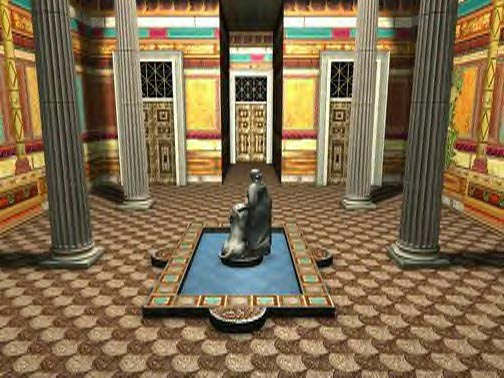 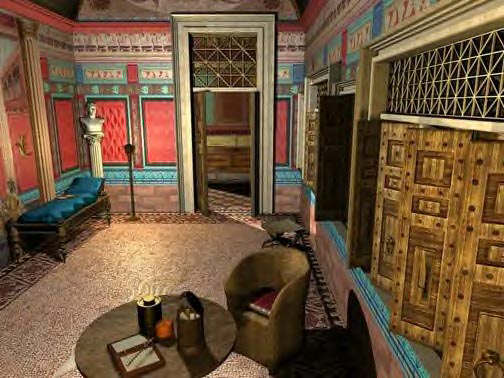 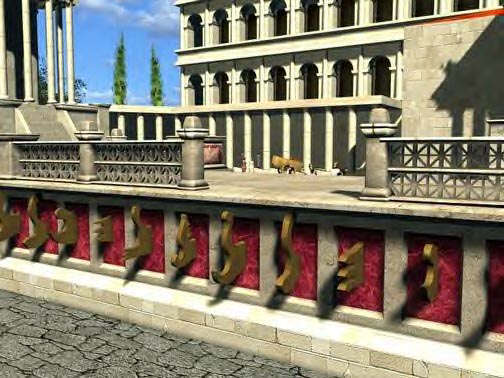 |
March 15, 44 B.C. The Ides of March. We are all familiar with the fact that on this day Gaius Julius Caesar was brutally assassinated inside the Senate building by a group of armed conspirators who considered themselves to be Liberators.
What may not be so well remembered is that this murderous act was motivated by fear and rebellion against the Will of Caesar, which increasingly was evidenced in the power and control that Caesar had imposed upon the Roman people to the extent that the Roman Republic was threatened and was being replaced by a hated monarchy.
Caesar’s control of politics, religion, and the military meant that he had become an absolute ruler. Opposition now came primarily from two groups: the aristocratic ruling class, who under Caesar could now never gain an office that could challenge him for control of the State; and the Republicans who feared the downfall of the Republic, which as long ago as 510 B.C. had replaced the rule of monarchs.
Were their fears right in concluding that Caesar’s aspirations were motivated by a desire to be king? Well, historians most often suggest that in the aftermath of a civil war against Pompey, which had taken a severe toll on the balance of power in the Senate, Caesar’s real intention was to make reforms to improve life in Rome by freeing the citizens of Rome from the greed and injustices of the Senate aristocrats.
The irony of Caesar’s assassination is that the efforts of the Liberators to save the Republic from a nonexistent threat of monarchy ultimately led Rome into becoming an empire, ruled by one supreme sovereign. Thus, in retrospect, their actions proved to be futile, and the waste of a powerful, well-intentioned ruler becomes evident.
With this short history lesson in mind, it should be made clear that Montparnasse Multimedia’s adventure game, Rome: Caesar’s Will, is not so much about the Will of Caesar, the influence of which was briefly described above, but actually about the aftermath of Caesar’s death, the search for Caesar’s Will, a vital document and testament to the true desires for succession in ruling Rome, which Will has been lost, leading to a struggle for power that has plunged Rome into turmoil.
What a wonderful historical premise for an adventure game …
The Story’s the Thing
It’s now autumn in the year 44 B.C., and the Republic is on the decline. Caesar’s assassins are no longer called Liberators, but rather Pedia law has declared them to be public enemies. As exiles, nearly all of them have fled to the outer provinces: Brutus to Crete, Cassius to Syria, Trebonius to Asia. The showdown between Caesar’s supporters and the defenders of the Republic has begun, and armies are on the move. Ambitious potential heirs present their claims of succession, even though nobody has yet found Caesar’s Will.
In the midst of this burgeoning struggle for power and the search for Caesar’s Will, an apparently insignificant event takes place. The noble Titinius drinks what is supposed to be a love potionfrom a goblet given to him by his wife, the beautiful Aurelia, when suddenly he keels over, falls to the floor, shudders and dies. It seems that the liquid was not exactly a love potion, but rather a poisonous concoction.
Aurelia is arrested and convicted of murdering her husband and is thrown into the Mamertine prison, where she is strangely passive and barely tries to protest her innocence.
Is her impassive demeanor a signal of probable guilt, or is there some other explanation? Perhaps a much larger political conspiracy tied to the current struggle for power in Rome or possibly an act motivated by a need to cover up some secret knowledge about the true forces behind the assassination of Caesar.
At this point, you play the part of Hercules Prasinus, a valiant decurion, who has served heroically with the armies on the eastern front, but who has now been called upon by his old lover, Aurelia, to come to Rome to help her by uncovering the truth about the death of Titinius.
What Hercules may not have realized at the start of his quest for information and evidence that will prove Aurelia to be innocent is that he will encounter dangerous traps and pitfalls that will lead him down a path where crime, passion, and a struggle for power coexist in the events and history of these interesting times. Will Hercules be able to determine who his friends are and deal with his enemies in a manner that will be helpful to his investigation and search for the truth?
As the player, Hercules, you will come in contact with many of the real historical characters of the period, such as Mark Antony, Cleopatra, Cicero, Octavius, and Brutus, as well as many other imaginary characters who add spice and mystery to the unfolding of the story. Also, you will have the opportunity to visit 16 historical locations and buildings in Rome, including Caesar’s Gardens, the Temple of Vesta, Cicero’s House, the Regia, the Port of Ostia, and the Rostra.
Rome: Caesar’s Will is a historical adventure game of somewhat monumental proportions, because of the scope of the story. In the end, once Hercules has gathered the evidence necessary to free Aurelia, he will need to press on with the investigation, because by now it is evident that historical events surrounding the assassination of Caesar may not have been what they seemed to be. Along the way he will need to find Caesar’s Will and the Capysian tablets, together with other objects and documents that will reveal the truth.
Once all the evidence has been gathered, Hercules must face the guilty parties in a public trial at the forum (the Rostra), where he will be confronted with difficult questions from the Plebes. The game screen will display each question with a choice of four answers that Hercules can use to call on witnesses or to produce incriminating evidence. Each answer has a point value, based on relevance to the story and winning the support of the people. The greater the relevance, the more points that you will obtain.
Okay, are you getting stimulated by the historical premise and the potential of an adventurous romp through Roman times? Well, I know that I was starting into this game with rapt enthusiasm in anticipation of the opportunity of being immersed into an exciting adventure, wrapped in the glorious experience of the history of Rome at the time of Julius Caesar.
Then came the disappointment. An opportunity was lost when a wonderful historical backdrop and a potentially engrossing storyline started to unfold against an inadequate and frustrating gameplay format, often with poor graphical presentation and other inconsistencies or “bugs” in the game.
To explain my failed expectations and frustrations …
The Gameplay
Rome: Caesar’s Will is played principally from the third-person perspective. The player uses the mouse to position the cursor (a lance) where he/she wants Hercules to go. Click, and Hercules moves there. Well … sometimes he will stop along the way and even spin around, because other people in the scene are also moving and they just get in the way of his travel. Then, at other times, Hercules will walk through objects: parts of buildings, barrels, trees, etc. Hercules will sometimes walk off-screen, and when the scene eventually changes, you may not be quite sure what direction he is now facing. All of this can be annoying!
At the start of the game, you are told that you have 40 hours to explore the city’s locations, gather information, and ultimately try to prove the innocence of Aurelia while exposing those who are really responsible for the death of Titinius. The distances between the various locations in the game each have a preassigned time period (hours and/or minutes) such that as you travel to locations you consume time. The game is nonlinear, so that you are free at any time to go to any location … but you better have a good reason, because you will always be using up time when you move about. Personally, although I didn’t run out of time, I dislike timed games, so this was mildly annoying. The timed feature in a well-made game like The Last Express had an obvious design that was inherent to the travel through the game, but here in Rome: Caesar’s Will, it didn’t seem to me to serve any useful or positive purpose.
My greatest annoyance, however, is reserved for the feature of the game that was most highly promoted by Montparnasse: the “innovative dialogue and artificial intelligence engine” called, ReActiveAttitudes technology. Throughout the game, you are constantly bombarded by the need to hold dialogue with the characters using this technology. What this means or how this works is that, when you encounter another character, you click on the character and you are presented with three character “masks.” The masks represent three different attitudes that you can adopt while speaking to the other character. For example, you might get to choose between being “friendly,” “curious,” or “insulting.” Depending on your choice of mask, hence attitude, the reaction of others will vary according to infinite combinations that will result in making allies, obtaining good information, obtaining bad or no information, or just simply being ignored.
Dialogues often continue past the first round of attitude choices, but when they do, the opening remark by Hercules is always the same as it was when he first started the dialogue. In other words, Hercules doesn’t make progress in his comments or questions based on the dialogue that has previously just occurred. He simply keeps repeating himself, even when in so doing he will get a different or subsequent answer from the other character. So much for AI.
Also, once the dialogue has come to an end or a particular character doesn’t respond to his attempt to converse, Hercules will often say, “He’s not very talkative,” even if the character is a woman. He doesn’t seem to recognize genders very well!
All in all, the concept of AI woven into a dialogue system might seem to have been a good idea … but after you get hit over the head with it constantly and you get tired of making attitude choices that don’t seem to result in very different responses, you might, as I did, become just disappointed with the whole process of trying to talk your way through the game based on attitudes. I know that my attitude soured pretty quickly, because there wasn’t much else to do (i.e., exploration, inventory-gathering, or puzzle-solving), just dialogue and attitudes.
The interface for the game is done very well. Pressing the spacebar brings up an interface screen that includes the main menu (new game, load, save, game parameters/options, help, and exit game), another exit button, sound adjustment, a map of Rome that allows the player to move to new locations, and an impressive documentary base that provides historical information on the characters and the historical events, culture, and life of the time. Also included on the interface screen is your player’s logbook, where major pieces of information are automatically recorded during your progress through the game, a sundial that tells you how much time that you have left, a money bag that keeps track of your money (sesterces), and inventory pockets in a column that store either documents (i.e., letters) or objects (i.e., Brutus’ dagger). The inventory system then allows you to “look at,” “give,” “show,” or “use” these documents or objects in the game.
Visual and Audio Impressions
The graphics are reasonably good when your character is being manipulated from a view from above, because you can see building exteriors, gardens, ports, beaches, interior rooms, etc., all of which are graphically rendered as colorful 2D backgrounds, and the effect is quite nice. The graphics lose their positive impact when the characters are brought into a close-up, which is a 3D presentation that is often used in the game’s animated videos. Here, we see the characters have become very angular, and their movements become uneven or jerky. By today’s game standards, the 3D presentations are below average.
Facial expressions and lip movements during speech are not evident, as often you are viewing from camera angles that don’t support a feeling of your involvement in the game.
Unforgivable is a graphical oversight during the game where Cicero’s head and hands, which have been hacked off during his murder so that they can be displayed on a wall at the Rostra, are hanging on the wall during the first visit and lament of his ex-wife, Terentia, but are curiously missing during all subsequent scenes at the Rostra, even though Terentia remains there, gazing at the wall.
There are other times during the game that it seemed to me that scenes were being portrayed out of sequence. Events were not in an order that made sense. Things were happening later in the game that should have occurred earlier. They were out of sequence from the viewpoint of the unfolding of the story. Very curious!
The music was not memorable yet not offensive or intrusive. There were some instances where the sound was accompanied by static and, at the default setting, it is quite loud, so you will need to tone it down a bit.
The voice acting was generally poor, in terms of the presentation of the English language in a manner that conveyed feelings and emotions. The speech was pretty bland/monotone and lifeless. This was especially surprising, since Montparnasse had gone to such great lengths to structure so much of the game around their dialogue/attitude technology. The lack of expression, feeling, and emotion only served to provide me with a more tedious experience as I used their dialogue engine.
The Puzzles
There are a few instances in which the player must find and use inventory items, but not nearly enough in my opinion. The puzzles are even scarcer. In fact, matching battle names with their geographic sites, decoding letters from Cicero to Titinius and Trebonius, and the seating arrangement for the guests at Clodia’s house are the only puzzles that I can remember.
Finding and use of inventory items, whether documents or objects, is always seamlessly woven into the story, and the puzzles are relatively easy and also integral to the story, which is always a desirable thing.
Overall, with the emphasis in this game focused on the dialogue/attitude engine, the puzzles and the exploration associated with puzzles were given short shrift, which is unfortunate.
Conclusion
Rome: Caesar’s Will was a historical adventure game (my favorite kind of game) that I had looked forward to, and so the disappointment is hard for me to express. I liked the premise and the storyline, but I didn’t like the overemphasis on the dialogue/attitude thing and didn’t see much reason to make it a timed game.
For me, it’s a pity that such a great opportunity went to waste. The story idea was wonderful, but it got overwhelmed by the dialogue/attitude technology, lost even more polish with poor graphical and aural presentations, and never really pulled me emotionally into the game, where I cared about the characters, even though I’m such a strong history buff.
Rome: Caesar’s Will does provide the educational side of the “edutainment” equation, but I would encourage Montparnasse to rethink or retool their approach to the entertainment part and come up with a next game that will provide a little better balance between exploration, dialogue, action, and puzzle-solving. I would also wish for a first-person perspective game with improved graphics and more professional emoting by the English-speaking actors.
Oh yes … with regard to the civil war that followed Caesar’s assassination, Mark Antony, Lepidus, and Octavius formed an “uneasy” triumvirate, whose joint armies faced off against the armies of Brutus and Cassius on the battlefield in Philippi in 42 B.C. Brutus and Cassius were defeated, and they both committed suicide on the battlefield.
The three victors divided up the spoils, as represented by the main provinces of the East (Antony), Africa (Lepidus), and the West (Octavius). Lepidus conspired against Octavius, so Octavius took Africa from Lepidus. Antony and Octavius met in 31 B.C. at the Battle of Actium, where the Egyptian fleet, under the control of Antony and Cleopatra, was defeated. Antony and Cleopatra committed suicide. The Republic now had ended and the rule of the Roman Empire began. Octavius took the name Augustus Caesar and became ruler of the Roman Empire in 27 B.C.
Finally, even though I cannot recommend Rome: Caesar’s Will as a game that will live up to its potential, and it should be evident that this game did not fulfill my expectations, if you are a real edutainment or historical adventure fan and you are not turned off by a game that is primarily driven by dialogue, then you might enjoy Rome: Caesar’s Will more than I did. After all, this review is only my opinion … but then I do have a track record with reviews of historical adventure games that generally provides higher ratings to these games.
Final Grade: C-
Minimum System Requirements:Pentium 200 MMX
32 MB RAM
4X CD-ROM drive
4 MB 3D accelerator card
Direct Sound-compatible card
800×600 display
Thousands of colors
Windows 95/98