Review: Reah — Part 2
|
Reah Developer: Black Friar/Avalon Multimedia By Ray Ivey     |
What’s the sound of one hand clapping? Not sure, but I can describe the sound of a thousand Slavic dogs barking: it’s the sound of Reah.
Now, Reah has all the earmarks of a Game Ray Should Love. It’s an unabashed Riven clone–check. It’s really, really pretty–check. It’s wall-to-wall puzzles–check. It’s a first-person game in which you wander through a mysterious, lovely world–check. Even some of its liabilities are not always deal-breakers for me: thin, thin story and a ridiculously weak ending. Heck, that perfectly describes games such as The 7th Guest and The Cassandra Galleries, both games I enjoyed thoroughly.
So why did Reah leave me and my gaming partner with such a bad taste in our mouths? Let’s see if we can get to the bottom of this.
It’s Just a Wafer-Thin Story, Sir, I Promise: Wafer-Thin
It would take me longer to describe the setup for this game than you actually spend thinking about it while playing. Suffice it to say that it has something to do with a mysterious planet on which portals exist into some weird kind of alternate reality. You play a journalist who volunteers to go through the portal to check out this place. Naturally, the minute you step through, the gateway disappears, leaving you on your own to solve the deep mysteries of Reah.
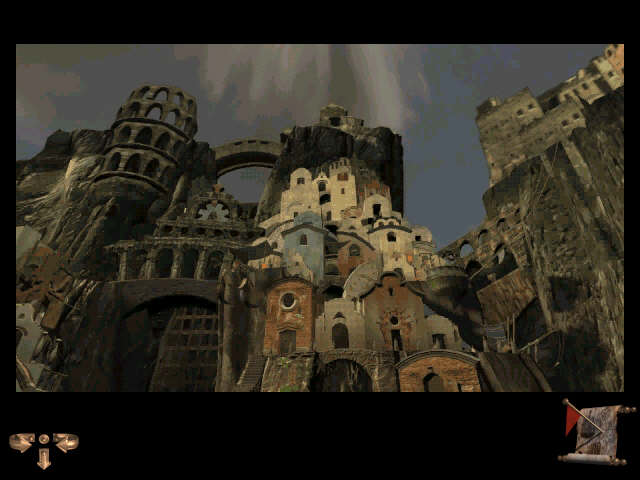
Okay, okay, so it’s a perfectly serviceable setup for a Myst clone. Why not? The game begins outside a city, which you enter after solving a very mild puzzle. Once you’re inside, you begin exploring an intriguing city and meeting some of its inhabitants.
Like, Tubular
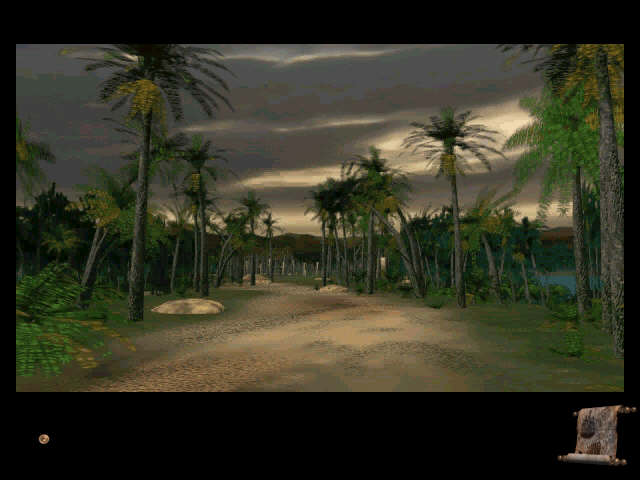
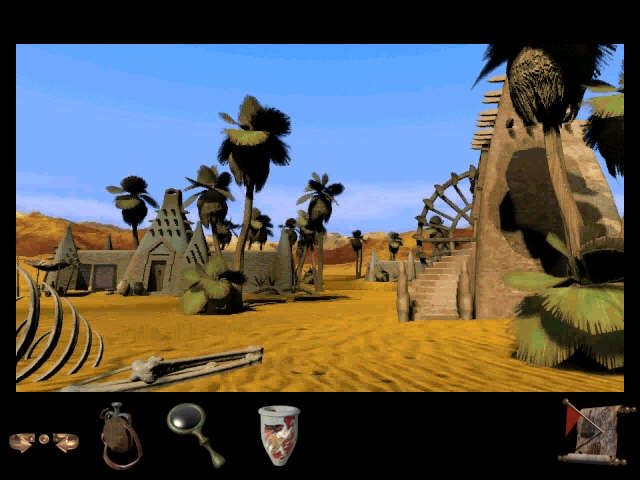
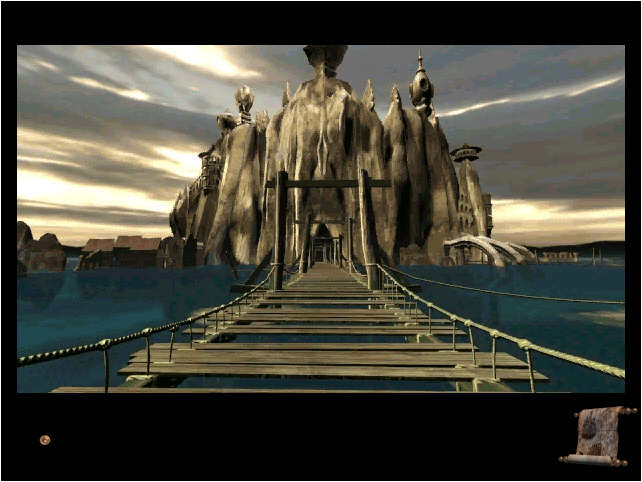
The game does have one outstanding quality. Not only are the environments truly beautiful, but the movement is fluid and realistic to the extreme. I’ve now played many adventures with the admirable 360-degree panning capability; in fact, it’s becoming an adventure game standard for high-quality first-person games. However, in those games, when you spin around, it’s as if you’re standing inside a painted cylinder, watching the flat picture rotate around as you turn.
Reah has a much more ambitious 360-pan. In this game, when you turn around, you get true parallax effects from the objects surrounding you, with the effect realistically diminishing with distance. The result is you truly feel like you’re in a three-dimensional world. The game is also filled with very effective ambient sounds.
Add to this beautifully animated nodular movement, and you’ve got a game in which it’s a true pleasure to move around and explore. Many of the environments are truly lovely, even though the best area, the drowned city in the second half of the game, owes perhaps a bit too much to Riven.
Unfortunately, standing in one place and spinning like a top turns out to be more fun than anything you actually do in the game. All these lovely animations and 3D environments take make the game fill six CDs, which is actually misleading because the game isn’t that long.
The Good, the Bad, and the Ugly
I’m not a Puzzle Difficulty Snob. I don’t mind easy puzzles. In fact, one of my favorite recent pure adventures, Dracula Resurrection, was considered way too easy by some reviewers. Some of the first challenges in Reah are mild indeed. No problem–give me a chance to sink into the story.
I don’t mind hard puzzles, either. Unless they’re the wrong kind of hard.
Which brings me to open my dog-eared copy of Ray’s Rules. There are three kinds of hard puzzles: (1) puzzles that are logical but devilish and satisfying, (2) puzzles that are so brutally labor-intensive as to eliminate all the fun from them, and (3) puzzles that are hard because they don’t play fair with the player.
Ray’s Rules clearly state that only hard puzzles from the first category are acceptable in a high-quality game. Good examples of this category would include assembling the skeleton in Timelapse, bugball in Jewels of the Oracle, or crossing the deadly tile floor in The Feeble Files.
Reah, on the other hand, is a veritable treasure-trove of puzzles from the unacceptable second and third categories. There’s a puzzle involving a series of mirrors that simply misleads the player in every type of visual clue needed to solve the puzzle logically. There’s a language-translation puzzle early in the game in which only two of the three elements of the puzzle have logical solutions. Then there’s a puzzle involving a telescope and symbols, the correct setting of which is totally illegible.
After finishing the damned mirror puzzle, my friend and I were so disgusted we barely had the will to finish the game. Little did we know that the worst was yet to come!
Death by Puzzle
The final round of puzzles in the game are of the unforgivable second category–puzzles so brutal and labor-intensive they just aren’t fun. Well, two of them are actually okay; one is simply a very fast game of Simon and the other is an intriguing “move the marbles” puzzle. But the most difficult is an inverted Hanoi Towers puzzle that has to go down in the annals of stinker puzzles of all time. It’s been a while since a puzzle made me actively long for my own death, but this one did. And the irony is, I like Tower of Hanoi puzzles, and I’m good at them!
But this one is so difficult as to defy mere recreation. After hours of fruitless slogging, we wearily resorted to a walkthrough just so we could finish the damned game.
We needn’t have bothered. The weak ending is so weak that you want to interrupt it and uninstall the game before it’s even over.
Behind the Iron Puzzle Curtain
Curiously, the last Eastern European game I played, Liath, provoked a nearly identical reaction from me: intriguing visuals but obtuse, illogical gameplay. Perhaps what we’re seeing is a cultural difference between East and West.
Perhaps that is indeed the problem. Perhaps east of the Oder River, players like bad adventure games, while over here in the West, we have this funny quirk of liking good ones.
Final Grade: C-
If you liked Reah:
Play: Morpheus
See: Your frown turn into a smile as you erase Reah from your hard drive
Read: The back of a cereal box, your dry-cleaning receipt, anything to get your mind off this game
System Requirements: Pentium 90 or equivalent
16 MB RAM
4X CD-ROM
SVGA
2 MB VRAM
50 MB free hard disk space
Mouse
Sound card
Screenshots