Reah
|
Developer: LK Avalon By John Florez |
Myst and Riven aficionados rejoice. From across the Atlantic, L.K. Avalon and Project Two Interactive have created a visually stunning first-person puzzle-based game for the entire world to enjoy. Subtitled in six languages, English, German, French, Dutch, Italian and Spanish, and distributed on six CDs, Reah is a feast for both the eyes and ears–an allusion to the several audio puzzles you’ll encounter along the way.
As a reporter invited to inquire into the activities of a scientific research team, you step into (gasp, yet another) time portal, a fate from which you may never return. “Okay, been there, done that.” Right? But gamers take heed. Like Myst, Riven, Legacy of Time, and Timelapse, this time your surroundings are so gorgeous you might very well find yourself gawking at the scenery while forgetting to playing the game. Naturally, if you complete the game, you’ll escape your imprisonment and return to life as usual, but the journey in just “getting there” is challenging, rewarding, and quite a lot of fun. Portals, investigating a new world, escaping to freedom, etc. … As good as the rest of the game is, Reah’s cliched plot deserves a grade of C.
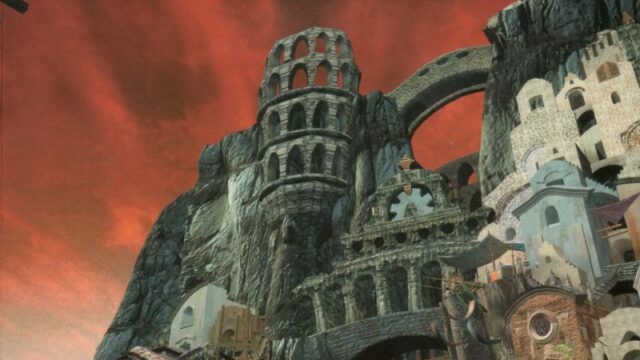
But let’s move on to the visuals. Among the best words to describe Reah’s graphics are “delicious” and “eye candy.” Several locations are so beautiful that you’d swear you were trapped on a vacation in Paradise. To be sure, jaundiced adventurers may find the visuals derivative of Riven and Myst, but Reah is indeed beautiful to behold and its immersive environment swallows you up and entices you back for more. Floating cities, fountains, arches, a desert village, and a futuristic tech center await, if, and only if, you can solve the myriad puzzles you’ll encounter along the way. The beautifully rendered pastel graphics rate a solid A.
In an industry where bloated gaming engines are emerging, Reah’s gameplay provides a smart alternative with ultra-smooth movement and transitions, thanks in part to a turbo-charged core sporting cursors and inventory screens that are both logical and intuitive. In fact, once you get the knack of holding down the mouse button to change directions, navigation is smooth and seamless. The inevitable inventory items, while shrewdly kept to a minimum, are automatically “used” when appropriate hot spots are discovered–a thoughtful, considerate perk. And then there are the puzzles. Ranging from extraordinarily easy (running routine errands for other characters) to simply sublime, challenges abound here for gamers of all ages. One particularly satisfying dilemma involved moving diverse shapes between three containers, with all the pieces starting on the far right and ending up on the left. “Easy,” you say? Not. The wrinkle is: this trick must be repeated three times, each time with accelerated levels of difficulty. Round number three is, to put it mildly, a real killer. Reah’s mix of inventory based, mechanical, and logical puzzles earns it an A+ for gameplay.
As for the underlying “bed” of the game, Reah’s synth and sound effects tracks are atmospheric and consistently excellent. Of particular note is a marvelous sound effect deployed to signal puzzle “solves.” In contrast, the voice-overs are, at best, marginal, except for the above average performance of an ethereal, 7th Guest-like Alchemist who magically appears from time to time to either encourage or taunt us at crucial stages of the game. And what about FMV? In this case, “amateur” is too kind a word to describe what conceivably could have been Project Two’s technical staff masquerading as actors. Thankfully, cinematic sequences are rare in Reah, with the developers wisely recognizing that the strength of their game lay in visuals, music, and puzzles. So, for the sake of fairness, let’s divide the category: Reah’s music and sound effects rate an A, the acting and script each earn a grade of C-.
When all is said and done, it’s fair to conclude that Reah is a game expertly constructed for those of us who love puzzles. If the emerging (or not) action/adventure genre is currently your cup of tea, Reah most definitely is not. And if, as in the Gabriel Knight and Tex Murphy series, engaging stories are your thing, you’d be wise to avoid Reah, which is thin on plot/character development and heavy on logic. But if you are the type of gamer who relishes wasting away the hours, scratching your head from time to time, even choosing to lose sleep while trying to solve a particularly mystifying challenge, then you are indeed a puzzle lover. And Reah is absolutely the game for you. Reah, gorgeous to look at and fun to play, deserves widespread U.S. distribution and earns an overall grade of A-.
A couple of technical notes: Reah ran bug-free on this reviewer’s machine. Further, it was delightful to have Win9x’s autoplay routine written to all six CDs–something other publishers often omit. With its lightning fast engine, all of Reah’s screens loaded instantaneously without even a hint of delay. And it was a pleasure to be able to exit the game from the save screen. Last but not least, a note of caution should be extended to gamers who are hearing impaired. Though subtitles are provided (in all six of the aforementioned languages), there are four audio puzzles early in the game that will probably prove frustrating and unsolvable without assistance.
Check to see if Reah is available at the Used Game Trading Zone or from Software First in the UK.
Final Grade: A-
System Requirements: Windows 95/98
Pentium 90 MHz
DirectX 5.0 (included)
16 MB RAM
4X CD-ROM drive
150 MB free hard drive space
1 MB SVGA graphics