Review: Pompei: The Legend of Vesuvius — Part 2
|
Pompei: The Legend of Vesuvius Developer: Arxel Tribe By Ray Ivey 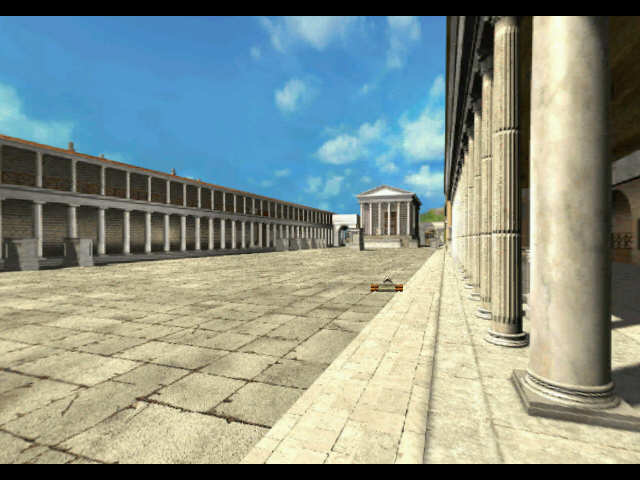 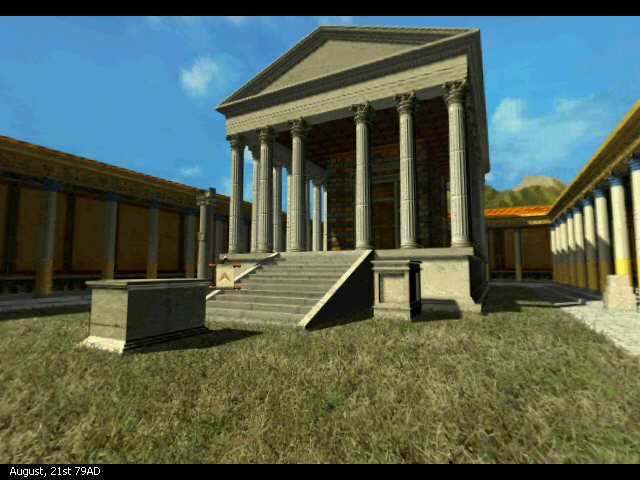 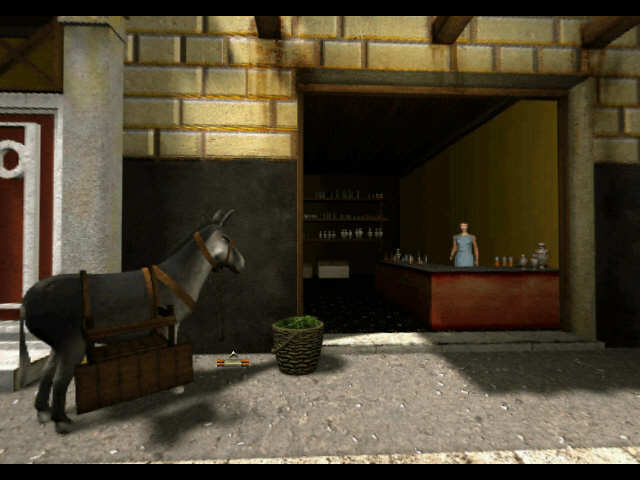 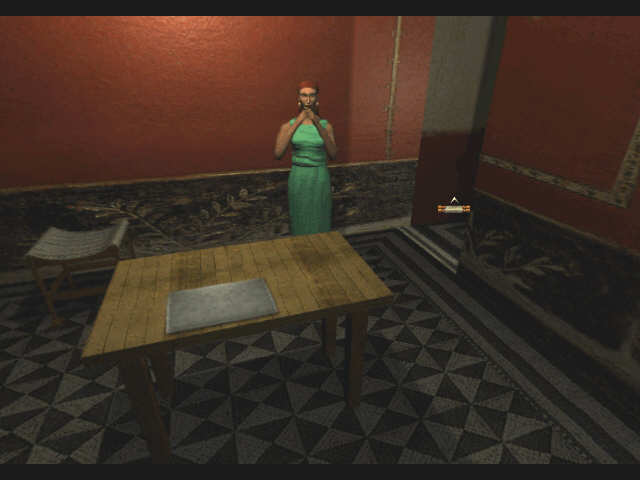 |
Here’s a review I wish I didn’t have to write. I’ve long admired Cryo and Arxel Tribe, the two companies behind this game. I’ve enjoyed Cryo’s historical dramas and luxuriated in Arxel Tribe’s stylish adventures for quite a while now. Regarding the troublesome unavailability of Cryo titles in North America, I’ve often quipped that “Cryo makes beautiful adventure games that it has no interest in selling.” Well, after Time Machine and now Pompei, I’m beginning to wonder if Cryo is making games no one has any interest in buying.
I expected Pompei to be more of an adventure, not just another Cryo historical drama. Why? Because of the involvement of the talented team at Arxel Tribe. But even as an addition to Cryo’s historical drama series, Pompei disappoints in virtually every department.
It’s the first of a proposed series of games about a man who’s searching through time for his lost love, Sophia. For some inexplicable reason, she’s been transmogrified into a freed Roman slave in the bustling city of Pompeii in the last days of that city’s life in the first century AD. Your character has just a few days to find her and convince her to leave before Vesuvius erupts and destroys the city.
Not a bad premise, right? Not bad at all.
Visually, the game is up to the standards of Cryo’s historical dramas, like Egypt and China, but it’s much inferior to its sweeping adventures, like Atlantis 2, or Arxel’s Faust. It’s got that same excellent, matter-of-fact look that I’ve admired in such games as Aztec.
And, like those other historical dramas, Pompei features a built-in encyclopedia that illuminates the period, with essays on cultural, historical, religious, and political subjects.
Unfortunately, this game breaks absolutely no new ground, and the story is pedestrian at best. You spend your time running around the city, solving problems the citizens should really be able to solve themselves, and then being proclaimed a canny and wise operator for doing so.
The game is presented in a first-person, point-and-click format with attractive 360-degree panning. However, much of the game feels claustrophobic, as you wind your way through narrow streets lined with identical buildings.
The voice acting in this game is not just bad, it’s insulting. It’s the hammiest, most overdone load of claptrap I’ve ever heard in a game put out by a major company. Worse, for the English language version, there were apparently only a couple of voice actors hired, so the performances are not only bad but monotonous as well. I have to ask a logical question here–why, oh why, in Rome, 79 AD, should the characters sound like rejects from a Cockney music hall? Give me a break. Drop a dime and find some real actors.
The puzzles are mostly easy, with a few illogical exceptions. There are a couple of timed puzzles, which won’t win Cryo any friends from the pure adventure crowd (which is the only conceivable audience for this game). Sometimes an important character interaction is only tripped if you are looking in a particular (and not always particularly logical) direction. In one regrettable instance, I was leaving a forum, and didn’t realize a character had just appeared behind me. So I had to then traipse around the entire game world, looking in vain for the next event, not discovering my mistake until I’d ultimately retraced my steps back to where I started and was facing the “proper” direction. Sigh.
Now I have to talk about the music. This subject is particularly painful, as Arxel has a history of brilliant music use. From the effective medieval period dances in Pilgrim to the sweeping Wagnerian strains in Ring to the sly, brilliant use of vintage pop music in Faust, I’d learned to associate Arxel with innovative use of music. Well, the music in Pompei seems to have been assigned to some underpaid intern who had too much to do that week. It’s simply quoted “found” music with absolutely no appropriate association to the period. I mean, I love the late Romantic composers as much as the next guy, but Mendelssohn’s Fingal’s Cave? Tchaikovsky’s Nutcracker? Mahler? For Rome, AD 79? Huh? This is just laziness, and it’s beneath Cryo. They’re a better company than that.
The bottom line is this. Pompei committed a game’s cardinal sin: it bored me to tears.
I might have been kinder to this game if it was released in 1996. Unfortunately, another French company–Index–has of late significantly raised the bar on what an “infotainment” game can truly be, with compelling historical adventures such as Crusader, Louvre, and Paris 1313. Cryo, you’d better watch your back, there’s a new kid in town.
If a good game can put me in a great mood, a bad one can turn me sour. Pompei had me grumpy for days. After Time Machine and Pompei, I’m sure hoping Cryo has something good up their sleeve. As for Pompei, it’s a shame Vesuvius didn’t bury all the copies of it under a mountain of hot ash.
Final Grade: D
If you liked Pompei:
Watch: The Last Days of Pompeii (pick a version)
Read: The First Man in Rome by Colleen McCullough
Play: Paris 1313
Minimum System Requirements:
PC:
Pentium 200 MMX
32 MB RAM
12X CD-ROM
290 MB available disk space
16-bit color graphics card
2 MB video memory
SoundBlaster compatible sound card
DirectX 6.0Mac:
Power PC 200 MHz
32 MB RAM
8X CD-ROM drive
300 MB disk space
System 7.5
Sound Manager 3.0
Thousands of colors
640×480 screen