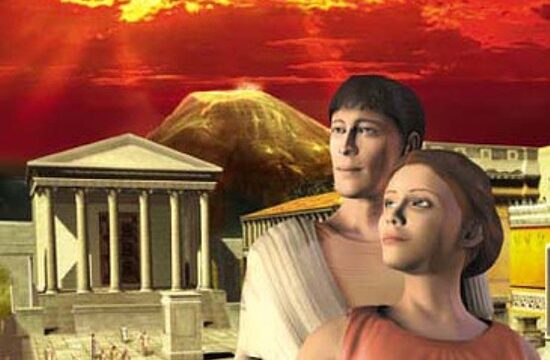
Pompei: The Legend of Vesuvius
|
Pompei: The Legend of Vesuvius Developer: Arxel Tribe By Tom Houston 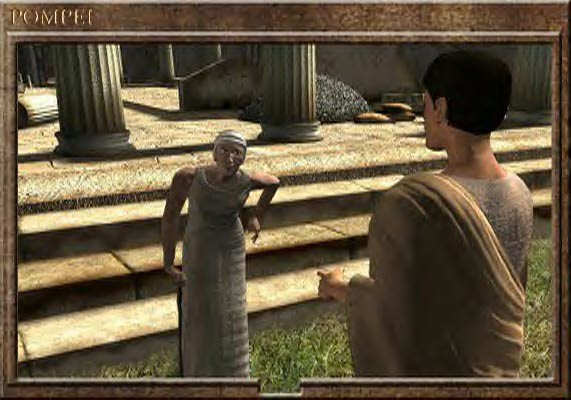 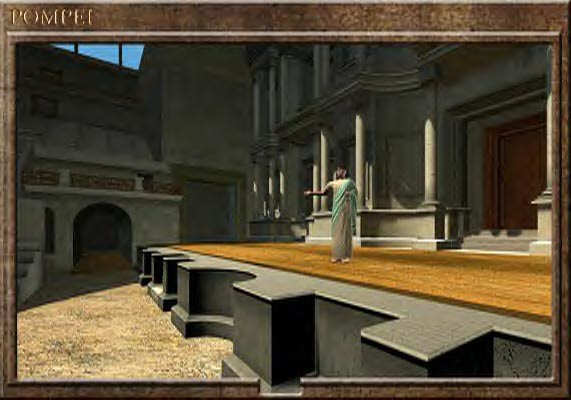 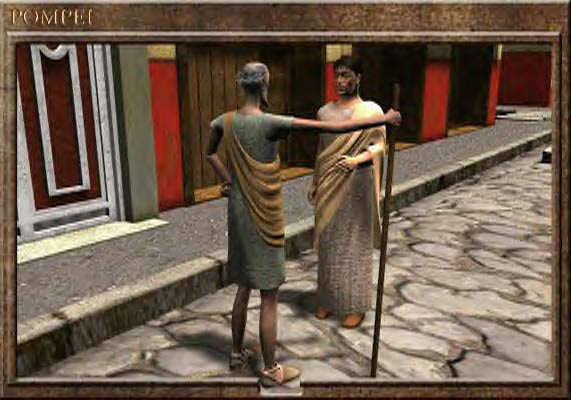 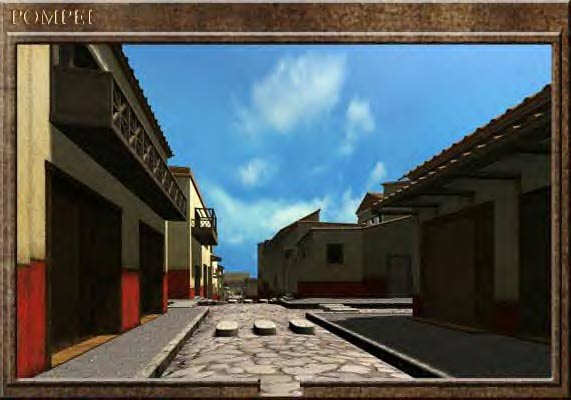 |
It is probably safe to say that my previous reviews of Cryo edutainment games, which include Treasure Hunter, Versailles, Egypt, China, and Aztec, will establish that I truly love historical adventure games. Enough to not only purchase and play these games, but also to make the effort to capture my impressions, passion, and opinions in writing. Not always an easy task, even for a conservative optimist. Should further proof be needed, I can point to two past JA+ articles entitled “That’s Edutainment.” So … what about Pompei: The Legend of Vesuvius?
Well … I can tell you that I was very eager to play Pompei, especially since this game was developed by Arxel Tribe, the company that also developed Faust, my choice for the best adventure game of 1999.
Add to the anticipation of getting to play another Arxel Tribe game the fact that I had just finished The Longest Journey, which for pure all-around adventure game design, presentation, and enjoyment is easily the best game of 2000 (to date) and perhaps of all time, and you can readily understand that I am on a high when it comes to expectations. So … did Pompei live up to my lofty expectations?
Lofty expectations just may be too difficult to overcome and for me to handle. Or it could be that the developers of Pompei did not feel the need to extend the art of making historical adventure games beyond what had been accomplished previously. In any case, the result for me was that Pompei was a good game-playing experience, enjoyable from many perspectives, but not up to the high standards set by Faust or most recently by TLJ. So … permit me to explain my impressions about what worked well in Pompei and what didn’t quite measure up to my hopes or satisfy my expectations.
The Story’s the Thing
Pompei has been touted by Cryo as “the first tome of a breathtaking trilogy of historical adventures.” Well, right away my attention is captured and I am excited to think that I can look forward to two follow-up historical adventure games based on the storyline that initiates with Pompei.
Your character for Pompei and, I presume, the two adventures that are yet to come is Adrian Blake, an explorer and well-respected cartographer who lives in England. While on an assignment in 1918 near the town of Erevan in the region that is now known as Armenia, Adrian becomes gravely ill. Stranded in a cave, Adrian is unable to move due to his illness, and his chances for survival grow dim. As his hopes fade, an apparition of the goddess Ishtar (Aphrodite) appears, offering to cure his malady if he professes his love for her. Adrian, despite the desperation of his situation, refuses Ishtar, because he loves Sophia, his bride-to-be, who is back in England awaiting his return. Ishtar becomes angry and vows to seek retribution.
Somehow, Adrian survives, because now it is one year later, on the eve of his eagerly anticipated wedding to Sophia, when he discovers that Sophia is missing. The grief-stricken Adrian searches for an explanation in his manuscripts. Ultimately, his thoughts turn to Ishtar, and he discovers an ancient curse of Ishtar that just might explain Sophia’s disappearance. Further study in his manuscripts reveals that to save Sophia and bring her back, Adrian must save the “personification” of Sophia three times in three different eras. Hence, we have the promise of a trilogy of historical adventure games.
History tells us that Pliny the Younger witnessed and recorded his observations of the volcanic eruption of Mount Vesuvius and the destruction of the towns of Pompeii and Herculaneum in 79 A.D. Pliny described, in detail, how about 10 feet of tephra (volcanic material) fell on Pompeii, burying everything except the roofs of a few buildings and killing 3,360 citizens of Pompeii. After the destruction, the city was essentially abandoned, and its location on the Bay of Naples in the southwest part of Italy was forgotten, until excavations in 1595 uncovered rich artifacts. Centuries of pillaging under the guise of archeological discovery followed, and now much of Pompeii has been excavated, revealing how the people of Pompeii lived and details about their culture and customs in 79 A.D. This historical information is available to the player in the encyclopedia contents on the CDs that are always available during gameplay.
The first of his adventures takes Adrian to Pompeii on August 20th in the year 79 A.D. Adrian knows his history well, so he realizes that Pompeii has only four more days to exist. Once Adrian literally falls into a garden courtyard in the home of Propidius in Pompeii, he realizes that he is in a race against time.
Thus, the adventure begins. What mysteries and challenges await Adrian? What friends will he make, and what enemies will he encounter?
The story advanced at a reasonably quick pace and always kept me anticipating progress through the story, in order to find out what friends or foes or what trials, tribulations, or successes Adrian would experience next. Then there were the little twists in the plot, the unexpected situations that would put a little edge on the proceedings. All in all, a very enjoyable melding of adventure, action, humor, and suspense that made the romp through the “last days of Pompeii” very enjoyable, exciting, and challenging.
The Gameplay’s Not Always the Thing
As Adrian, you play Pompei primarily from the first-person perspective, while only occasionally going to a third-person view–generally, this only occurs during conversations with other characters. Speaking of conversations … some might find it disconcerting when Adrian occasionally is engaged in conversations with characters whom you, the player, cannot see at all. However, most of the time, Adrian and the other characters are in full view. But again, some players might be bothered by the fact that the characters’ mouths do not move at all. Although this technique may solve any past problems in previous games, where lip-synching in different languages often provided an unsatisfactory result, I wonder if no lip movement at all is the best answer. Could it be that lip movement is just not that important to the game’s enjoyment, or is it that Arxel and Cryo simply didn’t choose to spend the money or make the effort to provide Pompei’s characters with the realism that lip movement would have provided? For me, the result was a small disappointment.
Pompei is a game with a reasonable length of playing time, and it has been described by Cryo as being nonlinear. I suppose it might depend on how one defines “nonlinear.” Although it is true that you are somewhat free to travel around the city at will, you are still restricted to some degree as to which areas will be open to you. Add to that the fact that you must complete certain tasks in sequence (most of the time) in order to proceed through the game, and I consider Pompei as primarily a linear game, which, by the way, I prefer. So … not a problem for me, but rather an advantage.
The mouse-activated menu screens, inventory, and movement/action/examine/use icons are typical for Arxel or Cryo games, are user-friendly, and should be very familiar and comfortable for any adventure gamer to use.
The Visual and Audio Impressions
The graphics are vintage Arxel and Cryo, which means that they are magnificent. Using a high-performance 3D technology called CINView technology, Arxel and Cryo provide the player with the ability to utilize a 360-degree rotational look-around, while enjoying every scene. The 3D images of the characters and the backgrounds are excellent and will pull the player into the environment and the circumstances of their surroundings. Somewhat of a magnetic effect. This is especially true, when CINView shows its video capabilities, as the characters move around and interact. Most outstanding and memorable is the video at the end of the game, which I trust won’t surprise anyone, showing the volcanic eruption of Mt. Vesuvius, the destruction of Pompeii, and the death of its citizens. These scenes are truly breathtaking.
The music is also beautifully composed (mostly symphonic) and never imposes on or detracts from the adventure that is unfolding, but rather, I felt, added to the overall feeling and mood.
At first I thought that some of the voice acting was a bit hammy, but as the game progressed, I revised my opinion and concluded that the voices might actually have been very appropriate for the era in which the story takes place (79 A.D.). I think that you will find the voice acting to be great fun.
The Puzzles Are a Good Thing
On the whole, the puzzles are integral to the progression of the story, which is always a good thing. There are no mazes and no arcade games, but you will encounter situations and puzzles that can cause you to die. When this happens, the game announces “The End,” because you have failed to perform tasks appropriately, have jeopardized your physical well-being or that of others, or have not completed the required task(s) within a predetermined, computer-controlled amount of time, or you have not moved quickly enough to escape some unseen danger. Oh, God help us … the player is exposed to and required to perform a few dreaded timed puzzles.
Well … perhaps I’m overreacting here, because I really didn’t have any difficulty with the timed puzzles, and in retrospect, I found that the puzzles were generally logical, fun, and for the most part should be easy for the experienced game player and only moderately difficult for an adventure gamer with limited experience.
Bringing Lofty Expectations to a Conclusion
Looking back at the past and present collection of adventure game offerings from Arxel Tribe and Cryo was, for me, the best way to ground my lofty expectations and determine where Pompei fits and how it rates. I am proud to admit that I love edutainment games, because I find that the combination of historical adventure gaming and my interest in revisiting past civilizations and reexamining their contributions to the progression of human cultural development to be very stimulating, both mentally and emotionally.
If you are inspired by these same passions, then I can recommend that you consider buying and playing Pompei.
Pompei may not advance the technology beyond that previously found in its most recent predecessors, Egypt, China, and Aztec, but it is every bit as enjoyable to play and most certainly has a compelling story, terrific graphics, and logical, fun puzzles.
Lofty expectations notwithstanding and with only minor reservations, I give Pompei a rating of A-.
Final Grade: A-
Minimum System Requirements:
PC:
Pentium 200 MMX
32 MB RAM
12X CD-ROM
290 MB available disk space
16-bit color graphics card
2 MB video memory
SoundBlaster compatible sound card
DirectX 6.0Mac:
Power PC 200 MHz
32 MB RAM
8X CD-ROM drive
300 MB disk space
System 7.5
Sound Manager 3.0
Thousands of colors
640×480 screen