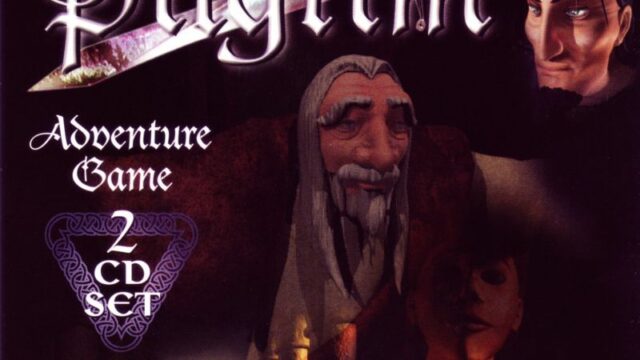
Review: Pilgrim
|
Pilgrim Developer: Arxel Tribe By Ray Ivey 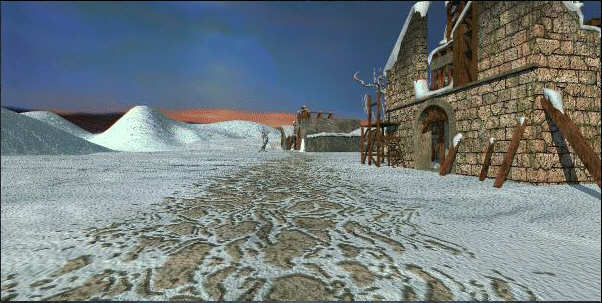 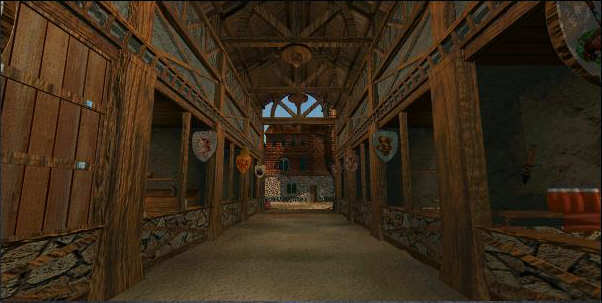 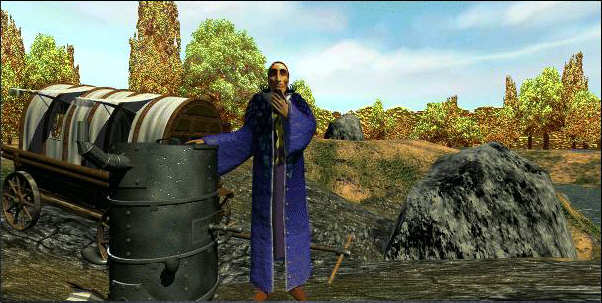 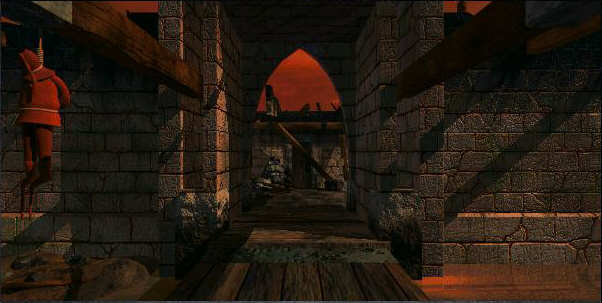 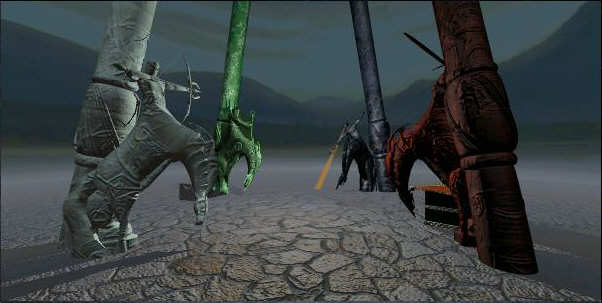 |
Okay, game players, Ray’s been fiddling around in the El Obscuro Vault again. Gird your loins, batten down the hatches, and set those phasers to stun. Yes, I’m once again here to tell you about a game that you’ve probably either a) never heard of or b) heard of but quickly forgot about after reading an utterly dismissive review or three.
Today’s subject is an early Arxel Tribe game called Pilgrim. Now, if you read much of my stuff, you may already know that Arxel Tribe’s other two adventures, Ring and Faust, have made me big fans of the team. But if this is the first review of mine you’ve read, let me assure you: Arxel Tribe’s other two adventures, Ring and Faust, have made me big fans of the team. I picked up Pilgrim, their game that preceded Ring, mostly out of academic interest to see where this talented group had started.
I didn’t expect to actually like the game.
But once again Arxel Tribe has created an adventure game with a setting I find irresistible. This time around it’s 12th century France. Our hero is a young man whose dying father gives him a mission: he must travel to Toulouse and deliver a mysterious manuscript to a mysterious stranger.
The game is presented in first person, slide show, point and click format. The graphics are absolutely beautiful–no big surprise for an Arxel Tribe game. Through the course of your character’s journey you will see a variety of environments, including the market at Toulouse, the countryside, a ruined fortress, various churches, and a host of surreal environments.
Did I say surreal? Yep. Because, even though the story of Pilgrim begins in a fairly conventional way–a young man on an journey of discovery, as the story progresses it becomes more and more fanciful. This is a good or a bad thing, depending on your point of view.
The puzzles are quite entertaining, and they frequently involve variations on the “get what you want by helping this person get what he wants” model. There’s a sequence early in the game in which you have to help several travelers at a bridge that’s extremely entertaining. In general, the puzzles in the game start out pretty mild and get more difficult as the game careens toward its surreal climax. Puzzles include a mechanical problem or two, lots of helping other characters, and some creative environment manipulation.
The game actually comes with a walkthrough on the disk, so you’re not going to be stuck for long in this game.
Which was fine with me. I enjoyed the dark story about a religious underground that the Pope’s henchmen were trying to root out. I also enjoyed the wide variety of characters I met–priests, merchants, acrobats, soldiers, scholars, etc.
The game is full of beautifully rendered cutscenes that were a true pleasure to sit through. The game does suffer a bit in the voice acting department–unfortunately this is commonly a weak area in adventure games. Specifically, Pilgrim suffers from “translationitis.” This game was not originally written or recorded in English, and it’s frequently painfully obvious that English is not the first language of the actors. Come on, Arxel, pony up the dough for real Anglo performers for the English language release of your games! (For the record, this area is greatly improved in Ring and especially Faust.)
Pilgrim is the kind of game that gives the term “graphic interactive fiction” a good name. Because that’s what this game is: a lovely, mysterious, educational, and compelling story told with words, beautiful pictures … and me. It’s the kind of game that reminds me why I like to play adventure games.
Final Grade: A
System Requirements: P75
8 MB RAM
90 MB free hard drive space
4X CD-ROM drive